Archive for the ‘Fly Fishing Tackle’ Category

Kwagu’ł Hand-Carved Reel from PEETZ

July 27, 2015

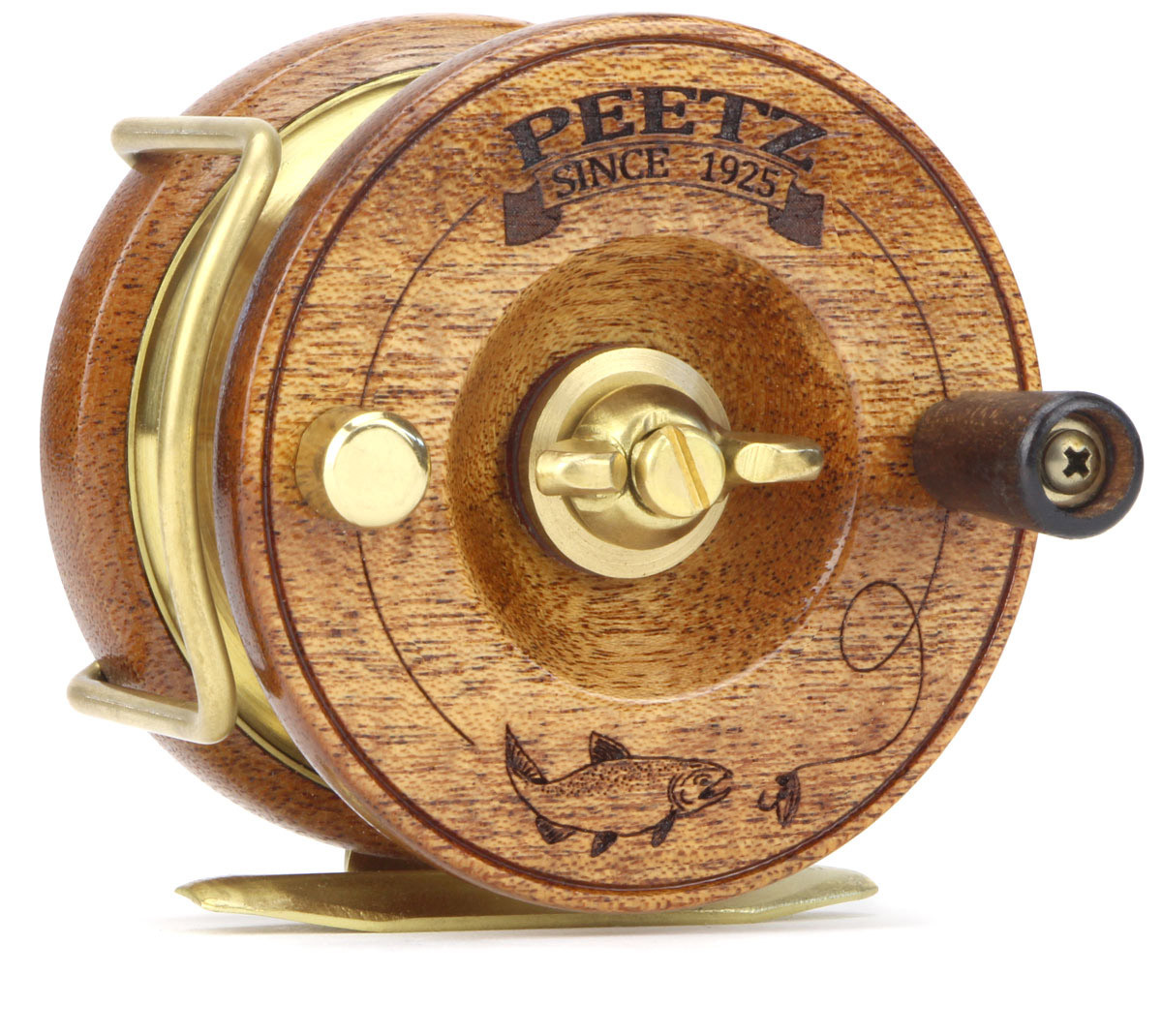
PEETZ, in Victoria, British Columbia, has long produced mahogany and brass “Nottingham” style reels for salmon and steelhead fishing. First made by Boris Peetz in 1925, even many of the early reels appear perfectly functional, despite being fished hard in salty Pacific Northwest waters. Recently, PEETZ introduced a three-inch diameter “starback” style fly reel. It looks like an excellent reel for minimalist fly fishers, like myself, who spend their time on smaller waters.
The fly reel, as featured on the PEETZ website.

The fly reel, as featured on the PEETZ website.

Besides the fly reel, what has really caught my attention is PEETZ’s new 5 inch Artist Series Handcarved Reel. The reel is their Evolution reel–a traditional “strapback” with bearings and an updated one-way drag system–featuring a hand-carved spool. The first 90 reels in this series are carved by Canadian First Nations artist Jason Henry Hunt.
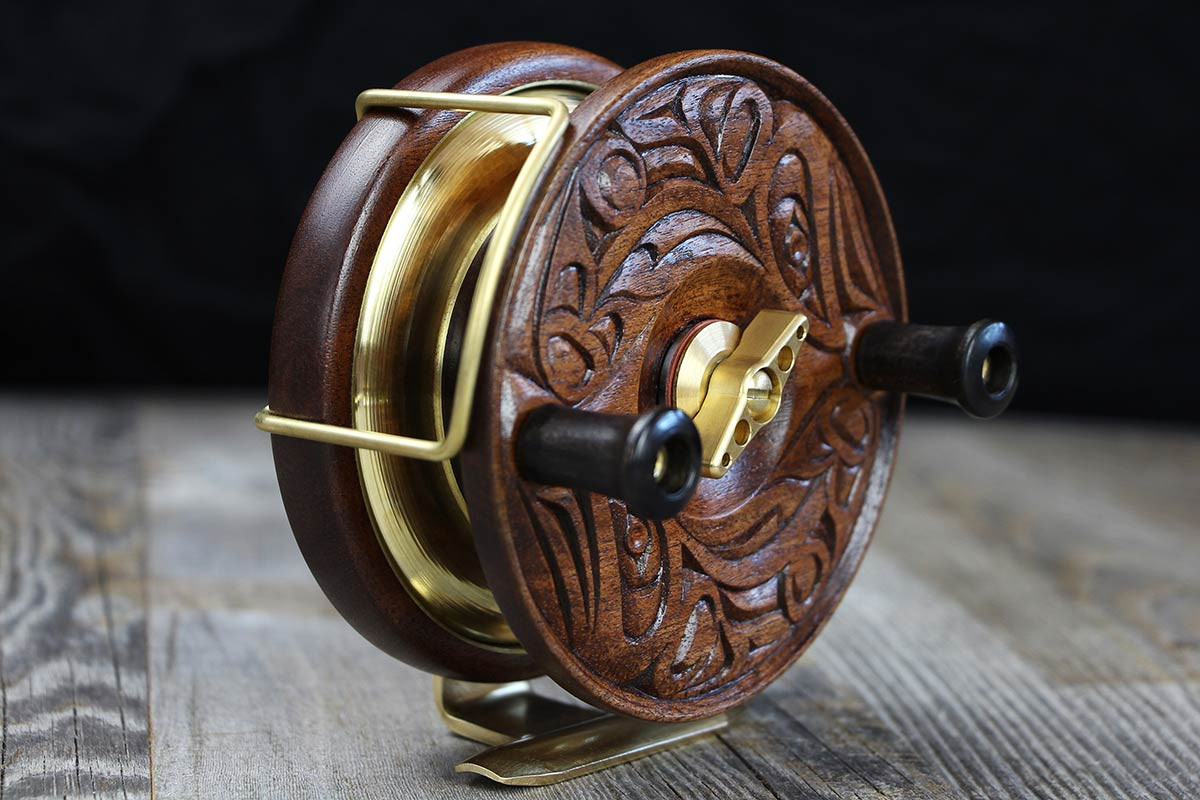
PEETZ-Artist-Series-CircleOfLife-JasonHunt-V01

The Artist Series reel, as featured on the PEETZ website.

Hunt is a descendant of the Kwagu’ł First Nation on Northern Vancouver Island, BC. He is part of a family known for their traditional artistry. For instance, his grandfather was the acclaimed Mungo Martin. You can see Hunt’s own stunning artwork at his Otter Bay Studio website. The theme of his carvings on the PEETZ reels is the “Circle of Life,” depicting salmon and roe.

600px-Wawadit'la(Mungo_Martin_House)_a_Kwakwaka'wakw_big_house

A Mungo Martin Big House and Pole in Victoria, BC.

I do not see myself giving up traditional fly fishing tackle for steelhead or salmon. That said, the 4 inch PEETZ “Classic” reel looks perfect for trolling with flies for trout, at the lake I fish. And the fly reel is very appealing.

While the large Artist Series reel is probably  not in my future, I really commend PEETZ for promoting First Nations artwork. It is appropriate that they do so, since salmon are so integral to the cultures of Kwagu’ł and other Pacific Northwest indigenous peoples.

Importantly, PEETZ donates a portion of the sale for each reel to the Pacific Salmon Foundation, a Canadian fisheries conservation organization. The lack of water and unusually high temperatures are having a major impact on salmon in the Northwest. Two days ago, The Seattle Times reporter Hal Bernton described the overheated Lower Columbia River as a “kill zone” for salmon (July 25, 2015). This means that organizations such as the Pacific Salmon Foundation can use as much support as possible.

Following is a video of Hunt carving one of the PEETZ reels:

Angling Gifts from Magyarország

May 25, 2015

While in Magyarország/Hungary, my wife and daughter and I took the ferry across the Danube River one morning to Visegrád to meet Ákos Szmutni. Ákos is the owner of Stickman Rods and the author of a beautiful hard-bound, Hungarian language instructional book on fly fishing. The 2009 text, which totals over 400 pages with color photos, is simply titled Legyező-Horgászat (Fly Fishing). 

My wife and daughter drove up to the Cloud Castle above Visegrád, a favorite place to visit, while I spent time with my fellow angler. We cast several Stickman Rods and shared thoughts about fly fishing, Central Europe, and life. Afterward, Ákos kindly gave me a copy of his book. It is pictured below, with a benchmade Hungarian knife, some flies tied “in hand” by Hungarian fly fisher and friend Levente Kovács, and an Association of Hungarian Flyfishers Badge.

IMG_1584

IMG_453628720

The Lower and Upper Castles (13th c.) of Visegrád, as seen from the ferry below. I admire the Upper or “Cloud Castle” often because it can be seen from the home of friends in Nagymaros, the town across the river. You can see far better pictures at the Visegrád website.

Anticipation and Preparation

April 21, 2015

IMG_1504

Work has keep me a bit busier than usual, of late. As a consequence, I have been fishing with a dwindling supply of flies. Soon, however, I will be returning to Central Europe to visit my wife’s family.  While there , I will fish for asp in the Danube and maybe look for a few trout in a stream near a relative’s home. I will also return to Transylvania to visit a couple of friends and to fish for trout and graylings. So, out of necessity, I am finally back at the vice. Next up…  comparaduns. The graylings loved them last time.

DSC02543

With friends in Transylvania.


The “Hugh Glass” Fly

March 23, 2015

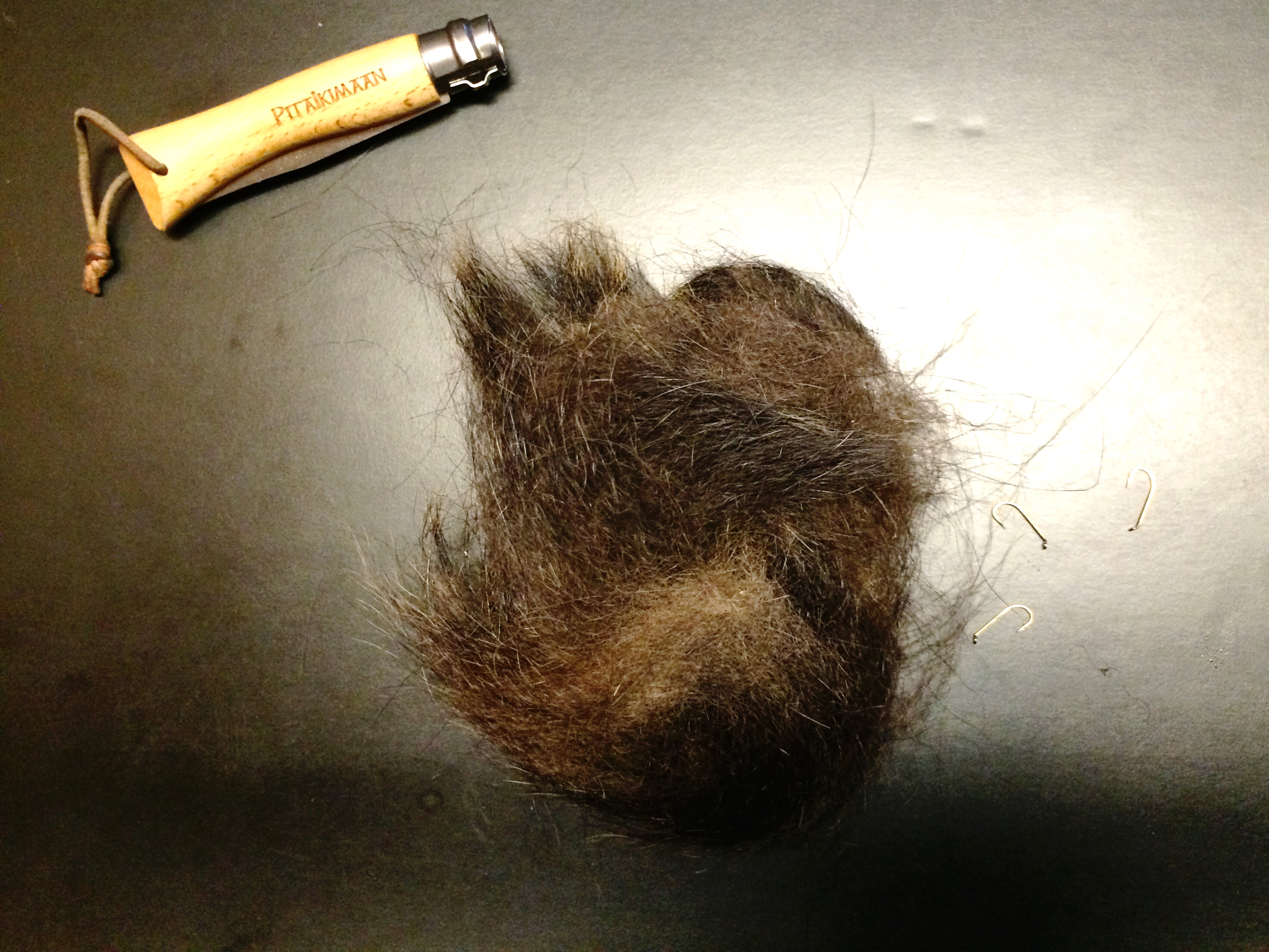
I have some grizzly bear (Ursus arctos horribilis) fur, and I’d like to tie a few nice flies for the person who gave it to me. I had thought about tying some Adams dry flies, using the lighter under fur for dubbing and the guard hairs for tails. Obviously, the grizzly hackle normally used on Adams flies would  fit the theme nicely. I would love to hear some other suggestions, however.

I might also tie a variation of the “black bear red but” salmon fly. I’ll call it the “Hugh Glass.” This name comes to mind because I am reading Missoula, Montana author and diplomat Michael Punke’s The Revenant: A Novel of Revenge. In the book, Punke describes the mauling of Glass by a grizzly on the Grand River, in present-day South Dakota, and the events that followed. Glass’s companions left him for dead after his encounter with the bear, and they took his prized rifle with them. The badly wounded Glass famously crawled approximately 100 miles to the Cheyenne River. He then floated downstream to Fort Kiowa, on the Missouri. After recovering physically, he set out after those who had abandoned him.

IMG_1461

“Human Blood and Woman’s Milk”

December 7, 2014
Tegernsee Abbey today. It no longer houses a monastic community.

Tegernsee Abbey today. It no longer houses a monastic community.

Richard Hoffman published a translation of a fragmentary text written around 1500 AD, which has become known as “Tegernseer Angel- und Fishbucklein.” In his book, Fisher’s Craft and Lettered Art: Tracts on Fishing from the End of the Middle Ages (1997), Hoffman identifies the text in English as “Tegernsee Fishing Advice.”  The “advice” is that presumably recorded by a Benedictine monk at the Tegernsee Abbey in Bavaria, in the late 15th century. The advice was probably intended for one of the fishermen licensed by the abbey to provide food for the monks.(117) Interestingly, much of “Tegernsee Fishing Advice” is devoted to fly fishing. This means that fly fishing was not just a pastime of nobility in 15th and 16th century Bavaria; it was also used to acquire food by peasants such as those working for the Abbey. A passage from the translated text, dealing with flies, follows:

Thereafter, as soon as the brooks become small and clear, like in May, [whether it] is the first month or second, then see to it to put ‘stone bait’ on the feathered hook which should be tied with yellow silk and with pinkish-coloured silk around the ‘heart’ [and] with a black one mixed around the ‘heart.’ (141).

However, the monks also provided fishing advice for fishing in still waters that is even more surprising to read:

If you want to catch fish in still waters, in brooks, or in lakes, then take and prepare a bait this way. Take human blood and woman’s milk together in a vessel, and take raw barley and cook it very well and completely and press it in a mortar while still wet until it all becomes like a gruel. After that press it through a cloth, and if it will not go easily through the cloth then add to it a little of the liquid in which it was cooked so that it does go through easily.Take that very thing [that was] pressed through a let it parch and dry up completely, and then make it into a fine powder. Then take that [powder] out and the above-mentioned blood and woman’s milk and stir it [all] together then, and make something like a gruel. Then let that become very hard and dry in the air. Thus it is ready. …. To that thing [will] so rush all the fish which live in that same water, and they will not turn back until after they have come into the trap. (171).

Today, we often think of fly tying as a time-consuming passion. But just you try making a complicated bait from human blood and woman’s milk.

Ready . . . .

November 20, 2014

IMG_438242280

Opinel “Trout” Knife

October 5, 2014

I discovered recently that the venerable French maker of  knives, Opinel, offers a model with trout engraved on an oak handle.  Opinel has made simple, folding knives, in a variety of numbered sizes, for over 100 years.  Despite their continued popularity and the fact that they are still made in France, Opinel knives remain very affordable to the working people for whom they were originally intended.

photo opinel 2

Today, Opinel knives are popular enough among outdoors persons that Patagonia sells them along with its own products.  Patagonia describes the Opinel No. 8 that they offer, online, they describe their Opinel No. 8:

If we made knives, this is the one we’d want to make. The Opinel folding knife, with its clean, simple design and remarkable utility, has been prized by adventurers, artists and chefs for more than 100 years. This modern version of the classic Opinel No8 features a 3-1/4” stainless steel blade and beautiful olive-wood handle. It fits easily in a pocket, but also comes with a leather belt sheath for easier access. Packaged in a wooden, slide-top box.

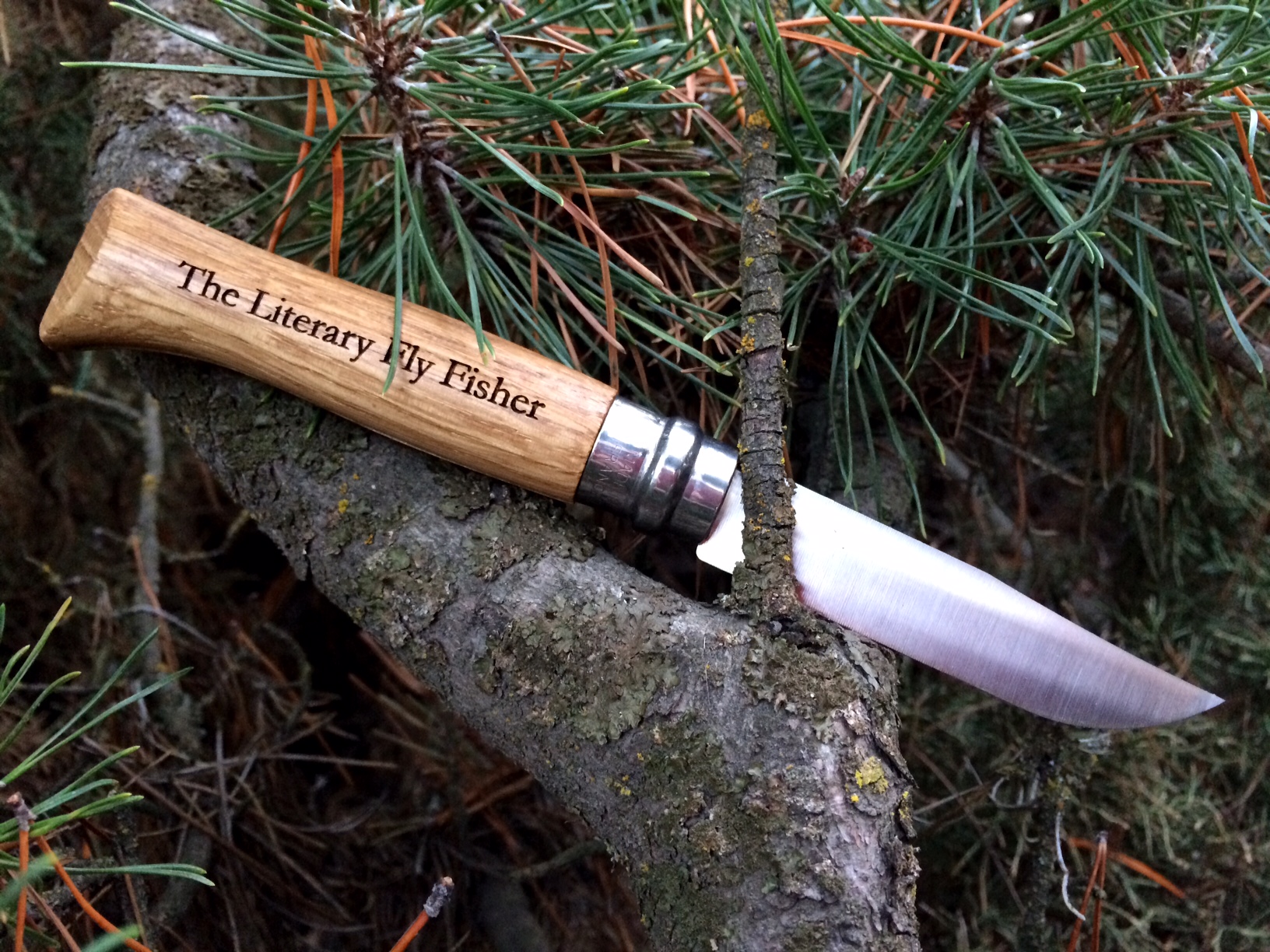
You can read about the Opinel No. 8, oak-handled “trout” knife, available directly (and much less expensively) from Opinel, at their website. You will notice that they offer custom engraving.  When ordering one, I could not resist making use of this service. It has been a handy companion during my time beyond the paved world.

photo opinel

Tom Morgan Rodsmiths and Religion

August 4, 2014

CBS Evening News has done an On the Road segment, entitled “Legendary Fishing Rod Creator shares a Special Secret,” on Tom and Gerry Morgan, of Tom Morgan Rodsmiths.  It is always interesting to see such stories in the mainstream media. In this particular case, the commentator, Steve Hartman, makes reference to the connection between religion and fly fishing that so many writers have claimed for so many centuries. Sadly, though, Hartman then describes a Tom Morgan rod as the “Holy Grail.” Of course, those who attribute deep meaning to fly fishing are inspired to do so by the experience, not the sometimes very expensive tackle. The commentator’s view reflects our society’s misplaced obsession with material wealth. No doubt, this obsession is often brought to the sport by certain tackle collectors and even by those who seem more concerned about what they look like on the stream than they are with the water and the life all around them. The inherent value of the living environment is so much greater that the merely symbolic value of our possessions.

Burkheimer, Peak, and Gingrich

March 25, 2014

Filson recently released a promotional video featuring graphite rod maker Kerry Burkheimer. Filson sells C. F. Burkheimer fly rods, and Burkheimer wears Filson’s gear in the video.

I love my Filson “strap vest,” but I have never handled a Burkheimer rod. His rods are popular around here, and I have spoken to people who love them and to people who do not. One thing that interests me, personally, about Burkheimer rods is their pedigree. Burkheimer was mentored by Russ Peak — probably the most revered maker of fiberglass rods. His rods thus have an interesting connection to the past.

My favorite angling author, Arnold Gingrich, wrote of Peak that, “I regard his glass rods, and  the best makers’ bamboos, as fully equal examples of the rodmaker’s craft” (The Joys of Trout, 1973). This is high praise. Gingrich, the founding editor of Esquire magazine, had the money, intelligence, and experience to be a true connoisseur of bamboo rods.

Posted below is Filson’s video. No matter whether your are interested in Filson gear and Burkheimer rods or not, the video is worth watching.  It allows one to imagine what stepping back into  Peak’s workshop might have been like, though Burkheimer is no doubt his own man.

River Crampon Sale

February 21, 2014

While I certainly enjoy my tackle, I really dislike the commercialized aspects of fly fishing, and I don’t normally plug gear. I have to make a quick exception today, however. I’m one of those people who will go almost anywhere to find a trout stream, and I will go almost anywhere on the stream to find the trout. This leads to a lot of climbing, scrambling, and all too often, falling.  Thus, I have become a fan of Patagonia’s River Crampons.  In my experience, they are easy to take on and off, very secure and light when attached.  Most important, I find them very effective in clinging to rock. Like a lot of quality outdoor products, however, the River Crampons are not realistically priced for those who would use them most; people who are addicted to fly fishing and other outdoor pursuits are not typically big earners — earning, after all, can cut into fishing. Currently, though, Patagonia is clearing out their first generation of River Crampons to make room for a new, “ultralight” version.  The original Crampons are nearly half off at the Patagonia website.

IMG-20130923-00225