Archive for the ‘The Arts’ Category

PEETZ Fly Reel, featuring Kwagu’ł Art

November 30, 2016
I have written previously about the PEETZ reel company, located in British Columbia, and their collaboration with First Nations Kwagu’ł artist, Jason Henry Hunt (see “Kwagu’ł Hand-Carved Reel from PEETZ” and “More First Nations Artistry from PEETZ”). PEETZ makes traditional Nottingham style reels, so named for their association with Nottingham, England reel makers of the late 1800s and early 1900s. These reels are used in many styles of fishing, though PEETZ makes two that are specifically marketed to fly fishers.
img_2255
Not long ago, I received an early edition of a new 3.5 inch fly reel, engraved with the traditional coastal image of a trout designed by Hunt. This is my second 3.5 inch PEETZ fly reel. I am very happy with both reels and with the service I’ve received from PEETZ. The reels balance several of my bamboo and fiberglass fly rods well, and I also use one with an LL Bean “Trolling Series” fly rod.
img_2117

Father, Daughter, PEETZ.

I am attracted to the aesthetic of these reels, but I am also very happy with their performance. Made in BC from brass and sustainably harvested mahogany, they are as solid as can be. The 3.5 inch reel has plenty of room for backing, and the large arbor makes retrieving that backing and the fly line easy. The check helps prevent overspooling.
For me, the simple pressure drag system is usually adequate. For those occasions when more drag is needed, there is plenty of exposed spool to palm. You can also exert drag by pressing the line guard against the spool. This is a practice that the inventor of this type of line guide, Charles Henry Cook (pen name John Bickerdyke), recommended in his 1898 book Practical Letters to Young Sea Fishers.

Many anglers, including myself, had found that it was more pleasant to check the reel by pressing the wire line guard than by placing a finger on the circumference of the reel. Captain Barton has gone a step further. In the Andaman Islands the fish ran so strongly and wildly, that the ordinary check was of little use, the reel frequently overran, and his line was broken. He tried placing his finger on the rim of the reel, with the same result as it if had been place in a piece of red hot iron. This was when fishing for the cavalla. He then  worked out a very simply and effective brake. To the  upper crossbar of the Bickerdyke guard, he sewed on the end of a piece of webbing about 8in. or 9in. length, and a trifle less width than the crossbar.  The  other end of the webbing was whipped on to the rod above the reel, the webbing being kept fairly taught. The rod thus fitted is held with the hand above the webbing. When a check is required, the hand is slid down over the webbing, pressure on which causes the guard to press against the rim of the reel as strongly or lightly as the angler may wish. Letters, 311.

In short, I love these reels, and every interaction with the people at PEETZ has been very positive. I am particularly happy to promote First Nations art, with the acquisition of this latest reel. The Kwagu’ł and other First Nations of Canada and the US have been fishing for salmonids for centuries, and their respect for these fish is integral to their cultures. The PEETZ Artist Series reels serve as a reminder that we should all cultivate more respect for the non-human inhabitants of our environment.  And not only does PEETZ recognize First Nations cultures, they also help support the conservation efforts of  the Pacific Salmon Foundation. For all these reasons, I recommend looking into PEETZ reels.

Art, Friendship, and Dan Klein’s Flies

November 15, 2016

Dr. Dan Klein is a legendary Montana fly tier. A story that carries his legend transpired decades ago, but he was well known even before then. The story is recounted by Geoffrey Norman in a March 1982 Esquire article titled “The Sporting Art of Tying Flies.” In the article, Norman mentions numerous fly tiers of fame, but states that, of the flies he owns, he values Dr. Klein’s the most. He continues:

Klein’s hopper is what people in the trade call “imitative,” as opposed to “suggestive.” That is to say, it looks exactly like a grasshopper, right down to the eyes and antennae. The things are eerie, and they catch fish. Klein ties them from unorthodox materials–surgical tubing and things like that–but they are not sneered at by insiders. To the contrary, they are prized, and prized very highly. One of the best rodmakers in the country traded Klein a cane rod, made to Klein’s specifications, for five of those hoppers. If you cold persuade him to take your order, he would charge you a thousand dollars or more for building a rod like that. When they decided to trade, Klein and the rodmaker asked other fly-fishermen to establish the terms. Three celebrated anglers studied the problem and then calculated what was fair. 132.

The rodmaker mentioned by Norman is the late Gary Howells. His bamboo rods remain among the most acclaimed and obviously cost much more now than they did in 1982 (I see several listed for sale online at prices between two and three thousand dollars). The famous trade is recounted in greater detail by Joseph Beelart, Jr., in his 2013 biography of Howells, titled “Howells: The Bamboo Fly Rods & Fly Fishing History of Gary H. Howells” (Whitefish Press).

Klein's Hopper

Klein’s Hopper

Dr. Klein achieved his renown when he lived in Idaho and fished the Henry’s Fork regularly. In 1976, he and his family moved to Helena, Montana. His youngest daughter began second grade that year a bit late. I joined that same class just days earlier, having recently moved with my family from Dillon, Montana. We have been close friends ever since, sharing similar paths in life, personal views, and so on.

Dr. Klein’s daughter blessed me recently with the gift of a hopper tied by her father. The personal connection–a connection I do not have with the other collectible Montana flies I own, such as those tied by the amazing Jack Boehme–makes the fly particularly special. Like Norman, however, and like Howells and many others,  I also view the hopper as a genuine work of art. And I happen to believe we need more art in our lives right now, and the beauty art so often conveys, no matter how small and mundane that art may seem.

Dr. Klein and his flies, in Beelart's book.

Dr. Klein and his flies, as pictured in Beelart’s book.

Author and Cartoonist H.M. Bateman

September 30, 2016
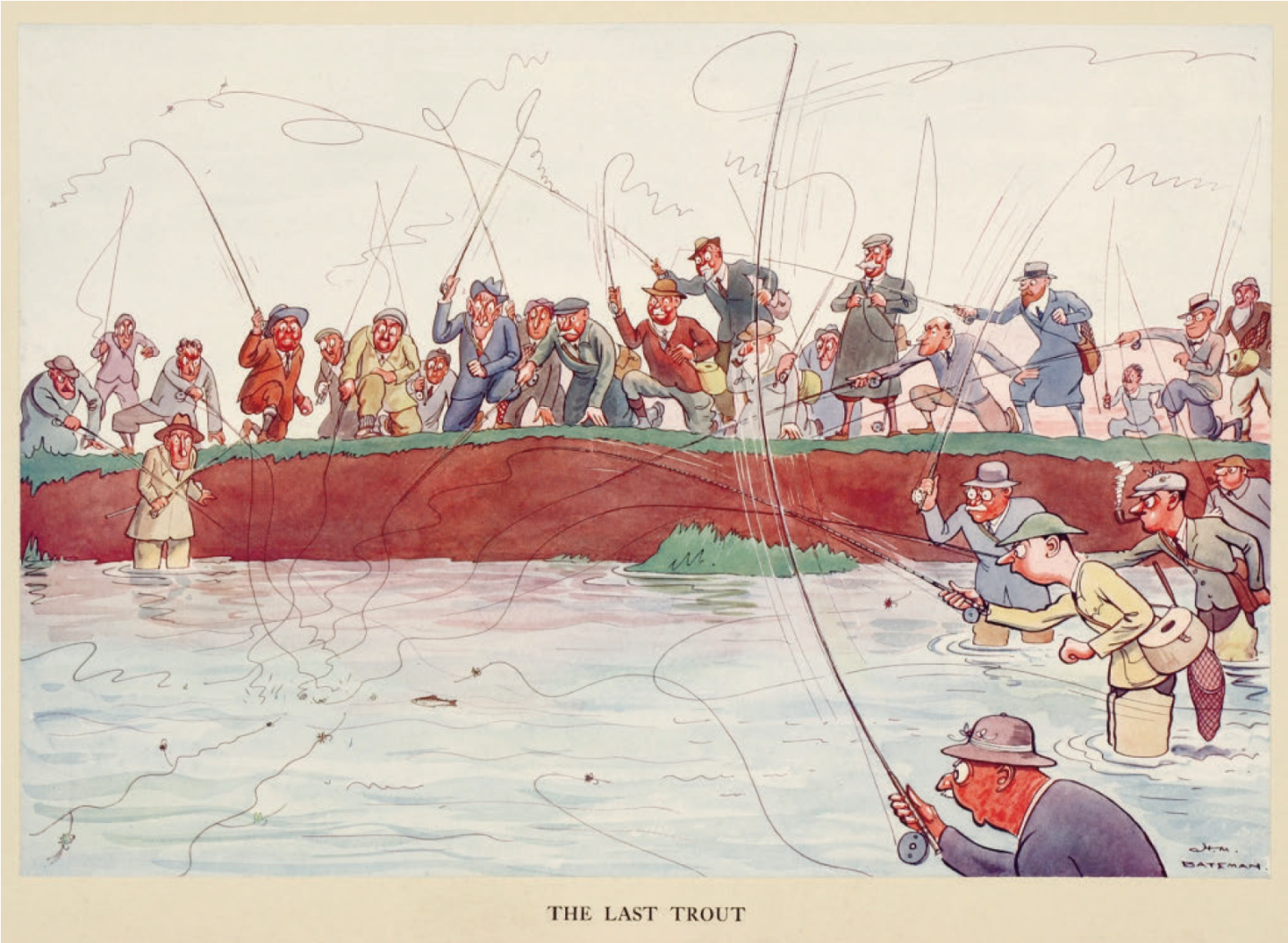
The Last Trout. From The Tattler. Copyright H.M. Bateman Designs, www.hmbateman.com.

The Last Trout. From The Tattler. Copyright H.M. Bateman Designs, http://www.hmbateman.com.

The American Fly Fisher: the Journal of the American Museum of Flyfishing, just published an article by James D. Heckman on author and cartoonist H.M. Bateman. The London-based Bateman (1887-1970) was an avid angler, but he also satirized the upper class, with whom fly fishing was often associated in the 20th century.  Thus, his favorite pastime was also a subject for his cartoons. Heckmans’s biographical sketch and the cartoons accompanying it (such as the one above) are worth a read. You can access it here: http://www.amff.org/h-m-bateman-cartoonist-extraordinaire-fisherman-life/ And you can learn more about Bateman (and purchase prints) at the website of H.M. Bateman Designs Ltd.

End-of-Day

August 29, 2016
Night at the Cabin

The Evening Scene, at the Cabin


“When Day is Done”

If the day is done,
if birds sing no more,
if the wind has flagged tired,
then draw the veil of darkness thick upon me,
even as thou hast wrapt the earth with the coverlet of sleep
and tenderly closed the petals of the drooping lotus at dusk.

By Rabindranath Tagore, 1913 Nobel Prize-winning Bengali poet.

Samurais, Fishing Poles, and The Loss of Tradition

August 18, 2016

Craftmanship online magazine recently published an article on a type of traditional Japanese fishing pole, known as Edo wazau, and its construction. Author Yukari Iwatani Kane takes the reader on a journey through their history. He also explores the current, diminishing state of the craft behind their construction. Explaining the poles origins, he writes:

The Edo-wazao is estimated to have started 228 years ago, by a samurai named Tosaku Matsumoto. All of today’s top masters trace their roots back to Tosaku. From the beginning, Edo-wazao were a luxury item for the wealthy, for whom fishing had been a popular pastime akin to polo or golf. While the working class used rough, homemade bamboo poles, nobility, kabuki masters, and prominent politicians used rods tailor-made to each season and fish species.

The article it titled, “Japan’s gorgeous, precarious fishing  poles.” (Yes, “poles.” These are not fly rods). It is accompanied by the authors excellent photography. Follow the link, below, to read it.

http://craftsmanship.net/bamboo-take-two-japans-gorgeous-precarious-fishing-poles/

Book Announcement: By a Thread: A Retrospective on Women and Fly Tying

August 2, 2016

Erin Block has written a book dedicated to the subjects of women and flytying. Titled By a Thread: A Retrospective on Women in Fly Tying, the book is published by Whitefish Press. Block previously wrote The View from Coal Creek, also available from Whitefish. She is also the Editor-at-Large of Trout Magazine and has published numerous articles.

Feather_DJ

Dust jacket image from Whitefish Press website.

Marketers in the tackle industry and other areas of fly fishing and outdoor commerce pay increasing attention to women as consumers. Sometimes this is a good thing. Other times it is transparently trite and commercial. For instance, marketing a pink version of a production fly rod really just draws great attention to the supposed gulf between men and women and reifies our often inaccurate views of gender. That said, if a pink rod appeals to you–no matter your gendered identity–enjoy.

What many marketers and fly fishing enthusiasts forget is that women have been involved with fly fishing since its late medieval growth in popularity as a leisure activity in Europe. In fact, generations of writers and anglers attributed authorship of the “Treatyse of fysshynge wyth an Angle”–the first major work devoted to fly fishing and printed in the English language –to a woman.

There is no clear evidence that Berners was the author of the Treatyse or even that she existed. It was first printed by Wynkyn de Worde in 1496, who included it in the The Boke of St. Albans. Berners (then spelled Barnes) was already identified as the supposed author of The Boke. So, she became the supposed author of the Treatyse as well. What really matters,  however, is that generations of readers were content with the idea that a woman wrote the Treatyse, whether it is historical fact or not.

Other women–real ones–played important roles in fly fishing and other field sports in subsequent centuries. For instance, I wrote earlier about Megan Boyd and Kiss the Water, a recent film that honored her place in history as a master salmon flytier. Blocks discusses many other such figures. The reader who wants to look beyond pink rods to the real contributions that women have already been making to fly fishing and other outdoor activities should therefore read By a Thread. Clearly, I am eager to do so.

Just to drive my point home, I share a wonderful 1955 British Pathé video about fly fishing on Scotland’s River Tweed. Notice the flytier, who features so prominently.

KL

Book Announcement: Backcasts: A Global History of Flyfishing & Conservation

June 30, 2016

41-w2ggOGSL__SX331_BO1,204,203,200_

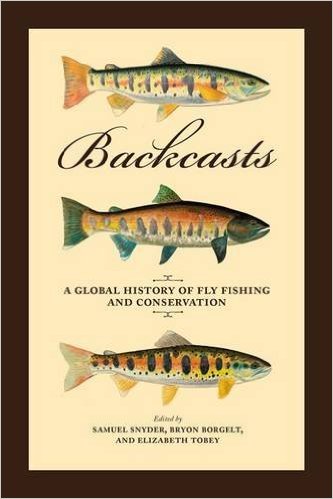
On July 11, The University of Chicago Press publishes a book that will interest a wide variety of readers. The book is titled Backcasts: A Global History of Flyfishing & Conservation. It is edited by Sam Snyder, Bryon Borgelt, and Elizabeth Tobey. The 400 page book considers fish and fishing from overlapping recreational, cultural, and scientific perspectives.

The U of Chicago Press is publishing Backcasts exactly 40 years after they published Norman Maclean’s famous A River runs Through It and Other Stories. That publication was seminal, not only because of Maclean’s fine writing, but also because Chicago had never published a non-academic book before (though Maclean, a professor at Chicago, was an academic himself). Backcasts certainly qualifies as an academic book, but it should appeal to a much broader audience. The writing is accessible and the topics are wide-ranging. Just take a look at the table of contents (from U of Chicago Press’ publication webpage):

Foreword: Looking Downstream from A River
Jen Corrinne Brown

Acknowledgments

Introduction. A Historical View: Wading through the History of Angling’s Evolving Ethics
Samuel Snyder

Part One: Historical Perspectives
1 Trout and Fly, Work and Play, in Medieval Europe
Richard C. Hoffmann
2 Piscatorial Protestants: Nineteenth-Century Angling and the New Christian Wilderness Ethic
Brent Lane
3 The Fly Fishing Engineer: George T. Dunbar, Jr., and the Conservation Ethic in Antebellum America
Greg O’Brien

Part Two: Geographies of Sport and Concern
4. Protecting a Northwest Icon: Fly Anglers and Their Efforts to Save Wild Steelhead
Jack Berryman
5 Conserving Ecology, Tradition, and History: Fly Fishing and Conservation in the Pocono and Catskill Mountains
Matthew Bruen
6 From Serpents to Fly Fishers: Changing Attitudes in Blackfeet Country toward Fish and Fishing
Ken Lokensgard
7 Thymallus tricolor: The Michigan Grayling
Bryon Borgelt

Part Three: Native Trout and Globalization
8 “For Every Tail Taken, We Shall Put Ten Back”: Fly Fishing and Salmonid Conservation in Finland
Mikko Saikku
9 Trout in South Africa: History, Economic Value, Environmental Impacts, and Management
Dean Impson
10 Holy Trout: New Zealand and South Africa
Malcolm Draper
11 A History of Angling, Fisheries Management, and Conservation in Japan
Masanori Horiuchi

Part Four: Ethics and Practices of Conservation
12 For the Health of Water, Fish, and People: Women, Angling, and Conservation
Gretel Van Wieren
13 Crying in the Wilderness: Roderick Haig-Brown, Conservation, and Environmental Justice
Arn Keeling
14 The Origin, Decline, and Resurgence of Conservation as a Guiding Principle in the Federation of Fly Fishers
Rick Williams
15 It Takes a River: Trout Unlimited and Coldwater Conservation
John Ross

Conclusion. What the Future Holds: Conservation Challenges and the Future of Fly Fishing
Jack Williams and Austin Williams

Epilogue
Chris Wood, CEO, Trout Unlimited

Appendix. Research Resources: A List of Libraries, Museums, and Collections Covering Sporting History, Especially Fly Fishing
Contributors
Index

Readers of angling or other environmental literature will recognize the names of many contributors. My own name is among them. I am particularly pleased to be a contributor because editor Dr. Sam Snyder is a friend. Like me, he has a Ph.D. in Religious Studies. His academic emphasis is upon the relationship between religion and the environment. In recent years, he has worked with several organizations protecting Alaska’s rivers. Sam’s co-editors are Dr. Bryon Borgelt, principal of St. Rose School in Perrysburg, Ohio and scholar of sport fishing and conservation, and Dr. Elizabeth Tobey, who has worked for the National Sporting Library & Museum and is an authority on field sports and religion. Of course, the cover artwork is by angler, author, and artist James Prosek.

I have yet to receive my complimentary copy of Backcasts, but having watched this book take shape, I am confident that it is going to represent a real contribution to existing literature and that it will be an entertaining and informative read, as well.  Books published by university presses can be pretty expensive these days, but the hardcover version of Backcasts is currently priced at a reasonable $45.00. You can order it from the U of Chicago Press, from Amazon.com, and hopefully from local bookstores.

More First Nations Artistry from PEETZ

June 28, 2016

Last year, I wrote about the 2015 “Artist Series” Nottingham-style reels sold by PEETZ, which featured the work of artist Jason Henry Hunt. A descendant of the Kwagu’ł First Nation on Northern Vancouver Island, British Columbia, Hunt is part of a large family recognized for their mastery of traditional art forms. PEETZ commissioned Hunt to carve 90 signed and numbered 5-inch Evolution reels (these reels feature a one-way drag system and are not the “knuckle busters” they may appear to be). The result was the beautiful “Circle of Life” reel.

PEETZ, based in BC, commissioned Hunt to carve their 2016 series as well. This year, Hunt’s design is called the “Orca, Salmon, & Moon.” According to PEETZ, it features “an Orca hunting salmon under a full moon.” As you will see below, it is simply stunning. Just as they did last year, PEETZ will donate a portion of the proceeds generated by the sale of these reels to the Pacific Salmon Foundation. Purchasers thus help support a Native American/First Nations artist, salmon recovery, and a venerable old company that still produces hand-made wooden reels. All three of these causes are immensely worthy of attention.

Peetz

“Orca, Salmon, & Moon,” as shown on the PEETZ website.

Of course, it is important to note that besides looking wonderful, PEETZ reels function perfectly. I have their 3.5 inch fly reel, which I enjoy very much. Most recently, I have spooled it with a 150-foot full sink level line and fixed it to LL Bean’s “Trolling Series” 6/7 weight fly rod. With this outfit, I troll streamers in a lake, behind a canoe. I normally fish dry flies there, but the trolling set-up is great to use when paddling from place-to-place or on those days that the trout simply cannot be coaxed to the surface. Incidentally, fishing flies this way is far from unique. For instance, a 2007 New York Times article describes the traditional practice of trolling for landlocked salmon in Maine. As for the PEETZ fly reel, when the center drag-adjustment screw is loosened, it is easy to unspool line. And the large arbor makes it easy to retrieve all that line once a fish is hooked.

IMG_2101

IMG_2105


Stan Lynde, Mountains, and our Creator

June 18, 2016

LATIGO-SUNDAY-02-19-12As a kid growing up in Dillon and, later, Helena, Montana, I loved the nationally syndicated newspaper comic strips of Stan Lynde (1931-2013). Lynde’s best known characters were Rick O’Shay and Latigo. Both of them were “Old West” lawmen, hunters, and gunfighters (fishermen–not so much).

In his full-color Sunday comics, Lynde often addressed religious matters. Numerous times, Rick O’Shay and Latigo made clear that “nature” was their church–the place where they were closest to their Creator (which Rick referred to as his “Boss”).

Lynde, himself, was a Montanan. He grew up in Lodge Grass, on the Crow Indian Reservation, and later lived in Helena. I remember meeting him when I was pretty young, before my own family moved to Helena. While he may have preferred the mountains to a church, he was certainly a strong Christian in his later years. Perhaps my dad’s role as a Presbyterian pastor has something to do with my meeting the artist.

I suspect Lynde held many views I don’t share (his early portrayal of Native Americans is questionable, for instance). Still, his view of nature left an undeniable impression upon me. Time and again, when I am at our cabin, near a stream, or even just admiring the view of the mountains from home, I find myself remembering those old comics and agreeing with Lynde’s characters. Nature, the world-less-touched by humans, their greed, and their ignorance, is where I feel closest to my Creator.

Rick_OShay_-_EASTER_-_prints_Feb_19_2008_011

IMG_2096

Mr. Lynde signed my Dr. Seuss Book of Autographs, when I was little.

Octavio Paz, the Break, and Nature

May 12, 2016


Octavio Paz besökte Malmö Internationella Poesifestival 1988, John Leffmann.

Octavio Paz besökte Malmö Internationella Poesifestival 1988, John Leffmann.

Octavio Paz (1914-1998), the 1990 Nobel Prize for Literature winner, was a Mexican poet and intellectual. He served in the Mexican diplomatic service, lectured at Cambridge and Harvard, and was awarded many prizes for his writings. While I do not support some of his later political stances, I find his poetry insightful and occasionally intoxicating. Here, I share a short poem, from a larger series of similar poems, first published in 1955. It is titled “Objetos” or “Objects.” In three lines, Pas captures our tendency to objectify the world around us, in our daily lives. And he indicates how powerful it is, when we break this tendency and recognize the vitality of our surroundings, human and otherwise. For me, fly fishing and spending time in “nature” (by which I mean “places-less-influenced-by-humans”) provides that break.


OBJECTS

They live alongside us
we do not know them, they do not know us
But sometimes they speak with us.

(this translation from the Spanish is taken from Selected Poems, Eliot Weinberger ed. (New Directions, 1984), 6.