You’ve got to love them.

You’ve got to love them.
In preparing for the Honors class I teach today, I was rereading Mark Browning’s Haunted by Waters: Fly Fishing in North American Literature (Ohio University Press, 1998). Reading a work for a second or third time almost always reveals new passages of significance. Today, I came across the following:
Ultimately, it seems, the best answer to the question why humans feel compelled to fish is that they fish in order to ask the question. Fishing is, by its nature, an uncertain and interrogatory endeavor, By engaging in this endeavor–or in writing, composing, painting, or any of a hundred other pursuits–the angler moves out of the realm of the known an into a creative realm of questions. (131).
This passage has significance to my class because we are exploring the reasons why there is such a large body of English-language literature devoted to angling and why so much of that literature has a religious theme.

Some rods I shared with my students today.
Many authors of angling literature fished for food. Yet, even Dame Juliana Berners, the ostensive nun and author of the 15th c. A treatyse of fysshynge wyth an Angle, suggests there is much more to angling than catching fish. For the angler who fails to procure her or his dinner with an artificial fly, Berners identifies several other benefits to trying:
And yet as the least he hath his holsome walke and mery at his ease, sweet ayre of the sweet sauour of the medow floures that maketh him hungry. He heareth the melodious armony of foules. He seeth the yonge swans, herons, duckes, cootes, and many other foules with their broodes, whyche me semeth better then all the noyse of houndes, the blastes of hornes, & the scry of foules, that hu[n]ters, faukeners, & foulers ca[n] make. And if the angler take fyshe: surely then is there no ma[n] meryer then he is in his spirite.
Browning, and other authors too, imply that a primary benefit of fishing is the sense of possibility that is part of each angling trip. This is the same sense of possibility that every reader feels when she or he begins a new book or rereads an old one. This is the sense of possibility that is represented by every blank page before the writer, every blank canvas before the artist, and so on. Most important, it the sense of possibility–of mystery even–that every religious person confronts through ritual and that some of us find in fly fishing.[1]
[1] Here I am thinking of Rudolf Otto’s concept of Mysterium tremendum et fascinans.
Recently, via Adventure Journal, I came across the mention of a harrowing grizzly bear encounter that took place in Canada. The encounter involved alpine climbers Nick Bullock and Greg Boswell, from Wales and Scotland respectively. I have never had a great interest in climbing myself, but it has produced some excellent outdoor literature that I appreciate very much. Bullock, himself, authored Echoes: One Climber’s Hard Road to Freedom (Vertebrate Publishing, 2012). He also writes a blog, in which the reader will find some finely written pieces.

Ursus arctos horribilis
It is in his blog, Great Escape. Nick Bullock, that Bullock describes the bear encounter referenced in Adventure Journal. Having spent a significant part of my life in or near grizzly country, bears are never too far from my mind. Fortunately, I have never had any problems with them, nor have any family members. My attitude toward them, therefore, is one of wary admiration, rather than fear or even worry. However, my attitude might change if I had an encounter like the one Bullock and Boswell did. Bullock’s account, which is harrowing, honest, and amusing–all at the same time– is worth reading. You will find it in his December 1 post, “From Dawn to Dusk. From Dusk to Dawn.” The words in the title of this entry are Bullock’s, and they give a sense of what you will find in his story.
Incidentally, Adventure Journal, now an online publication, will soon be available as a quarterly print publication. The print version will offer unique content and, I assume, some longer format essays. It will likely be an excellent publication. You can find more information here: Adventure Journal Quarterly Subscription.

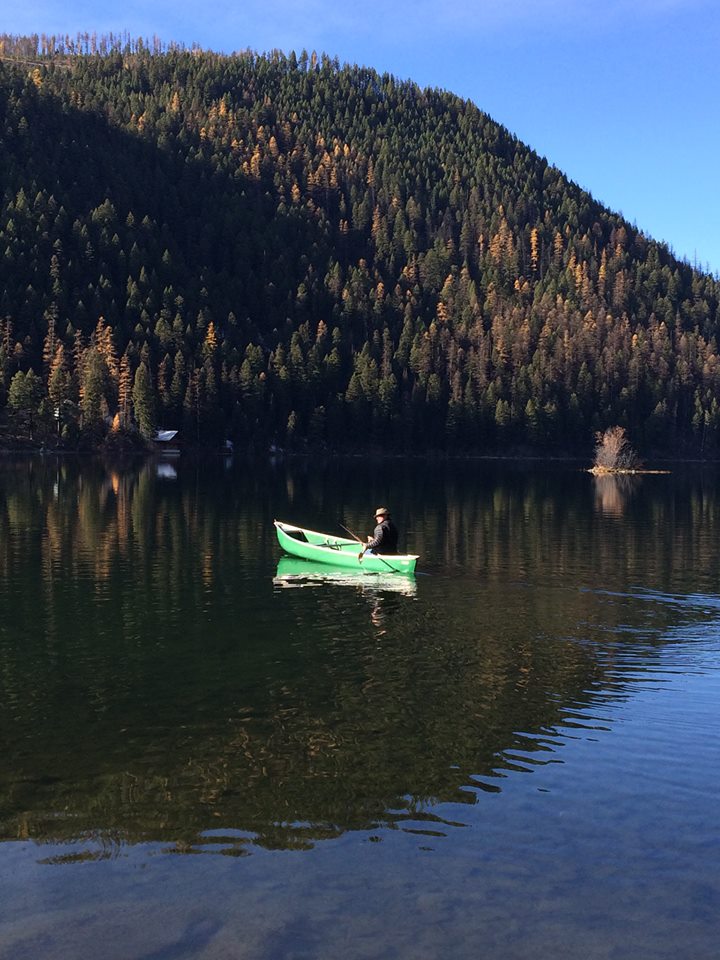
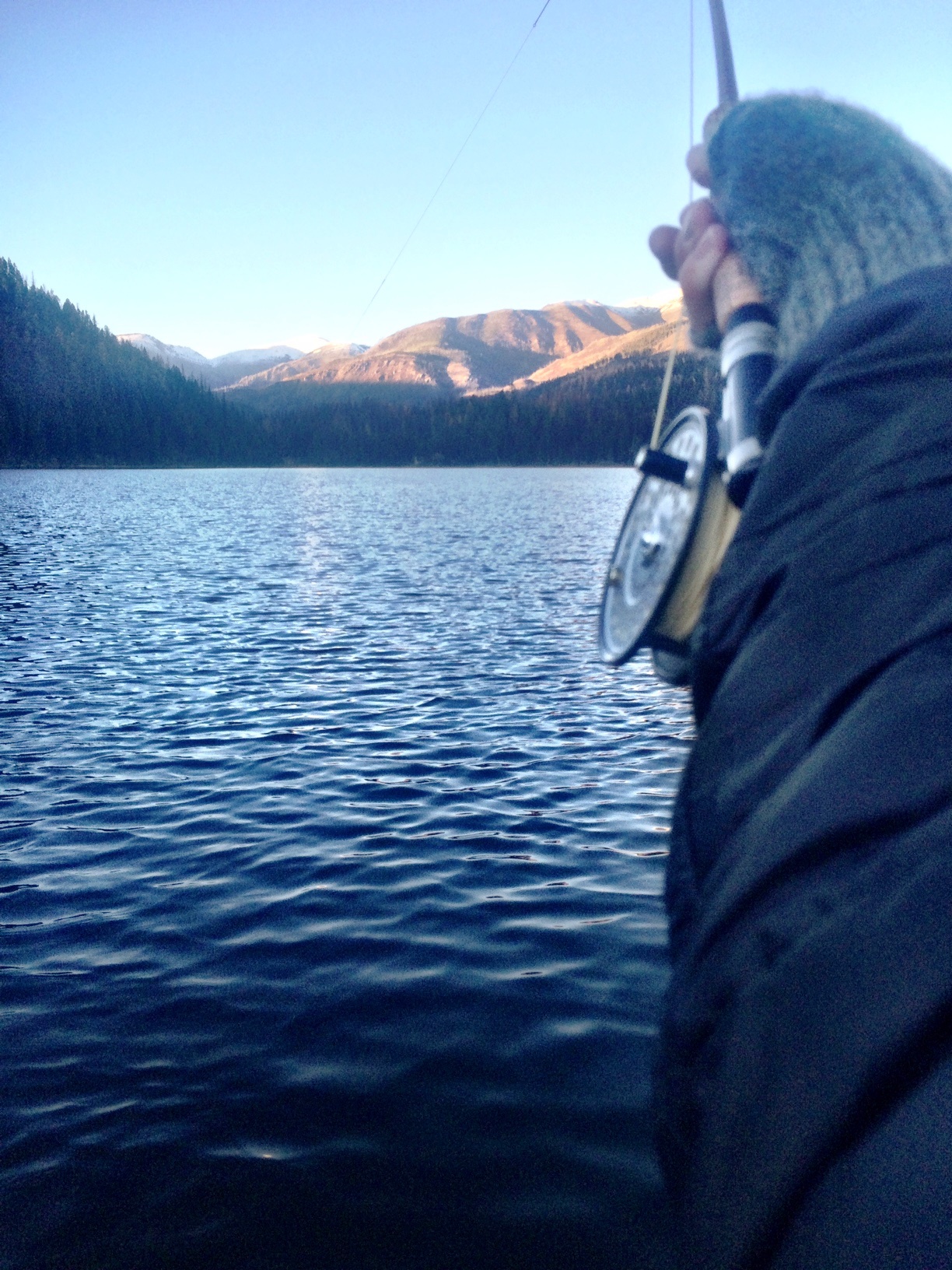
I was able to spend a few days at our cabin last week. I passed part of the time there reading A Thousand Mornings of Music: The Journal of an Obsession with the Violin (Crown Publishers, 1970), by Arnold Gingrich. Of course, I spent time enjoying my family and fly fishing, as well.
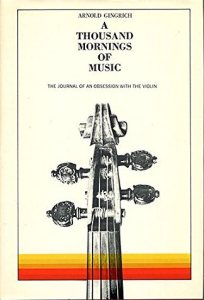
I have long been a fan of Gingrich’s writings, especially of The Well Tempered Angler (Alfred A. Knopf, 1965). In A Thousand Mornings of Music Gingrich writes about a passion that paralleled his interest in all things fly fishing–a passion for violins, which he playfully calls “fiddles” throughout the book. If you have read his angling books or Toys of a Lifetime (Alfred A. Knopf, 1966), you know that he had the tendencies of a collector. In A Thousand Mornings he describes those tendencies, as they were directed toward violins over a period of several years. At the end of that period (and at the end of the book) he had acquired violins made by some of the most respected luthiers in history. Among them was one made by Antonio Stradivari of Cremona (now a of part of northern Italy), in 1672. Gingrich named this violin “The Gudgeon,” after its second owner.
Gingrich’s Stradivarius was played for a period by Hungarian born virtuosa, Erna Rubinstein. Gingrich, himself, during his tenure as a collector, renewed his own studies of violin playing. For a time, he even spent early morning at the Rembert Wurlitzer offices, playing celebrated, rare violins that passed through the company’s hands.
It is no surprise that Gingrich loved both violins and bamboo fly rods. Many people have made comparisons between them, emphasizing the care that must be exercised in forming both, the importance of varnish, and so on. Indeed, I know more than one fly fisher, who collects violins. That said, the work done by luthiers is certainly much more extensive than that done by any fly rod maker.
I recently came across a video that shows a French luthier, Dominique Nicosia, engaged in his craft. The video was made by Baptiste Buob and filmed at the Musée de la lutherie et de l’archèterie françaises de Mirecourt. No doubt, Gingrich would have loved such films. Yet, I hope that neither music nor his interest in instruments would have kept him away from the beauty that we find while fly fishing, a beauty that far exceeds that produced by of any violinist, luthier, or rod maker.

During some recent virtual wanderings, I came across the website of Marlo DiPietro, who makes custom fly tying vises. His work is stunningly beautiful and unique. It might seem odd to some readers to think of vises as art. However, fly tiers can become pretty attached to their tools, and it’s not uncommon for us to appreciate their aesthetic beauty as much as their functionality (see my previous post on “form and function.”). Indeed, I prize my rather common Regal Medallion vise almost as highly as any reel, rod, or even painting in my possession.

“Imitura Natura” vice. Image © Marlo DiPietro
DiPietro’s custom vises exist in different realm than my Regal does. His gallery of pictures allows you to check that realm out, if, like me, you don’t have the means to actually purchase one of his vises.
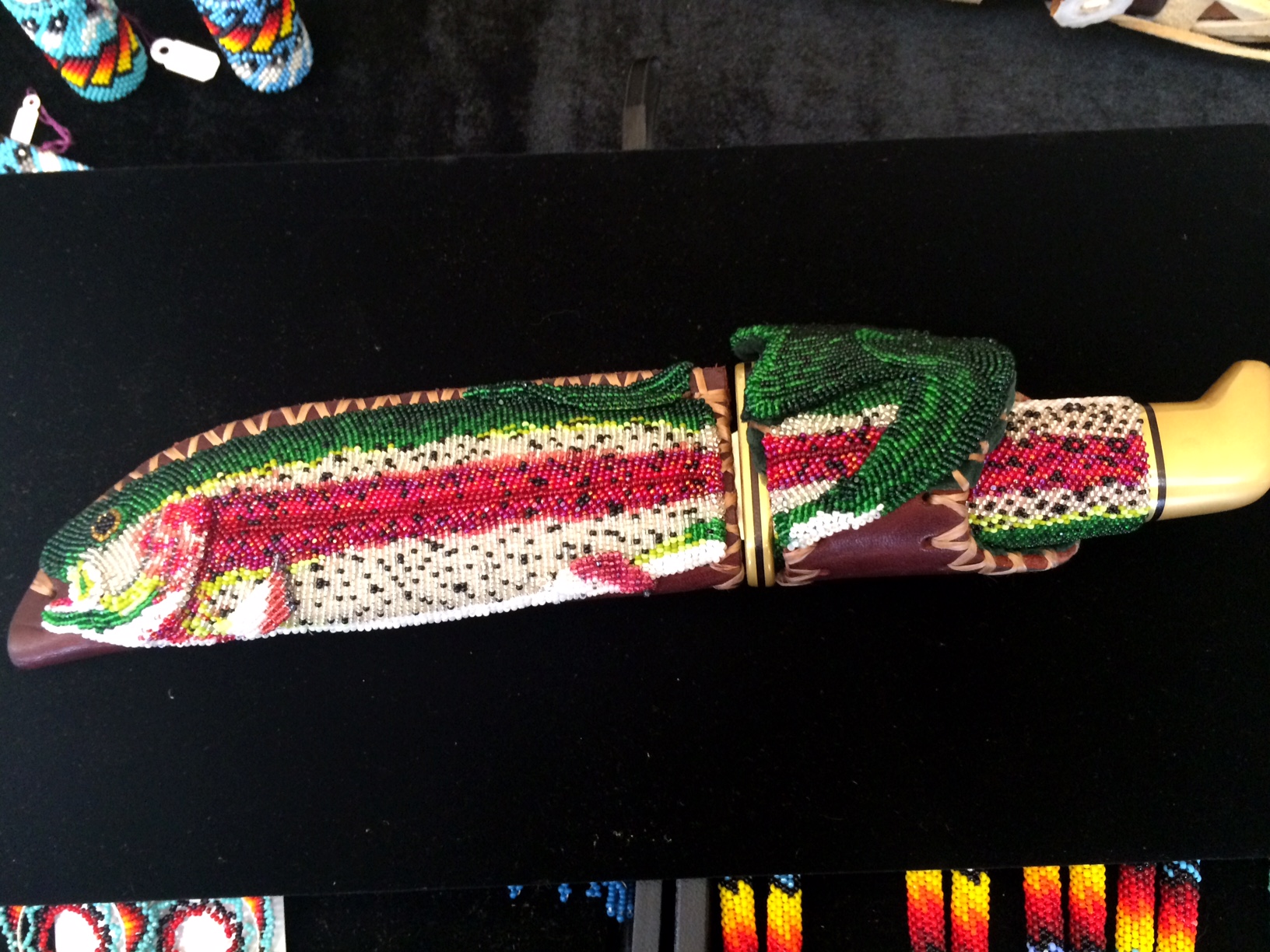
I have had limited time to post lately, due to a busy work schedule. Fortunately, I like my work, and it often takes me to places I like, as well. Recently, I attended some meetings at Salish Kootenai College in Pablo, Montana. As is often the case with meetings and conferences in Indian Country, there were some vendors there. Among them was Dion Albert. He was displaying some of his art, which included the beaded rainbow trout knife and sheath pictured below. My picture is not great, but you can still see how amazing this piece is.
The beauty of this knife and sheath brings architect Louis Sullivan to mind. In an 1896 article, “The Tall Office Building Artistically Considered” (Lippincott’s Magazine, March 1896, 408), Sullivan wrote the following:
It is the pervading law of all things organic and inorganic, of all things physical and metaphysical, of all things human and all things superhuman, of all true manifestations of the head, of the heart, of the soul, that the life is recognizable in its expression, that form ever follows function. This is the law. (Sullivan’s emphasis).
To make Sullivan’s claim absolutely true, we would have to include our emotions as “functions,” since many contemporary expressions of art have no more purpose than to provoke feelings. Also, the Euro-American concept of “art” is not always applicable to traditional Indigenous crafts, of which Mr. Albert’s knife is an expression. But Sullivan was not really speaking of art, and his implication that there is beauty in functionality certainly apply here. They apply to hand made fly rods, artificial flies, and to many other things I love, as well.
Anyone interested in knowing more about Dion Albert’s crafts can reach him via email at memsicemboy@msn.com. Besides doing beadwork, Mr. Albert produces functional and beautiful items from buckskin, birch bark, and more. He is a member of the Confederated Salish, Kootenai, and Pend d’Oreille Tribes. Beneath the display board, upon which the knife is resting, you can glimpse beadwork done by another craftsperson. You can contact the “Native Artwork by Linda” at 406-531-5848.
Last week, I took my students to the Manuscripts, Archives, and Special Collections Department of our university libraries. Washington State University’s MASC holds a huge collection of angling texts, many of which were donated by alumni Joan and Vernon Gallup. MASC Department Head Trevor James Bond gave an informative and enjoyable overview of the collection to the students. I urge anyone interested in working with these texts, or even visiting them for the mere pleasure of doing so, to contact him. And if you do visit, let’s wet a line.
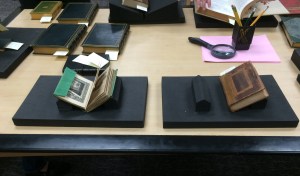
Various editions of Izaak Walton’s The Compleat Angler. First editions (1653) in the foreground. Vellum bound edition, illustrated by Arthur Rackham (1931), in right background.
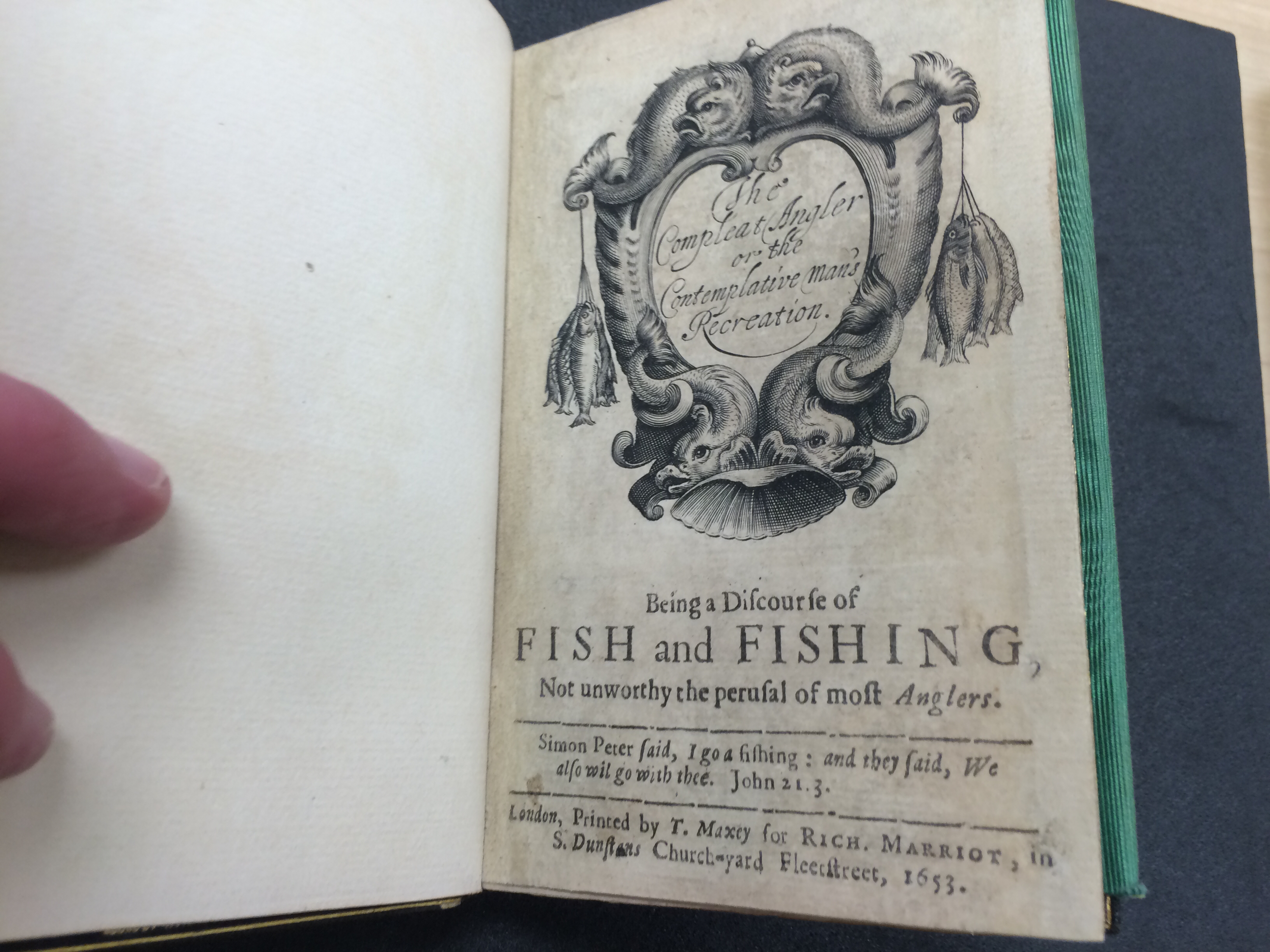
First Edition of The Compleat Angler

William Blacker’s Catechism of Fly Making, Angling, and Dying (1843).
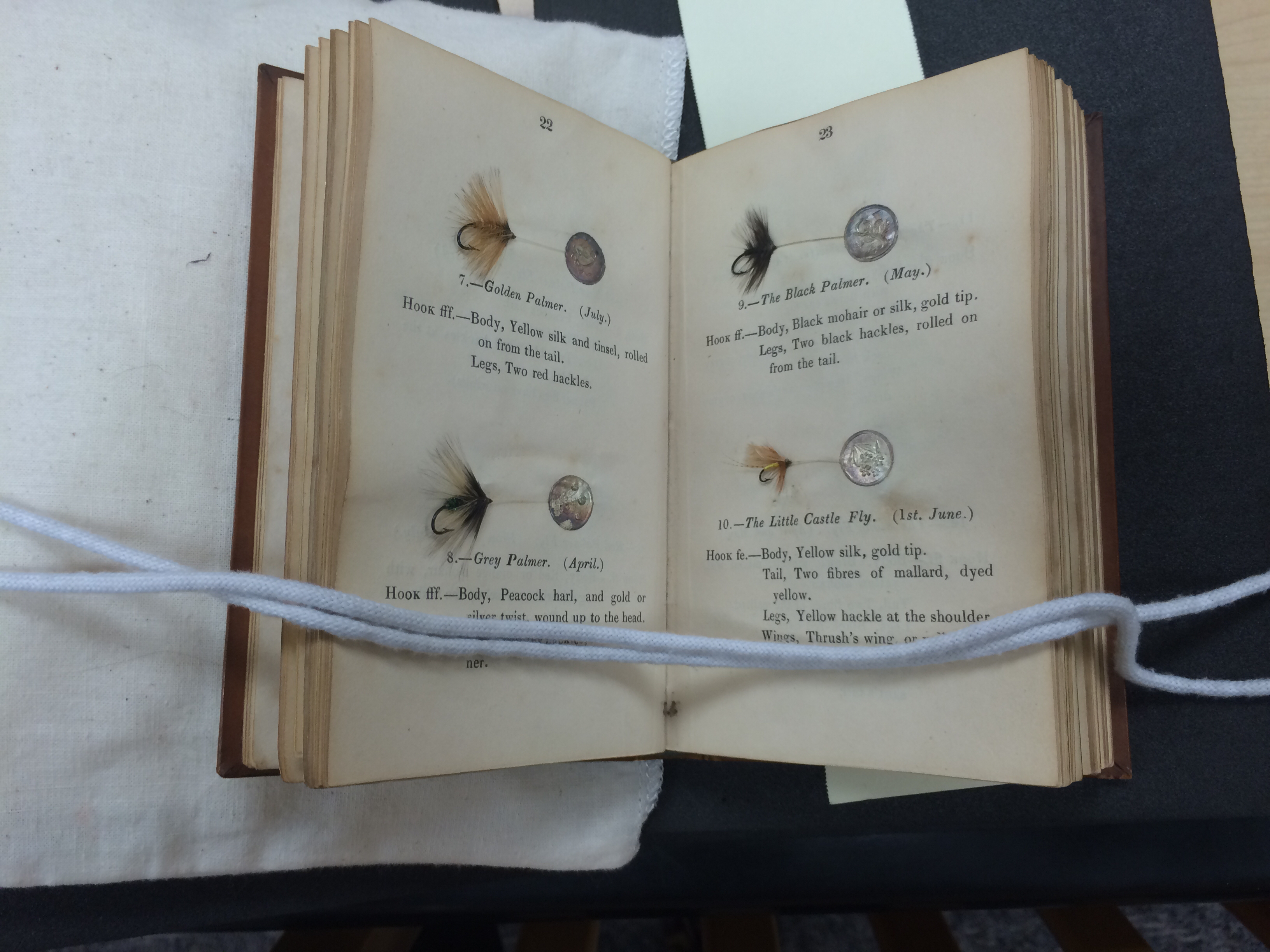
The actual flies tipped into Blacker’s text. This copy includes both trout and salmon flies.
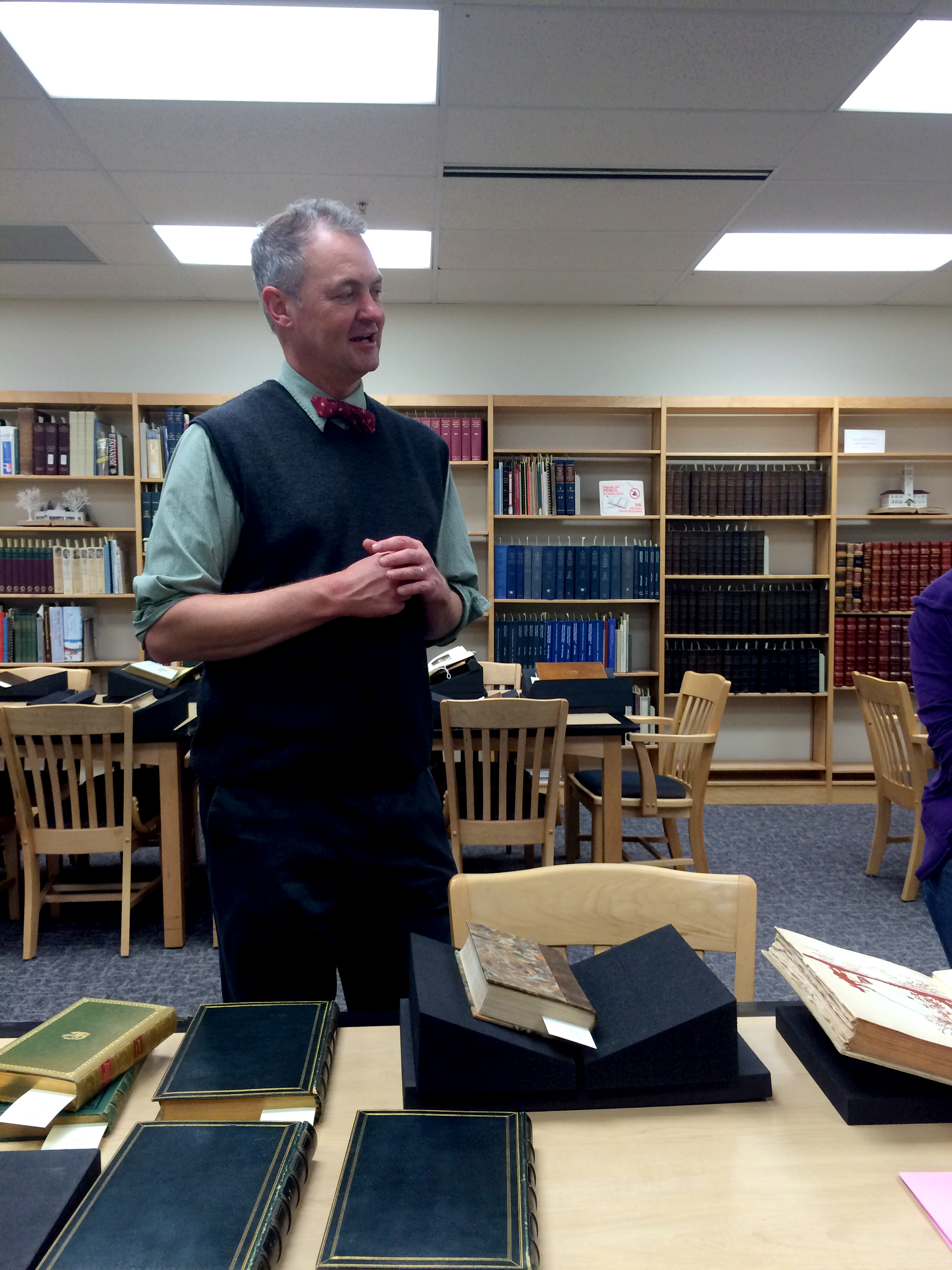
Bond. Trevor James Bond. Seriously, this guy knows a lot more about security than Daniel Craig does.
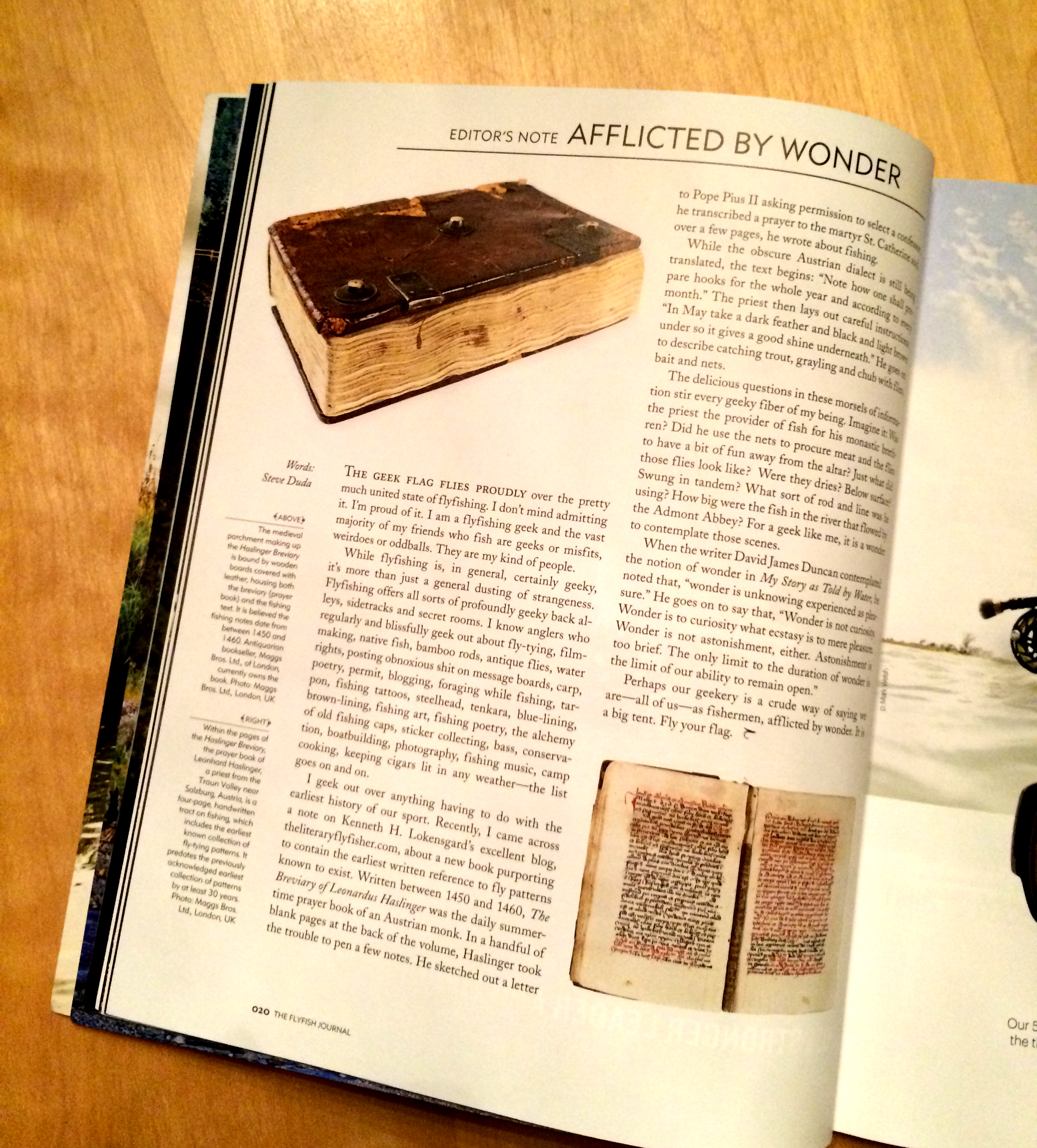
Steve Duda, editor of The Flyfish Journal, titles the editor’s column in the latest issue (7:1) of the magazine “Afflicted by Wonder.” In the column, he writes about his passion for “anything having to do with the earliest history of our sport.” He continues on to discuss fifteenth century Breviary of Leonardus Haslinger, about which I wrote some time back.
Duda kindly writes that he was made aware of The Breviary through my own “excellent blog.” I am grateful for this note. I think very highly of The Flyfish Journal, preferring its literary, reflective tone to the more technical and often sensationalistic tone of other outdoor magazines. Of course, this tone is maintained by Duda’s editorial leadership. I should add that he is fine writer, himself, as well.
In “Afflicted by Wonder,” Duda describes how many fly fishers are particularly taken with certain aspects of the sport, which leads them to seek more information and to grow even more passionate about the activity, generally. Like Duda, much of my passion has to do with sporting history. Whatever your passion may be, as a fly fisher, it will likely be fueled by The Flyfish Journal. And if you are not a fly fisher … well, I am sure there are print publications out their for you too, though there are certainly fewer of them than there were in the past.

“Piscator, Auceps, and Venator,” Arthur Rackham, 1931.
“There is no necessity of being rich: for I told you, there be as many miseries beyond riches as on this side of them.”
Piscator, the “Master,” speaking to Venator, in Izaak Walton’s The Compleat Angler, 1653.


 The Literary Fly Fisher
