Check “Classic and Used Fly Fishing Tackle for Sale” (link at right) for updated items, including Ross reels.
Archive for the ‘Uncategorized’ Category
Items for Sale updated
November 6, 2010Old School Fly Tying
November 6, 2010
This beautiful “Fontinalis Fin” wet fly was tied for me by Levente Kovács-Sinkó. Levente tied this by hand, without a vice. His skill is obvious, as is his love of classic flies and other tackle. I look forward to fishing with Levente on one of my visits to my wife’s native Hungary. Levente and I met online. But, in one of those “small world” coincidences, it turns out he is acquainted with a close Hungarian family member. You can check out Levente’s blog, “Classic Fly Fishing” (in Hungarian) here: “http://klasszikusmulegyezes.blogspot.com/
A Hardy Classic
September 15, 2010
Old “Dusty Miller” salmon fly from House of Hardy. Tied in Alnwick, England.
Fishing Friends
August 20, 2010Authors of angling texts have written about the pleasures of fishing with friends for centuries. According to them, fishing, away from the distractions of daily life, facilitates and intimacy between friends. Likewise, being with good friends enriches the fishing experience itself. This led Isaac Walton to proclaim in 1653 that a fishing “companion that is cheerful, and free from swearing and scurrilous discourse, is worth gold.”[1]
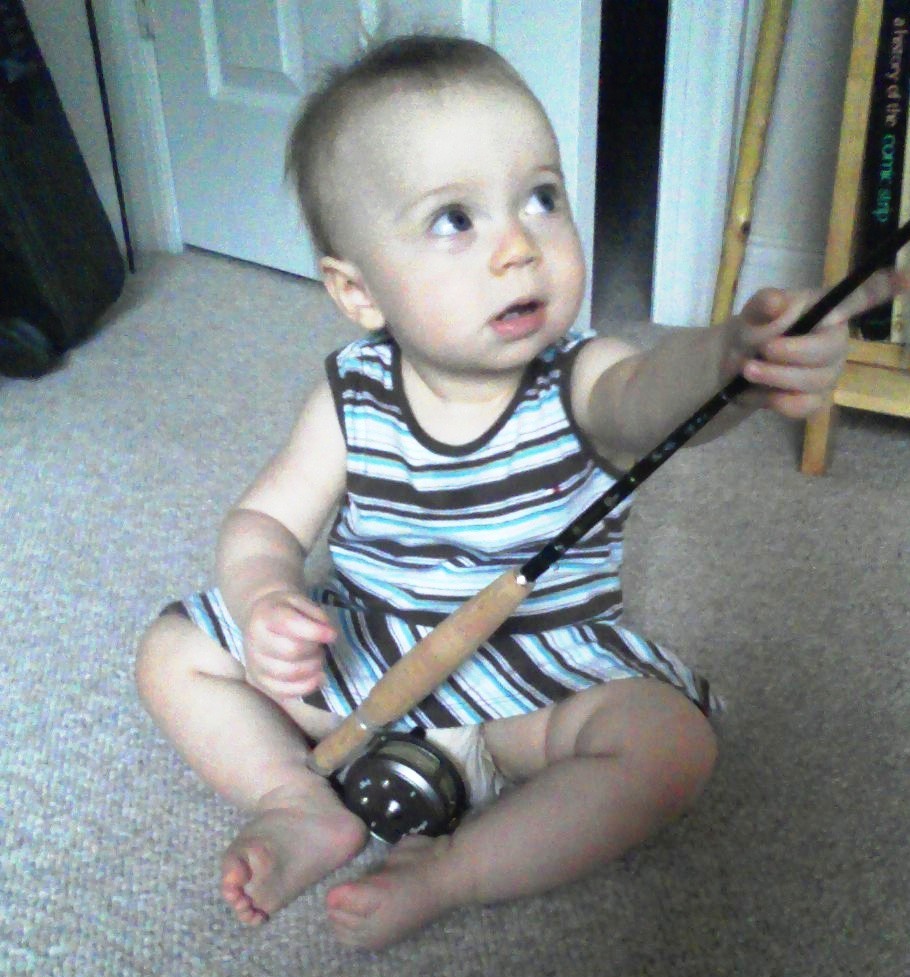
I’m fortunate to have a good number of friends with whom I greatly enjoy fishing (though we do not do so “free from swearing,” as Walton would have us do). I hope that my young daughter will grow to be one of my fishing companions. Perhaps she will not be as passionate about the sport as her father is, but I trust that she will enjoy it and the time it will allow her to spend with her father and with the quiet, natural world. She certainly takes after her father in one respect, so far; she enjoys playing with her tackle.
[1] Isaac Walton and Charles Cotton. The Compleat Angler, or, The Contemplative Man’s Recreation (New York: Modern Library, 1998).
Home Waters
August 15, 2010I’ve lived many places in the United States, but if “home is where the heart” is, then my home remains in Montana. I grew up there, and I visit often. My “home waters” are those on which I learned to fish, near the family cabin at which I still spend a lot of time. They have not just a sentimental significance to me, but a religious one as well.

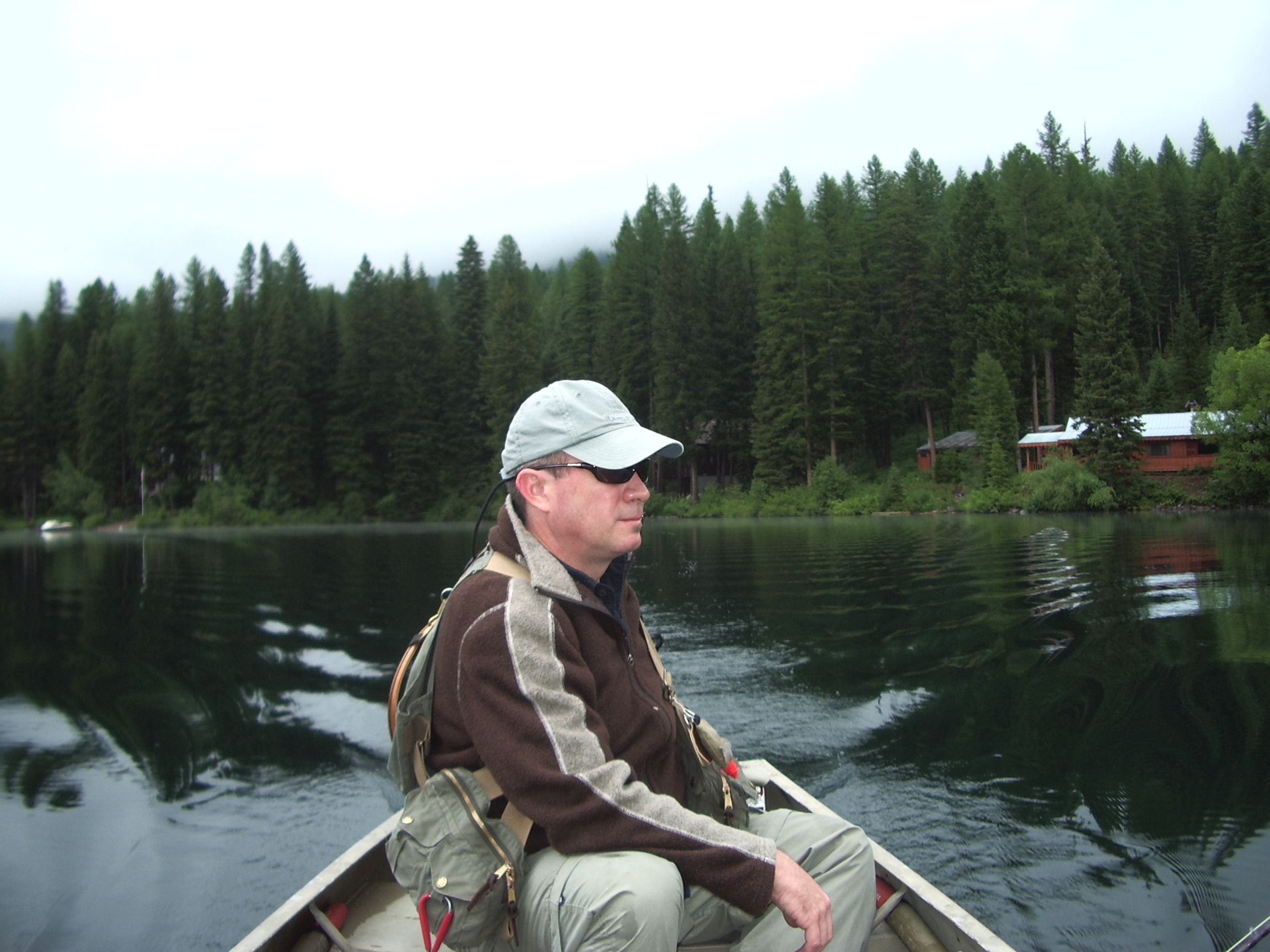

Our family cabin is located on a small lake, on the border of the Scapegoat Wilderness area. The Scapegoat is part of a massive wilderness complex that includes two more wilderness areas as well as Glacier National Park and Waterton Lakes National Park in Alberta, Canada. This country is truly wild. The forests are inhabited by all types of animals, from grizzly bears, to mountain lions, to wolverines. Of course, the rivers and lakes fed by the mountain snow are filled with life too. Trout are plentiful and insect hatches are abundant. Needless to say, fly fishing can be excellent.
Of course, I fish regularly on the lake where our cabin is located. In the evenings, the water is usually placid, and rising trout are easily spotted sipping mayflies, caddis, bees, and terrestrials that have blown into the water. The fall caddis hatches, in particular, bring many fish to the surface to feed. Fishing for these trout, on this home water, is one of my biggest joys.
I love to fish on another piece of home water too. This is the North Fork of the Blackfoot River, which lies just one ridge over from the lake where our cabin is located. The North Fork flows out of the mountains of the Scapegoat Wilderness and into the Big Blackfoot River. The main branch of the Big Blackfoot cuts through a nearby valley.

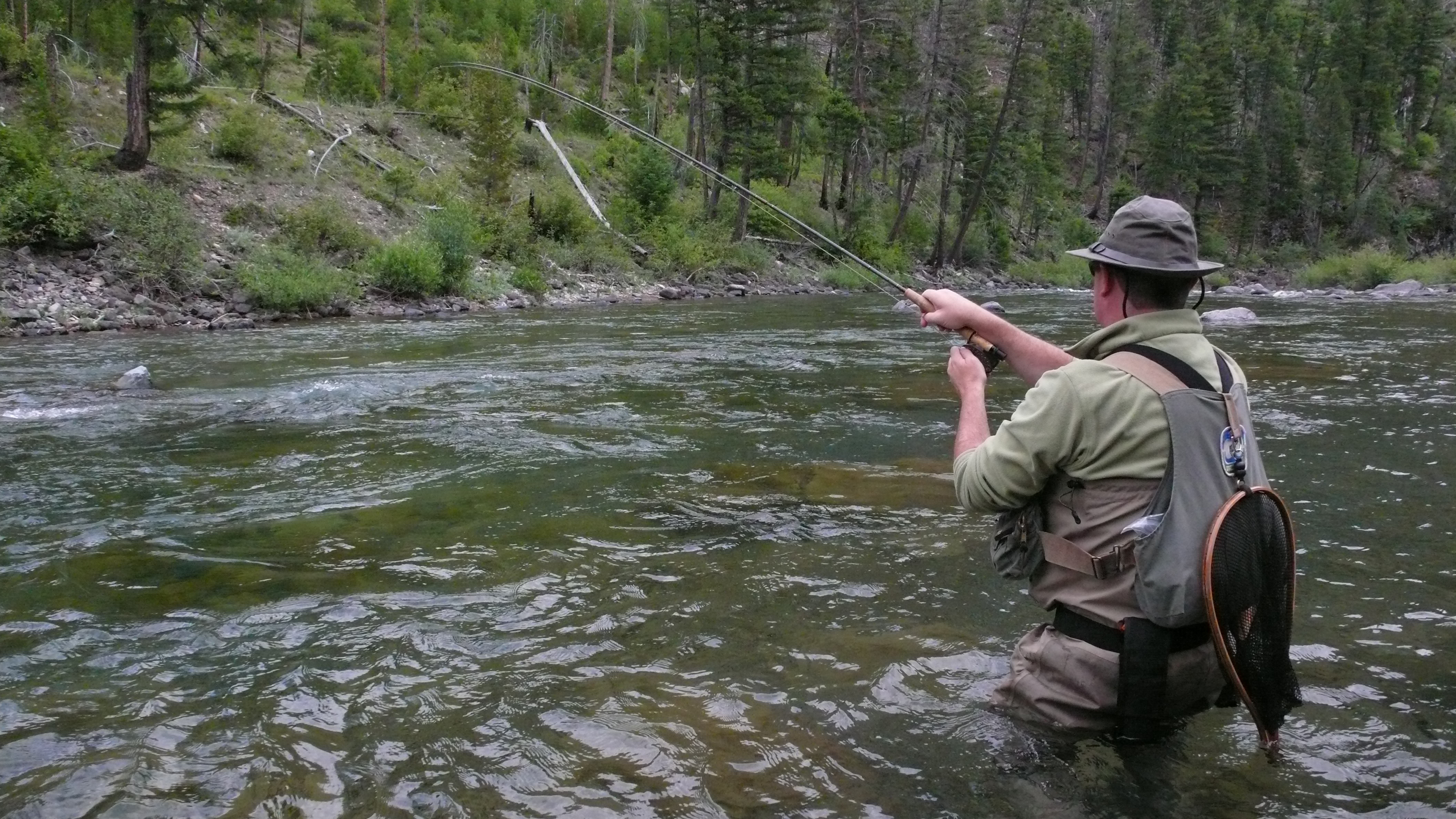

Many fly fishers are familiar with the Big Blackfoot, thanks to Norman Maclean’s novella, A River Runs Through It, which was later made into a movie by Robert Redford. The Big Blackfoot figures heavily in the story of the years Maclean spent fly fishing with his brother and his father, the latter of whom was a Presbyterian preacher.
Like Maclean’s, my father was also a Presbyterian minister, and he introduced me to fly fishing in the same beautiful part of the world. My father has never been passionate about the sport, but he provided me the basic tools and to become a passionate fly fisherman myself, and he raised me in a place where the fishing can be fantastic.
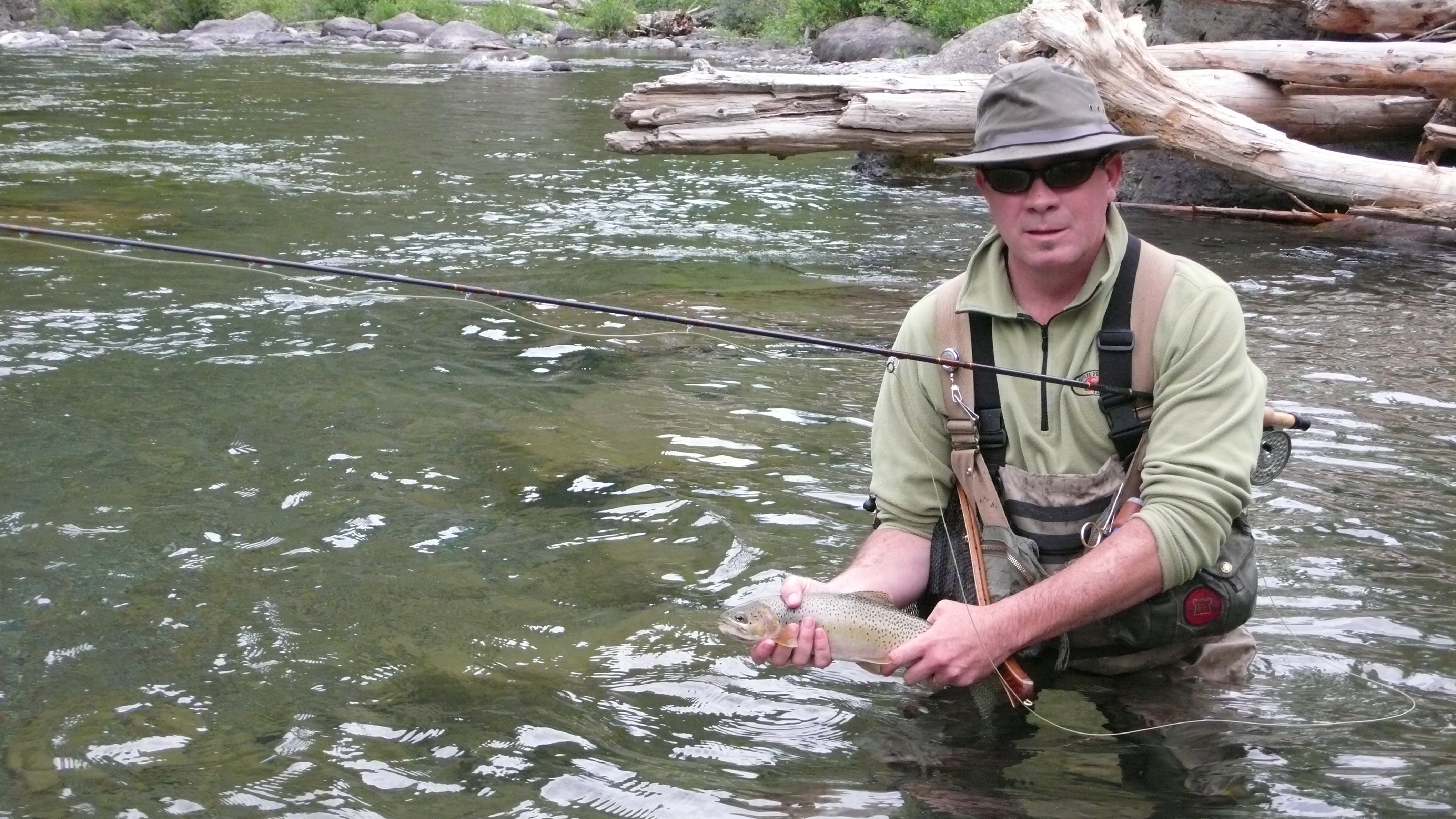


Anthropologist Keith Basso writes that “sense of place may gather until itself a potent religious force, especially if one considers the root of the word in religare, which is ‘to bind or fasten fast.’”[1] Without question, the sense of place that I feel when fishing my home waters is religious in that it helps me to appreciate how I am bound or fastened to the world around me. It orients me as an individual, by reminding me of where I stand relative to a much larger, beautiful, mysterious world. The beauty and mystery of that world arise from the presence of the clean waters, the healthy trout, the wild animals, and the knowledge that something much greater than me created these things.
Note: I thank my nephew Kyle Kleschen for the photos of the cabin and of my fishing.
[1] Keith Basso, Wisdom Sits in Places: Landscape and Language among the Western Apache (Albuquerque: University of New Mexico Press, 1996).
Sacred Texts
May 3, 2010Recently, I visited the National Sporting Library in Middleburg Virginia. I went there at the suggestion of Sam Snyder, Ph.D., who held a fellowship at the library this spring.
The Library holds an amazing collection of fly fishing related books. Among these are the first (1653) and fifth (1676) editions of The Compleat Angler: or, The Contemplative Man’s Recreation, by Isaac Walton. The fifth edition was the first to include the section authored by Charles Cotton, at Walton’s invitation, dealing specifically with fly fishing. This text is now often cited as the third most published book in the English language, after the King James Bible and The Pilgrim’s Progress by John Bunyan.
Like the aforementioned two books, The Compleat Angler is filled with religious themes. Walton’s original text argues that fishing, by requiring the angler to visit those places least affected by culture and its distractions, allows the individual better to contemplate the presence of his or her creator in the world.
It was a thrill to examine these two important editions of The Compleat Angler and many other fly fishing texts as well.  Anyone interested in fly fishing or other field sport should consider a visit to the National Sporting Library. Their web address is http://www.nsl.org/.
Fly fishing, Ethics, and Nature
April 19, 2010The relationship between religion and fly fishing has been written about for centuries. Fly fishing authors have discussed this relationship at least as far back as 1496, when “A Treatyse of Fyshynge with an Angle” was published. It is only recently, however, that fly fishing authors have considered the specifically ethical aspect of fishing. Previously, the fish were oddly left out of the picture, and it was simply the setting of the fly fishing experience that brought one closer to God.
In the conclusion to his 1959 book, Fishing and Thinking, A.A. Luce plunges much more deeply into the religious dimensions of fishing. He reflects upon whether is wrong, or even “cruel” to fly fish for enjoyment. Ultimately, he claims that it is not, as long as the fly fisher keeps his catch with the intent of eating it. Many contemporary fly fishers, who practice “catch and release,” no doubt disagree with Luce. Indeed, Luce describes catching quantities of fish so great that it is hard to believe he could eat them all. Moreover, he laments the decline of his local fisheries, without considering whether or not his fishing contributed to those declines.
Still, there is value in many of Luce’s reflections. He was, in fact, well prepared as a thinker to write on the topic of religion and fishing. Luce was a philosopher and chaplain, holding doctoral degrees in divinity and literature. He taught at Trinity College, Dublin, where he held numerous chairs in the faculty of Moral Philosophy. Luce was also a decorated World War I veteran. So, his ethical reflections upon the mortality of fish and the morality of human actions are informed by a very intimate familiarity with matters of life and death.
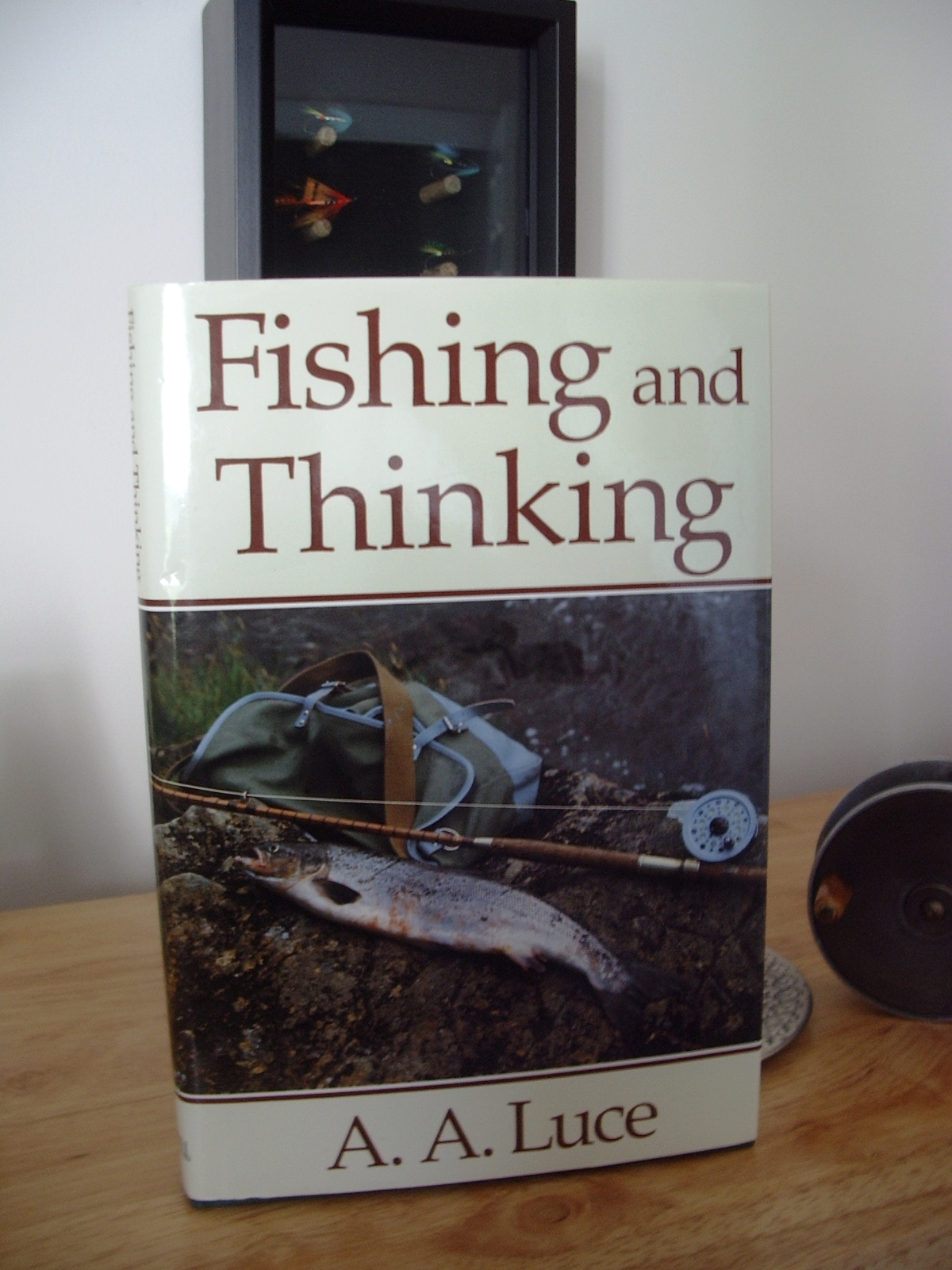 I offer to the reader the final three passages of Thinking and Fishing, in which the author offers some very general ideas about the relationship between religion, fishing , and ethics. While many of us take issue with Luce’s opposition to catch-and release fishing, we can certainly agree with him that when we fish in the “right way” (even if we disagree upon what that way is), fishing can be a profoundly meaningful experience. Following, then, are Luce’s own words:
People mean different things by the word ‘Nature’: some personify Nature; for some, Nature is an impersonal symbol; for some, Nature is an active force; for others, Nature is passive being; for some, Nature means God; for others, not. But whatever meaning we attach to the term, it is not true that Nature us cruel; and therefore it cannot be true that Nature sets a headline for man’s cruelty.
Angling need not be cruel. Angling, properly conducted in the spirit of Christian sportsmanship, is not cruel. If there are cruel forms of angling, if there are cruel practices or tendencies in angling, the anglers concerned cannot plead by way of justification that Nature is cruel and that they in being cruel are acting as their mother’s sons.
Traditional angling for trout and salmon teaches kindness to animals, shows the need for it, and offers a field for cultivating it. Thoughtful angling should strengthen morale, and not weaken it. He who fishes in the right way and thinks along right lines can hardly fail to absorb a healthy moral optimism about Nature and her ways. For nature does nothing idly, makes nothing bad or ugly, and in sternness remembers mercy. The same can be said in the warmer, no less truthful, language of religion. Anglers see at close range and in great detail the works and wonders of the Lord. All His works are good. He has made everything beautiful in His time, and His tender mercies are over all His works.
Arthur Aston Luce, Fishing and Thinking (Wykey, Shrewsbury, England: Swan Hill Press, 1990), p 191. Fishing and Thinking was first published by Hodder and Stoughton in 1959
Fly Fishing and Religion: The Fly Line as Connecting Thread
March 28, 2010
Paper delivered by Kenneth H. Lokensgard, at the 2009 American Academy of Religion Annual Conference. Copyright 2009 Kenneth H Lokensgard
In 1976, University of Chicago English professor Norman Maclean wrote famously of the relationship between religion and fly-fishing:
In our family, there was no clear line between religion and fly fishing. We lived at the junction of great trout rivers in western Montana, and our father was a Presbyterian minister and a fly fisherman who tied his own flies and taught others. He told us about Christ’s disciples being fishermen, and we were left to assume, as my brother and I did, that all first-class fishermen in the sea of Galilee were fly fisherman and that John, the favorite, was a dry-fly fisherman.[1]
Maclean wrote this passage in his mostly autobiographical novella, “A River Runs through It.”
Maclean is not unique in pointing toward a relationship between religion and fly fishing. Despite the fact that scholars of religion have largely ignored fishing and other field sports, such as hunting, the association between religion and fly fishing has been made in European and Euro-North American popular literature for centuries.
Given this historical association, the fact that many consider fly fishing to be potentially religious is plain. The question is, “why?” Fishing is not a part of established Jewish, Christian, or Muslim ritual or doctrine, although fish and fishing do appear in the Hebrew and Christian bibles. Fishing writers have highlighted this fact, as Maclean does, but these writers have spent more time writing about the overall experience of fishing and its benefits.
Key to understanding why fly fishing has been viewed as potentially religious for so long is the fact that it is necessarily practiced in the so-called “natural” world. Indeed, Sam Snyder, the one recent scholar to consider the religious aspects of fly fishing, characterizes it as a “religion of nature.”[2] Snyder’s label is apt, but he concentrates primarily upon contemporary, conservation-oriented fly fishers. Many historical fishing writers, most of whom were religious in a very conventional, Christian sense, would likely bristle at this characterization. These writers portray nature more as a setting for religious activity rather than as a focus of religious action. In nature, they seem to suggest, the fly fisher is partly freed from the most obvious elements of “culture”—elements that the writers consider as distractions from intimate community with the Christian God and elements of its creation, including fellow Christians. Thus, it is the “connection” to others, which the setting seems to facilitate, that makes fishing religious in the minds of so many authors and their readers.
Before continuing, allow me to explain just what fly fishing is. It involves casting a heavy line with a long rod. At the end of this heavy line is a “leader” of several feet—a very thin line that is difficult for the fish to see. Finally, at the end of the leader is the “fly,” an imitation piece of bait, hand tied with threads, feathers, and other materials to a hook. Traditionally, these baits represented actual flies floating on or near the surface of the water, upon which many fish feed. Over the last hundred years or so, fishing “flies” have evolved to include representations of just about everything else upon which fish prey.
One of the first clear references to fly fishing in European literature is made by the famous German epic poet and knight, Wolfram von Eschenbach, in the early thirteenth century CE.[3] In a fragmentary text titled Titurel, he describes the young nobleman and squire Schionatulander catching perch and grayling “with a feathered bait” and rod, while on retreat in the forest.[4] Notably, Schionatulander is, in a sense, a religious figure. He is an associate of the Grail seeking knights of King Arthur’s court. Like many of them, he is a thoroughly chivalrous character and the very embodiment of thirteenth century Christian ideals.[5]
The first significant English language reference to fly fishing, which deals explicitly with the relationship between fishing and religion appears in the fifteenth century. In a short essay titled “A Treatyse of Fyshynge with an Angle,” the author describes fishing as a field sport superior to others because it brings good health and other things, as she puts it, “pleasing to God.”[6]
The “Treatyse” was first published as the conclusion to the second edition of The Boke of St. Albans in 1496.[7] Authorship of the “Treatyse” is attributed to Dame Julyana Berners. No clear historical data exist on her, but she came eventually to be described as a Roman Catholic nunnery prioress in Hertfordshire, England, of noble birth.[8]
The bulk of the larger text is devoted to various types of hunting, a field sport long associated by the European elite with chivalry and morality. Perhaps it is not surprising, then, to see fishing now described as a sport that is fundamentally good for the Christian’s soul. Here, I quote a passage to this effect from a modern English version of the “Treatyse” by scholar Sherman Kuhn:
You must not use this aforesaid artful sport for covetousness, merely for increasing or saving your money, but mainly for your enjoyment and to procure the health of your body and, more especially, your soul. For when you intend to go to your amusements in fishing, you will not want very many persons with you, who might hinder you in your pastime. And then you can serve God devoutly by earnestly saying your customary prayers. And in so doing, you will eschew and avoid many vices, such as idleness, which is the principal cause inciting a man to other vices, as is right well known. … Also you should busy yourself to nourish the game in everything that you can, and to destroy all such things as are devourers of it.[9]
Notice the author’s emphasis upon the need to be free from distraction in order to fish successfully and to “serve God devoutly.”
We see a similar emphasis upon the benefits of the good Christian freeing her or himself from distraction in the next great text on religion and fishing. This text, in fact, is one of the most significant English language texts on any subject. This is The Compleat Angler or, The Contemplative Man’s Recreation, by Izaak Walton. The book was first published in 1653, and it has been constant publication ever since.
Walton, a dedicated English Royalist and Anglican, describes fishing in much the same way that the author of the “Treatyse” does. He argues that fishing benefits the Christian because it removes him or her from the distractions of financial pursuits and social ambition. Indeed, Walton’s chief character in the book, a master fisherman who converts a hunter to fishing, proclaims that anglers pity men distracted by such things and “enjoy a contentedness above the reach of such dispositions.”[10] For the experience of fishing, according to Walton, allows the fisherperson to bond with his fellow Christian fishers and better to appreciate the power of God, as evidenced in the beauty of creation. Walton’s reformed hunter, surely made a better Christian by converting to fishing, proclaims the following:
So when I would beget content, and increase confidence in the power, and wisdom, and providence of Almighty God, I will walk the meadows by some gliding stream, and there contemplate the lilies that take no care, and those very many other various living creatures, that are not only created, but fed, man knows not how, by the goodness of the God of nature, and therefore trust in him.[11]
It is toward the stream to fish, then, that Walton suggests Christian readers turn to find and appreciate their god.
The overall experience of fishing Walton believes, represents the perfect combination of “contemplation,” then understood as an explicitly religious activity, and “action.” It thus forms, for him, the most “ingenuous, quiet, and harmless art.”[12] The beautiful, distraction free setting in which it is practiced and its generally relaxed nature facilitate contemplation of God. And fishing, itself, combats idleness, which Berners condemns so strongly in the “Treatyse.”
With the immediate popularity of The Compleat Angler, fishing literature took off. Because many of the authors of this literature restate Berners and Walton, and because of our short time together, I skip ahead again through time to look at Maclean’s great novella. A River Runs through It is the story of MacLean’s family and of the bond the author felt with his strict Presbyterian father and his troubled brother while fly fishing in 1930’s Montana.
In the story, Maclean tries to “help” his hard-drinking and gambling brother, Paul, by taking him fly fishing. During each fishing trip, the two brothers experience a closeness they are unable to achieve at other times. Moreover, Maclean himself feels a closeness and a connection with something other-than-human—something we might presume the Presbyterian author associates with God.
Maclean says things such as he has “left the world behind” while fishing.[13] But his trips are not just means of escape. Indeed, he takes his primary problem—his brother—with him. Still, the two men leave behind many other distractions that normally prevent them from truly connecting. During these trips Maclean is able to let Paul know that he is concerned about his welfare. For Maclean, fishing thus facilitates intimacy between human individuals, as it does for Walton.
Maclean also discusses his connection to the wider, natural world extensively. He uses almost mystical terms to describe the intimacy and condensation of this world that he experiences while fishing. He writes that “poets talk about ‘spots of time,’ but it is really the fisherman who experiences eternity compressed into a moment.”[14] The experience of intimate connection that he feels with the natural world extends even to the fish.[15] Almost certainly, the fish he deceives and hooks with his flies do not feel as positive about this connection as Maclean does, but I leave the discussion of fishing ethics for another time. The listener should know, though, that this subject is considered at length by many fly fishing writers.
Regardless, the setting and overall experience of fly fishing allow Maclean to experience some of his most meaningful moments: moments of connection to others. For him, these moments represent actual unity with the wider world, and with reality itself. The author makes this clear at the conclusion of the novella. In doing so, he alludes to an earlier discussion with his father about the Christian New Testament verse, John 1:1 and whether words or water were the first to exist:
Eventually, all things merge into one, and the river runs through it. The river was cut by the world’s great flood and runs over rocks from the basement of time. On some rocks are timeless raindrops. Under rocks are the words, and some the words are theirs.[16]
Maclean is never able help his brother to the extent that he would like; in the story as in real life, his brother dies prematurely and violently. However, as he writes the novella near the end of his own life, he seems able to take solace in the fact that his brother is a part of the “oneness” that he finds while fishing.
A fourth text to enter the canon of writings on fly fishing and religion is David James Duncan’s 1983 novel, The River Why?. In this book (now being adapted to film), Duncan tells the story of a young man named Gus.[17] As a boy, Gus reads The Compleat Angler, which he calls the “family bible.”[18] He becomes frustrated that Walton’s “God of nature” eludes him, even though he spends inordinate amounts of time fishing. Gus therefore decides that if he completely immerses himself in the activity about which he is so obsessed, he might at least find happiness, if not God. So, he graduates from high school and moves to a cabin by a river to fish.
He fly fishes so hard and so often that he effectively severs contact with his family and peers. Eventually, however, he begins to notice the landscape beyond the river and his cabin, he meets a young fisherwoman, and he slowly becomes less reclusive. After beginning to enjoy relationships with those around him, he finally has an intimate encounter with Walton’s “God of nature.” In a passage that brings to mind the conversion of Paul in the New Testament, Duncan describes this encounter. Of course, he does so in fishing terms:
Mad with joy, I sank to my knees on the white road, and I felt a hand, resting like sunlight on my head. And I knew that the line of light led not to a realm but to a Being, and that the light and the hook were his, and that they were made of love alone. My heart was pierced. I began to weep. I felt the Ancient One drawing me toward him, coaxing me out of this autumn landscape, beckoning me on toward undying joy.[19]
Fly fishing itself is not a religious experience for Gus. Yet, once he begins to appreciate the setting and not just the activity of fishing, he opens himself up at last to intimacy with others, including what he jokingly calls in fishing language, “The Whopper” or God. [20]
Each of the authors whose works I have reviewed make clear that it is not the activity of fishing alone that gives it religious significance. It is the relationships that one can establish while fishing that do so. Berners emphasizes the relationship with her god and certain elements of its creation, in this case the game fish that she instructs her reader to protect. Each of the other authors also emphasizes the relationship with God, whether they use that term, as Walton does, or whether they describe it as something ancient, eternal, and whole, as Duncan and Maclean do.
Each of the authors indicates that the “natural” world is implicated in this relationship. Berners feels that a respect for God should compel the fisher to care for God’s creation. Walton, Maclean, and Duncan seem to feel almost the opposite—that establishing a relationship with the natural world will help one establish a more meaningful relationship with God. Walton, Maclean, and Duncan differ in their views from Berners, who supposedly lived a somewhat solitary monastic life, in one other way. The three later authors also emphasize that meaningful human relationships are made possible through fishing.
For each of the authors religion is fundamentally relational. This is no surprise, if the word “religion” really derives from the Latin religare, meaning “to bind.”[21] In each text, the authors or their characters are metaphorically bound or connected to their creator and creation through the fly line that features so heavily in their sporting activity. The later three authors are also metaphorically bound to their fellow humans through the fly line. In a sense, then, to contradict Maclean playfully, there is a very clear line indeed between religion and fly fishing. It is a line, though, that connects, not divides. Division arises in our daily lives from the zealous pursuit of wealth condemned by Berners and Walton, and by personal obsessions: the drinking and gambling engaged in by Maclean’s brother and even by the single-minded obsessive pursuit of fish by Duncan’s Gus.
Anthropologist Victor Turner suggests there are essentially two, alternating states in which humans live.[22] One is the state of social structure, characterized by social hierarchy. This hierarchy is determined by the positions each of us hold in our families, our workplaces, the wider society, and so on. These positions are reinforced by our needs for recognition, for wealth, etc. Such internal and external interests prevent us from truly engaging others. The other state is the state of liminality, usually achieved through ritual activity. Simply put, this is when we are free from the things that characterize and reinforce social structure. In the liminal state, we are able to establish more intimate relationships. Scholars have used Turner’s theory to explain the appeal of non-field sports, particularly to fans of organized team sports and participants in physically strenuous sports.[23]
As different as fly fishing is from these other sports, Turner’s theory help us understand the religious significance of fly-fishing too. For the authors whose works I have discussed here, the setting in which fly fishing is practiced seems to facilitate liminality. Fly fishers are required to visit those places that are unaffected by culture enough that fish can actually survive. Today, of course, they might also visit previously damaged fisheries that have been purposefully restored. This challenges the definition of “nature,” but the fact remains that most fly fishers must fish away from the ecologically damaging centers of culture, and therefore from the distractions associated with life in those places. As it happens, the clean, healthy places that remain or that have been restored on our planet are what most of us would consider beautiful too. Berners and Walton attribute this beauty explicitly to God.
So, in the minds of the authors I have reviewed, the fly fisher practices his or her sport in a setting that enables religious connection. In this setting, whether alone or with close companions, the fly fisher engages in the generally focused, repetitive activity of locating fish, determining their prey, and casting imitation flies to them. These activities might help the fly fisher to connect more intimately with his or her fellows, with animals or plants that the fisher might consider as creations or manifestations of a god, and maybe with that god itself. But it is not the fishing that is essential to establishing these connections. Rather, it is Berner’s undistracted prayer, Walton’s Christian comradery and contemplation, and the less purposeful immersion in one’s surroundings described by Maclean and Duncan. All of these things are easier to accomplish, according to the authors, in places where it so happens that the fly fisher is most likely to find fish.
In conclusion, if religion is relational, if it is about orientation toward others, human and otherwise, as historian of religion Charles Long puts it, then we can understand why so many people have considered fly fishing as a potentially religious activity.[24] We can appreciate why Maclean claims that religion and fly fishing were not distinct phenomena in his family. Furthermore, we can appreciate why works dealing with religion and fly fishing, stretching as far back perhaps as Wolfram von Eschenbach’s time, have been so popular among the European and Euro-North American public.
[1] Norman Maclean, “A River Runs through It,” in A River Runs through It and other Stories, 25 Anniv. Ed. (Chicago, IL: University of Chicago Press, 1976), 1.
[2] Sam Snyder, “New Streams of Consciousness: Fly Fishing as a Lived Religion of Nature,” Journal of the American Academy of Religion 75, no. 4 (2007): 896-922.
[3] Andrew Herd, “Fly Fishing in Medieval Times,” A Fly Fishing History, http://www.flyfishinghistory.com/fly_fishing_in_medieval_times.htm (accessed Oct. 12, 2009).
[4] Wolfram von Eschenbach, Parzival and Titurel: A New Translation by Cyril Edwards, translated by Cyril Edwards (Oxford, UK: Oxford University Press, 2006), 366.
[5] Walter Johannes Stein and Irene Groves, The Ninth Century and the Holy Grail (East Sussex, UK: Clairview Books, 2001), 117-123.
[6] John McDonald, Quill Gordon (New York, NY: Alfred A Knopf, 1972), 153.
[7] Ibid., 149.
[8] John McDonald, The Origins of Angling, with assistance from Sherman Kuhn, Dwight Webster, and the editors of Sports Illustrated (Garden City, NY: Doubleday and Company, 1963), 73-74.
[9]John McDonald, Quill Gordon, 172.
[10] Isaak Walton and Charles Cotton, The Compleat Angler or, The Contemplative Man’s Recreation (New York, NY: The Modern Library, 2004), Part 1, 6. Later editions of The Compleat Angler included a second section, devoted entirely to fly fishing, which Walton asked his friend Charles Cotton to contribute.
[11] Walton, Part 1, 252.
[12] Walton, Part 1, 26, 27.
[13] Maclean, 51.
[14] Maclean, 44.
[15] Maclean 98.
[16] Maclean, 104.
[17] David James Duncan, The River Why? (San Francisco, CA: Sierra Club Books, 1983), 182.
[18] Duncan, 35.
[19] Duncan, 278.
[20] Duncan, 182.
[21]Oxford English Dictionary Online, s.v. “religion.”
[22] Victor Turner, The Ritual Process (New York, NY: Aldine de Gruyter, 1995), 96.
[23] See, for instance: Joseph Price, From Season to Season: Sports as American Religion; (Macon, GA: Mercer University Press, 2001); Pamela Cooper, The American Marathon (Syracuse, NY: Syracuse University Press, 1998).
[24] Charles Long, Significations, Signs, Symbols, and Images in the Interpretaion of Religion (Aurora, CO: The Davies Group, 1999), 7.
Thaddeus Norris, the Father of American Fly Fishing, describes the True Angler
December 8, 2009With many persons, fishing is a mere recreation, a pleasant way of killing time. To the true angler, however, the sensation it produces is a deep unspoken joy, born of a longing for that which is quiet and peaceful, and fostered by an inbred love of communing wiht nature, as he walks through grassy meads, or listens to the music of a mountain torrent. This is why he loves occassionally — whatever may be his social propensity indoors — to shun the habitations and usual haunts of men, and wander alone bythe stream, casting his flies over its bright waters: or in his lone canoe to skim the unrufflled surface of the inland lake, where no sound comes to his ear but the wild, flute-like cry of the loon, and where no human form is seen but his own, mirrored in the glassy water.
Thaddeus Norris, American Angler’s Book, 1864.


 The Literary Fly Fisher