Archive for the ‘The Environment’ Category

Nature, Beauty, and Gunfire

January 5, 2015

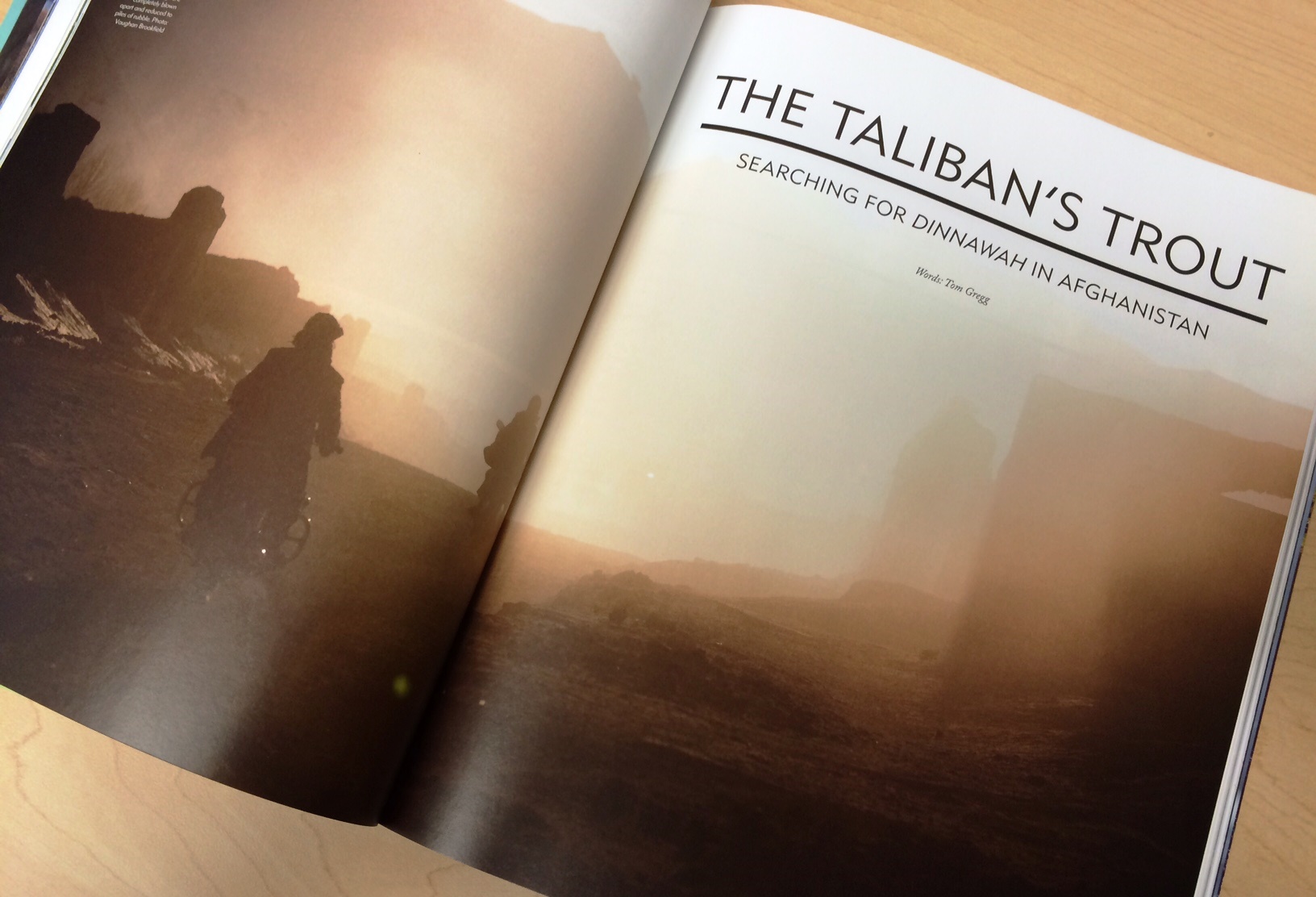
The latest issue of The Flyfish Journal (6:2) includes an article by Tom Gregg about fly fishing in Afghanistan. In “The Taliban’s Trout: Searching for Dinnawah,” Gregg relates his quest to assemble fishing tackle and locate trout, while he was a Political Affairs Officer for the United Nations in 2005.  Eventually, he was able to catch some snowtrout or Schizothorax progastus–the Dinnawah of the title. On the day that he did so, he was accompanied by an escort of five soldiers and his translator. During his first cast, he heard gunfire and assumed his small group was under attack by the Taliban. This turned out not to be the case. He writes, “The soldier’s commander told me one of the soldiers in my security detail had been overcome by the beauty of the morning. He had fired his gun out of happiness and three of his colleagues had returned fire in joy.”
Taliban

We all experience the beauty of the less-cultivated, physical world in different ways, and we express those feelings differently as well. Gregg makes clear that what he enjoys the most about fishing and “nature” is the silence that one sometimes finds on the stream.  He even invokes Izaak Walton, in describing his appreciation of “quiet.” This is apt, since Walton also fished during a time of turmoil–the English Civil Wars.

Still, in his article, Gregg does not fault his escorts for firing their guns. Perhaps, like Walton, Gregg understands that humans, as noisy as they can be, are a part of nature to be appreciated too. In my mind, it makes sense that observers of violent conflicts would feel this way, since they see such great losses of human life and the suffering such losses entail. Admittedly, however, I am imposing an awful lot of meaning upon an otherwise simple passage in Gregg’s essay.

For my own part, I first found the actions of the soldiers in the article odd, foreign, etc. Yet, upon reflection, I am now more interested in their appreciation of how beautiful that morning was, and less so in how they expressed that appreciation. I also find myself thinking that if we could all focus upon what we have in common, and what motivates us to act the ways that we do, then there might be a lot less conflict in every nation’s history. So, if I were to sit down and talk about “nature” with Gregg, I’d like to talk with the soldiers in his article, as well. After all, all three parties would have a starting point for our conversation.

John Steinbeck, a Knight of the Round Table, and Contentment

December 19, 2014

“Contentment requires so little and so much.”

These words are spoken by Sir Marhalt, in Nobel Prize winner John Steinbeck’s The Acts of King Arthur and his Noble Knights (176). Marhalt is a knight of King Arthur’s “Round Table,” travelling with a “lady” adventuring companion. He makes the pronouncement after catching some trout and sitting down to relax in their forest camp. The scene is set in the following passage.

In a little glade beside a spring of cold bubbling water he built a cunning little house of boughs hacked off with a sword, and bedded it deep with dried sweet-smelling ferns. Nearby he fitted stones in a structure to hold the little pot, and gathered a heap of dry wood cloven from the underside of a fallen tree, and he tethered his horse in nearby grass. His armor hung on the oak beside the bower and his shield and lance beside it. The damsel was not still. When he had robed himself she washed his underthings and hung them on a gooseberry bush to dry. She filled her little pot with gooseberries and watching and listening followed the flight of bees and brought wild honey from a hollow tree for sweetening. And in the bower she busied herself spreading wild thyme to perfume the couch, rolling sweet grasses in her tight-woven cloth to make a rich soft pillow, arranging her little store of needments in domestic order, and with her small strong knife she cut and notched saplings from which to hang her clothing. Her knight begged the golden pin that held her hair, and he pulled tail hair from his horse and braided a line, and he went toward the sound of water falling in a pool and gathered mayflies as he went. And shortly he returned with four fine speckled trout, straightened her hairpin, and gave it to her. And then he wrapped the trout in a blanket of green fern and laid them by to place in hot ashes in the evening. (175).

The passage brings to mind the description of Schionatulander, another figure associated with King Arthur, fly fishing in Wolfram von Eschenbach’s 13th century Titurel. Steinbeck’s Marhalt does not use the “feathered hook” that Schionatulander does, but he is clearly willing to make use of the trout’s attraction to flies. Steinbeck, himself, was an avid fisher. As indicated in his description of Marhalt’s fishing method, however, he was not strictly devoted to one type of fishing or another. Steinbeck scholar (and f;y fisher) Robert DeMott explains that Steinbeck simply enjoyed catching or even trying to catch fish. He was not a “meat” fisherman, and he clearly held a deep, if somewhat romantic, appreciation of the fish themselves. This is seen in a moving quote provided by DeMott, in his recent Steinbeck Review article, “Of Fish and Men.” DeMott writes, “A decade later, according to his eldest son, Thom, Steinbeck placed a large piece of broken mirror in a mountain stream near Los Gatos so that the streams single resident—a small trout—on seeing its  own image would not feel lonely” (114). Steinbeck’s The Acts of King Arthur was published posthumously, in  1976, by Farrar, Strauss, and Giroux. The stories were inspired by those recorded by Sir Thomas Mallory in Le Morte d’Arthur. Mallory’s text was published by William Caxton in 1485. Steinbeck, however, worked from the earlier “Winchester Manuscript” and “other sources.”

sa50a

“The Fight with Sir Marhaus” (stained glass), Dante Gabriel Rossetti, 1862. Copyright: Bradford Art Galleries and Museum, West Yorkshire, UK.

Sir Marhalt is “Sir Marhaus” in Mallory’s La Morte d’Arthur. A long-standing character in Arthurian and related narratives, his name is rendered many other ways by other or unknown authors. He is generally associated with the Irish princess Iseult or Isolde and meets his death at the hands of Iseult’s lover, Tristan (as spelled by Steinbeck) or Tristram. Steinbeck portrays Sir Marhalt as a wise man. Most of us, whether we are fishers or not, can likely relate to Marhalt’s statement about contentment—that it is both easy and hard to achieve. On the one hand, life often seems so simple and enjoyable. Yet, nearly as soon as we see it so, we are faced with new complexities that make contentment challenging to maintain. No doubt, this is why so many of us return to the stream, again and again, to cast our flies. Like Sir Marhalt, we can find contentment there. Sometimes that contentment slips away, off of the water. But we always know where to find it once more. Also like Marhalt, however, we should look for it in companionship, and in many other places as well. Sources: DeMott, Robert. “Of Fish and Men.” Steinbeck Review 11: 2 (2014), 113-137. Steinbeck, John. The Acts of King Arthur and his Noble Knights. Chase Horton, ed. New York: Penguin, 2008.

Autumn

November 10, 2014

Fall fishing is a revival after the quieter times of summer. Cooler nights and the melt of early snowfall in the mountains bring falling water temperatures and rains freshen the streams. Shadows are longer, shielding the pools. The fish are more active and there is a touch of urgency about it all, a feeling that it cannot last very long so one had better get out and be doing. After all, there have been falls when the heavy rains came early and suddenly, the streams flooded and everything was over before it had started.

Roderick Haig-Brown, Fisherman’s Fall, 1964.

IMG_1286

IMG_1288

FullSizeRender

“The River of the Road to Buffaloe”

October 16, 2014

photo nfk

In 1806, Meriwether Lewis, William Clark, and other members of the “Corps of Discovery,” made their return from the West Coast of North America, over the Continental Divide, on their way back to Saint Louis. In approaching the Divide, they relied heavily upon the knowledge and physical guidance of the Nez Perce or Nimiipuu. On July 3, Lewis and Clark divided the Corps, in order to explore different areas. Lewis and his party travelled east along what we now know as the Big Blackfoot River. The Nez Perce guides told the party that the river was the Cokahlarishkit, as Lewis rendered it, or “the River of the Road to Buffaloe” (better transcribed as Qoq’áax ‘í skit and translated as “buffalo road”).

On July 6, 1806, Lewis notes that the party crossed the North Fork of the Big Blackfoot. He describes it as 45 yards wide, deep, rapid, and turbid. He notes the squirrels, goats, deer, curlews, woodpeckers, plovers, robins, doves, hawks, sparrows and duck in the area. He also remarks on the cottonwoods and pines.

He notes, too, that the Corps was wary of meeting parties of the Blackfoot tribes or their allies. The Blackfeet, or Niitsitapiiksi (“Real People”), reside on the eastern side of the Continental Divide. At the time of Lewis and Clark’s expedition, the Blackfeet largely controlled Nez Perce and other Plateau people’s access to the bison of the Plains

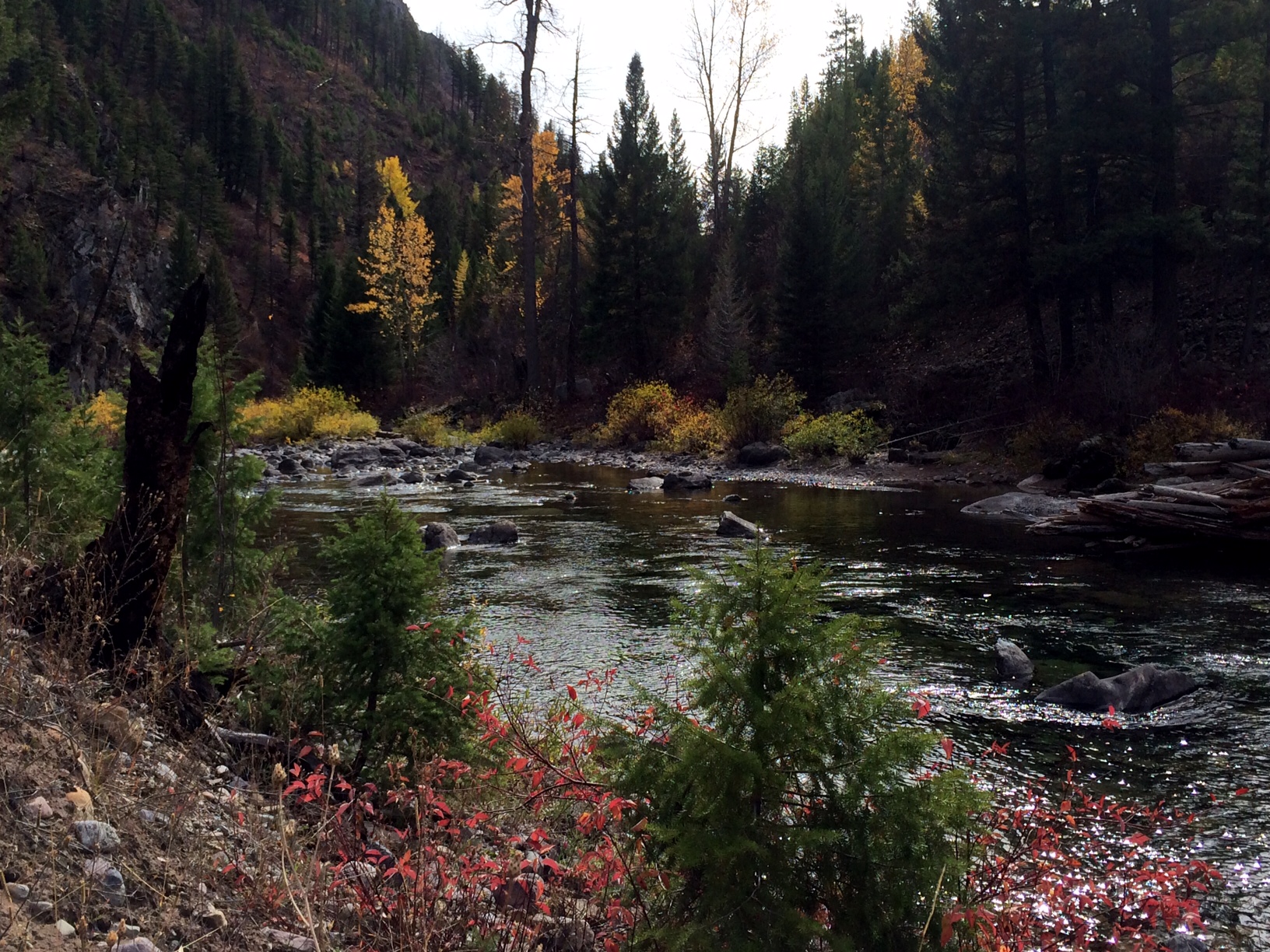
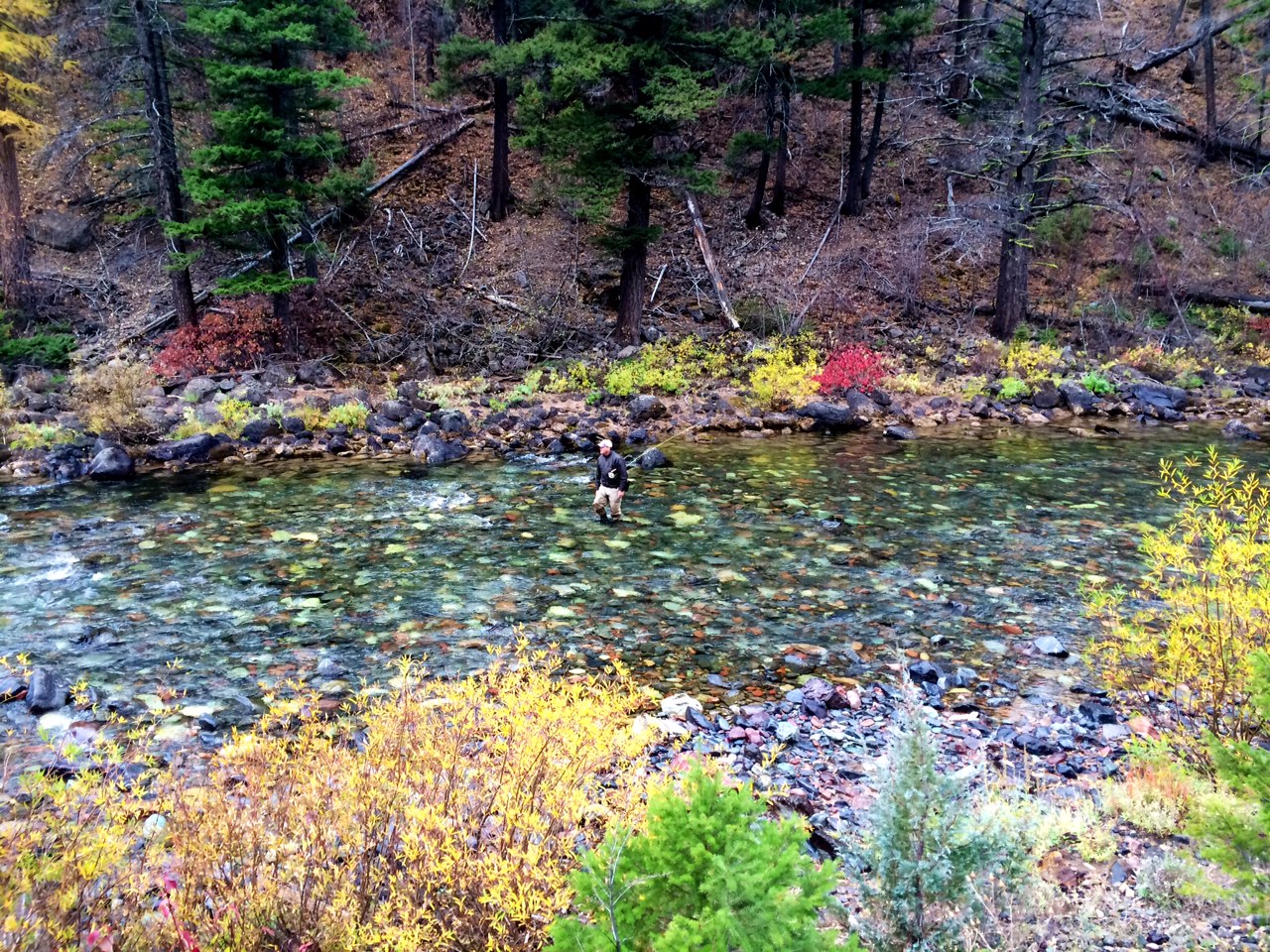
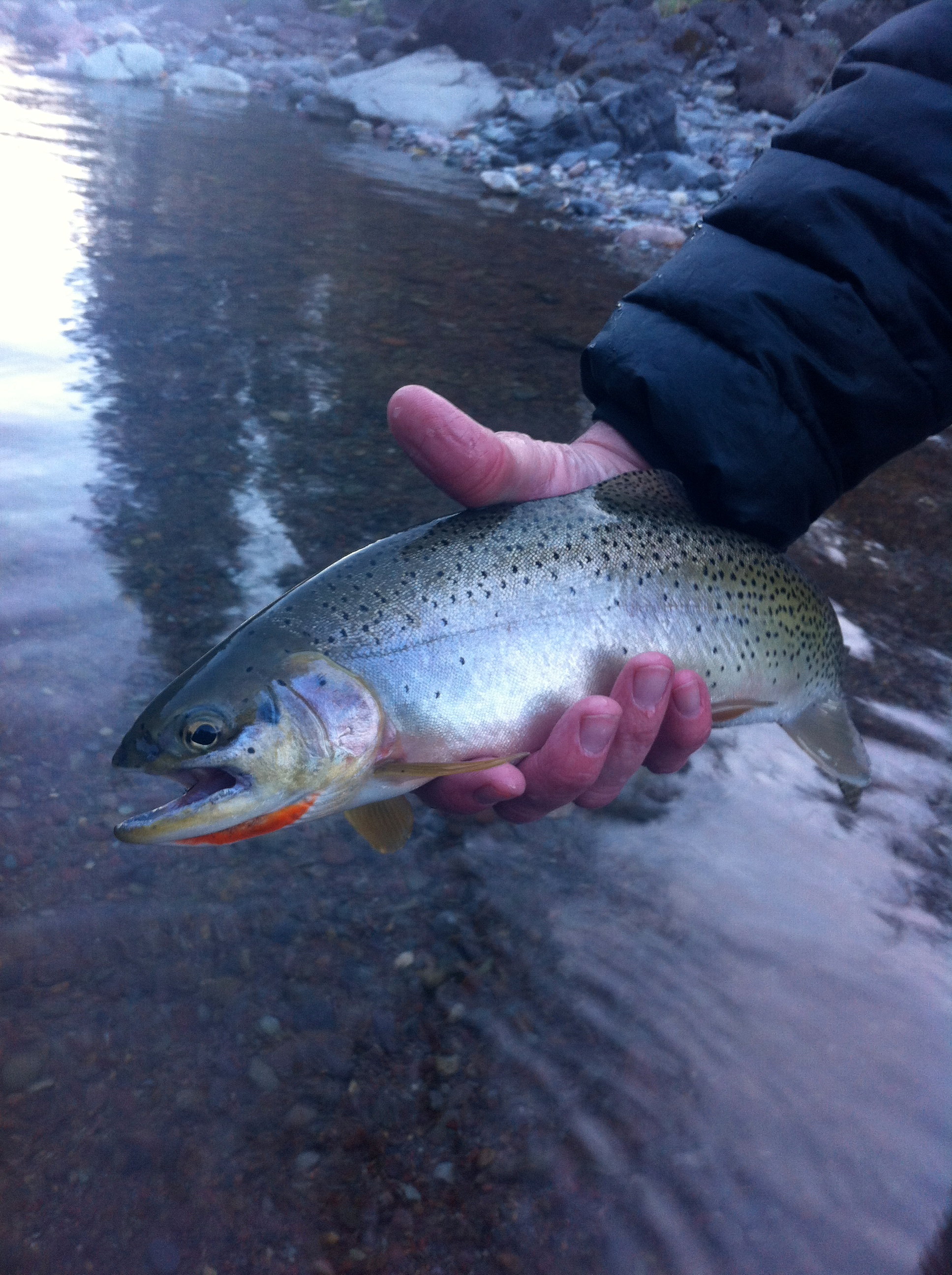
I spend a great deal of time near the North Fork of the Big Blackfoot, as our family cabin is in the area. And, indeed, I drive along the main river, via Highway 200, to visit friends on the Blackfeet Reservation or on the Canadian reserves. The North Fork remains the powerful river described by Lewis over two hundred years ago. And the drainage remains a lively place, populated by all of the flora and fauna recorded by Lewis and many other plants and animals as well (including trout). It is a particularly pretty place during the fall. For this reason, I share a few pictures taken during my latest visit (the trout picture was taken my by friend, Bill Gregory).

photo bill

trout

A Father’s Songs and a Daughter’s Memoir

September 27, 2014
Stoddart

Thomas Tod Stoddart, as pictured in Angling Songs.

In 1889, Anna M. Stoddart published a loving memoir of her father, Thomas Tod Stoddart (1810-1880),  along with a collection of verses written by him (some of which were previously published).  Most of these verses have to do with fishing.  Thomas Stoddart was licensed to practice law, but he seems to have spent most of his life writing and engaged in fishing and fishing related activities. He was particularly involved in conservation. Living in Kelso, Scotland, the Rivers Tweed and Teviot received most of his attention. Besides his writer daughter, he had two other children-both boys. To illustrate how seriously the senior Stoddart took his identity as an angler, daughter Anna writes:

My father called one day on Henry Glassford Bell, and the genial Sheriff hailed him with the very natural question, “Well, Tom, and what are you doing now?” With a moment’s resentment, my father brought his friend to his bearings. “Doing? Man, I’m an angler.”

Angling Songs, with a Memoir

Angling Songs, with a Memoir

I can relate to Thomas Stoddart, as he responds to Bell. If my own daughter were ever to write a memoir about me after my death, she might very well include a similar story, to illustrate just how passionate about fly fishing I was. She could not describe me as a poet, however; in that way I am different from Thomas Stoddart.  Thus, due in part to my own lack of talent, I include two of the “songs” written by Thomas and published by Anna in Angling Songs, with a Memoir.

THE FAIRY ANGLER

I.
‘Twas a bland summer’s eve, when the forest I trod;
The dew-gems were starring the flowers of the sod,
And “faire mistress moone,” as she rose from the sea,
Shed apart the green leaves of each shadowing tree.

II.
I passed by a brook, where her silvers lay flung,
Among knolls of wild fern it witchingly sung,
While a long fairy angler with glimmering hand
From the odorous banks waved her delicate wand.

III.
In silence I watched, as with eager intent
O’er the moon-silvered water she gracefully bent,
And plied with green rush-rod, new torn from its bed,
Her line of the thorn-spider’s mystical thread.

IV.
A pannier of moss-leaves her shoulder’s bedecked,
The nest of some bird, with the night winds had wrecked,
Slung round with a tendril of ivy so gay,
And a belt of stream flowers bound her woodland array.

V.
No snow-flake e’er dropped from its cloud on the brook
So gently impelled as her moth-plumaged hood;
The pearl-sided parlet and minnow obeyed
The magical beck of that wandering maid.

VI.
And aye as her rush-rod she waved o’er the rill,
Sweet words floated round her, I treasure them still,
Tho’ like a bright moon-cloud resolved in the air,
Passed from me, regretted, the vision so faire.

THE RIVER

I.
Through sun-bright lakes,
Round islets gay,
The river takes
Its western way,
And the water-chime
Soft  zephyrs time
Each gladsome summer day.

II.
The starry trout,
Fair to behold,
Roameth about
On fin of gold;
At root of tree
His haunt you may see,
Rude rock or crevice old.

III.
And  hither dart
The salmon grey,
From the deep heart
Of some sea bay;
And herling wild
Is beguiled
To hold autumnal play.

IV.
Oh! ’tis a stream
Most fair to see,
As in a dream
Flows pleasantly;
And our hearts are woo’d
To a kind of sweet mood
By its wondrous witchery.

University Course: “Salmon and People”

September 18, 2014

I am sharing the flyer for a course that a colleague in anthropology is teaching. She is an archaeologist, but she is offering a comprehensive look at the place of salmon in Pacific and Inland Northwest cultures, both Native and non-Native. She has worked closely with Nez Perce representatives to incorporate contemporary Native views. All in all, it’s an impressive course.  In fact, it would be nice to see more classes that focus upon such basic, yet essential topics. Academic theories are important devices through which to understand human perception of the world. But discussions should always start with the tangible things in life.Salmon

Adventure Books

August 28, 2014

In January of 2003, Outside Magazine published a list of recommended “adventure” books, in an article titled “The 25 (Essential) Books for the Well-Read Explorer.” Antoine de Saint-Exupéry’s Wind, Sand, and Stars, published in 1939 (first in French and then in English, in the same year), was at the top of their list. In the article, Brad Wieners describes Saint-Exupéry’s classic:

Antoine de Saint-Exupéry

Antoine de Saint-Exupéry

Wind, Sand and Stars is so humane, so poetic, you underline sentences: “It is another of the miraculous things about mankind that there is no pain nor passion that does not radiate to the ends of the earth. Let a man in a garret but burn with enough intensity and he will set fire to the world.” Saint-Exupéry did just that. No writer before or since has distilled the sheer spirit of adventure so beautifully. True, in his excitement he can be righteous, almost irksome like someone who’s just gotten religion. But that youthful excess is part of his charm. Philosophical yet gritty, sincere yet never earnest, utterly devoid of the postmodern cop-outs of cynicism, sarcasm, and spite, Saint-Exupéry’s prose is a lot like the bracing gusts of fresh air that greet him in his open cockpit. He shows us what it’s like to be subject and king of infinite space.

I have written before about Saint-Exupéry, and I’m happy that Outside included one of his books in their list (he is, most famously, the author of The Little Prince). Truly, Wind, Sand and Stars conveys a sense of what most of us would describe as adventure. However, the books that Outside recommended, and which other publication have recommended in similar lists, might better be classified as “environmental” or “outdoor literature.” After all, “adventure” is a term that is as hard to define as “art,” “nature,” or “love.”

Regardless, if  you find yourself house-bound or otherwise restricted from enjoying the outdoors yourself,  you can find some fine reading material in Outside’s old list. By using the search function on their webpage, you can locate several other lists of recommended readings as well. Also, take a look at the extensive list of “adventure” books published online by National Geographic in 2004 (notice, there is a link to more recent recommendations at the bottom of their webpage).


Tom Morgan Rodsmiths and Religion

August 4, 2014

CBS Evening News has done an On the Road segment, entitled “Legendary Fishing Rod Creator shares a Special Secret,” on Tom and Gerry Morgan, of Tom Morgan Rodsmiths.  It is always interesting to see such stories in the mainstream media. In this particular case, the commentator, Steve Hartman, makes reference to the connection between religion and fly fishing that so many writers have claimed for so many centuries. Sadly, though, Hartman then describes a Tom Morgan rod as the “Holy Grail.” Of course, those who attribute deep meaning to fly fishing are inspired to do so by the experience, not the sometimes very expensive tackle. The commentator’s view reflects our society’s misplaced obsession with material wealth. No doubt, this obsession is often brought to the sport by certain tackle collectors and even by those who seem more concerned about what they look like on the stream than they are with the water and the life all around them. The inherent value of the living environment is so much greater that the merely symbolic value of our possessions.

Taken by Fairies and Fishing

July 11, 2014

Walter Yeeling Evans-Wentz (1878-1965) wrote his doctoral dissertation at Oxford University on Celtic views of and practices associated with “fairies.” He later expanded his work and published it as The Fairy-Faith in Celtic Counties, in 1911. He was undoubtedly influenced by the romanticism that also influenced mentor and poet William Butler Yeats and so many other Irish and other Northern European intellectuals at the time.  This romanticism is very evident in The Fairy-Faith, manifested in a great number of biases both in the ethnography and its interpretation.  Evans-Wentz was also influenced by mysticism, as presented by the American philosopher and psychologist William James, another of his mentors. And yet, Evans-Wentz displays a remarkable desire to take seriously the Celtic views of and practices surrounding fairies, which were and are dismissed by so many. This desire led him to record an immense amount of information presented directly from informants of Celtic descent in Ireland, Scotland, Isle of Man, Cornwall, and Brittany. So, while we might set aside many of his interpretations, and while we must also treat the quotations of his informants (particularly those translated from Gaelic languages) with caution, there is much to be gleaned from The Fairy-Faith.  Moreover, it is simply a fascinating read, for those of us who love the green, misty, mountainous places that Evans-Wentz’s informants associated with fairies.

Evans-Wentz later went on to work on Tibetan Buddhism, popularizing its study among European and American academics. His work there, too, must be treated cautiously, as his attitudes toward Tibet and Buddhism were perhaps even more romantic than his attitude toward Celtic views and practices.  This is partly due to the fact that “Madame” Helena Blavatsky’s imaginative, Asian and Spiritualist influenced “Theosophy” was a significant part of his life.

Walter_Evans-Wentz_and_Lama_Kazi_Dawa_Samdup_photographed_circa_1919

While Evans-Wentz apparently spent a great deal of time on the banks of the Delaware River as a boy — even claiming to have had an “ecstatic” experience there — I do not know if there is direct evidence of him having been a fisherman, as his mentors Yeats and James certainly were. However, the Celtic informants whose voices are recorded in his first book, spoke often of fish in their broader discussions of fairies and other non-human persons that animated their landscapes. And it is these voices which interest me the  most.

Following, is a “testimony” about the fairies that Evans-Wentz  attributes to an anonymous “Peasant Seer” in County Sligo, Ireland:

Another time I was alone trout-fishing in nearly the same region when I heard a voice say, “It is — barefooted and fishing.” Then there came a whistle like music and a noise like the beating of a drum, and soon one of the gentry came and talked with me for half and hour. He said, “Your mother will die in eleven months, and do not let her die unanointed.” And she did die within eleven months. As he was going away he warned me, “You must be in the house before sunset. Do not delay! Do not delay! They can do nothing to you until I get back in the castle.” As I found out afterwards, he was going to take me, but hesitated because he did not want to leave my mother alone.

trout

As it does for the informants met by Evans-Wentz over a  hundred years ago, going trout fishing or simply going to the places where trout are found, feels like a sort of boundary crossing to me. There is a sense, too, of being taken or, more precisely, not wanted to return back across the boundary.  Mind you, I am not one to draw a hard distinction between nature and culture or even so-called “super-nature.”  I am not speaking, then, of entering and wanting to remain in another reality.  Rather, fishing for me simply involves entering an area dominated by others–the fish, bears, birds, and perhaps even fairies, though I have yet to meet one of the latter (there are, however, many traditions among Indigenous Americans that involve little people and other human-like beings, both malevolent and kind).

Regardless, my thoughts are often focused upon the very animated world around me, when I am visiting trout streams and their environs.  I know that I am not alone in this.  As evidence, I present a picture of a fairy house made by my wife, at our cabin, while I was catching the sort of fish that you will see in the picture above. Perhaps my wife’s purely artistic creation of the fairy house will serve to propitiate any other-than-human beings, who might be responsible for my often feeling “taken” with fly fishing.

House

Walton / Cotton Fishing Hut for sale

June 21, 2014

From the Trout School blog, comes news of Cotton’s and Walton’s fishing cottage being put on the market.

Brandon Simmons's avatarTrout School

Walton Fishing Hut

Izaak Walton’s fabled fishing hut is for sale. Its hard to believe such an icon of our fishing heritage is on the market.

The hut was built in 1674,  20 years after the first publication of The Compleat Angler, and 2 years prior to the 5th edition which included Charles Cotton’s fly fishing chapters. The hut was built by both men and includes their initials over the entrance.

I am surprised the Houghton Club (on the Test) or the Anglers’ Club (in London) can’t pony up £450,000 (~$750,000) for the hallowed property and the 3km private river access to the Dove.

Link to the Real Estate listing- the pictures are worth viewing.

View original post