Archive for the ‘The Environment’ Category

Kiss the Water Film Review

October 11, 2013

Recently, I noted that a film about the eccentric and revered Scottish salmon fly tier Megan Boyd, titled Kiss the Water: A Love Story, will soon be released to the public. The director and coproducer Eric Steel (with Kate Swan), very kindly let me preview the movie. I enjoyed the film immensely, and I want to share my impression of it here, in hopes that others will see it as soon as they can.

Megan Boyd spent much of her life living alone in the village of Kintradwell, near the River Brora, in the North West Highlands of Scotland. She did not fly fish, herself, but as a child she learned to tie flies for her father — a riverkeeper — and his friends. Her skill in tying made her flies popular among locals and eventually among fly fishers throughout the world.  Prince Charles was, perhaps, the most famous admirer and user of her flies. Boyd’s reputation as a fly tier was so great that she was memorialized in a New York Times obituary upon her passing in 2001. In fact, it was this obituary that inspired Eric Steele to make Kiss the Water even though, like Boyd, he does not fly fish.

Steele’s finished film is a piece of art, in itself. The movie tells the story of Boyd’s life through a series of interviews with close friends, fly tiers, and others.  The narrative is woven together by a strand of truly amazing animation by  Em Cooper, Sharon Liu, and Veseslina Dashinova of the Film Club Productions studio. The music, by composer Paul Cantelon, complements the interviews, the scenes of nature in Scotland, and the animation perfectly.  Of course, the music is wonderful in its own right, as well.

Boyd’s story, as told by Steel, is so compelling that Kiss the Water should appeal to a wide variety of audiences, well beyond those composed of fly tiers and fly fishers.  It touches upon the themes of artistic genius, nature and ethics, and much more.  Needless to say, the film addresses Boyd’s eccentricity as well. Yet it does so in a loving and understanding way. For instance, one interviewee acknowledges that Boyd “preferred the solitude.”  But then he adds, “And she was never alone. … She had her seasons. You know?”

You can visit kiss-the-water.com to learn more about Kiss the Water, to see the screening schedule and, eventually, to buy your own copy. This weekend, you can see it at the Hamptons International Film Festival in Sag Harbor and East Hampton, New York and at the Hot Springs Documentary Film Festival in Hot Springs, Arkansas. The trailer for the film is below.

Kind Words, Special Places

September 26, 2013
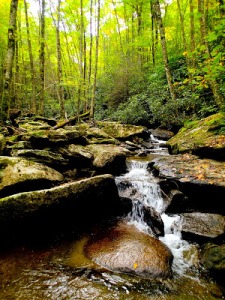
Photo by Mike Seplelak.

Photo by Mike Sepelak.

I fished the other day in a special spot, with a good friend.  Today, in his blog, Mike’s Gone Fishin’ … Again” he reflects upon place and, very kindly, friendship.  Mike is not only a gifted writer, he also takes some great  pictures.  Check out his latest blog entry here: http://www.mikesgonefishing.com/2013/09/i-forget.html.

Waiting, not impatiently.

August 16, 2013

Waiting


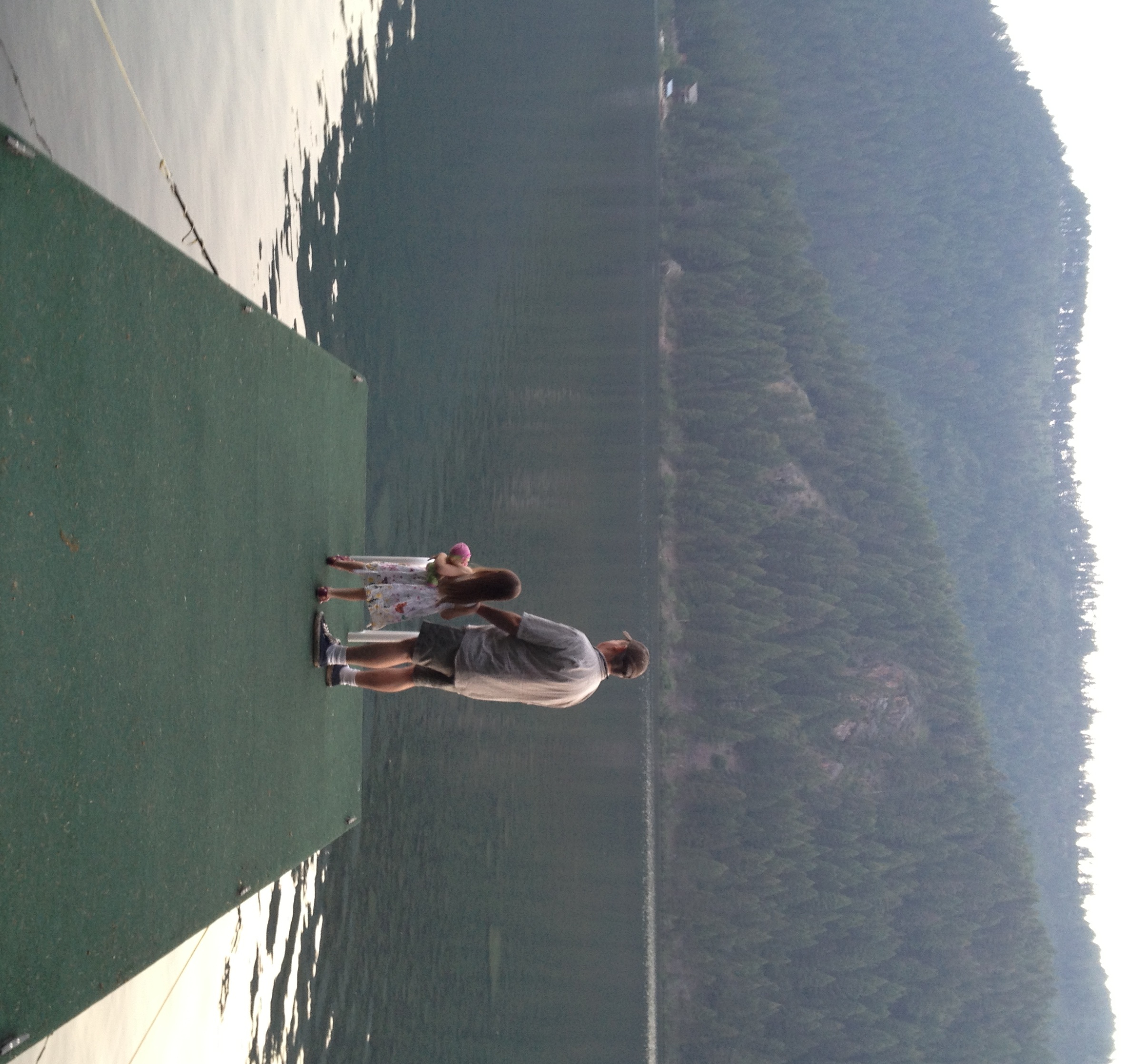
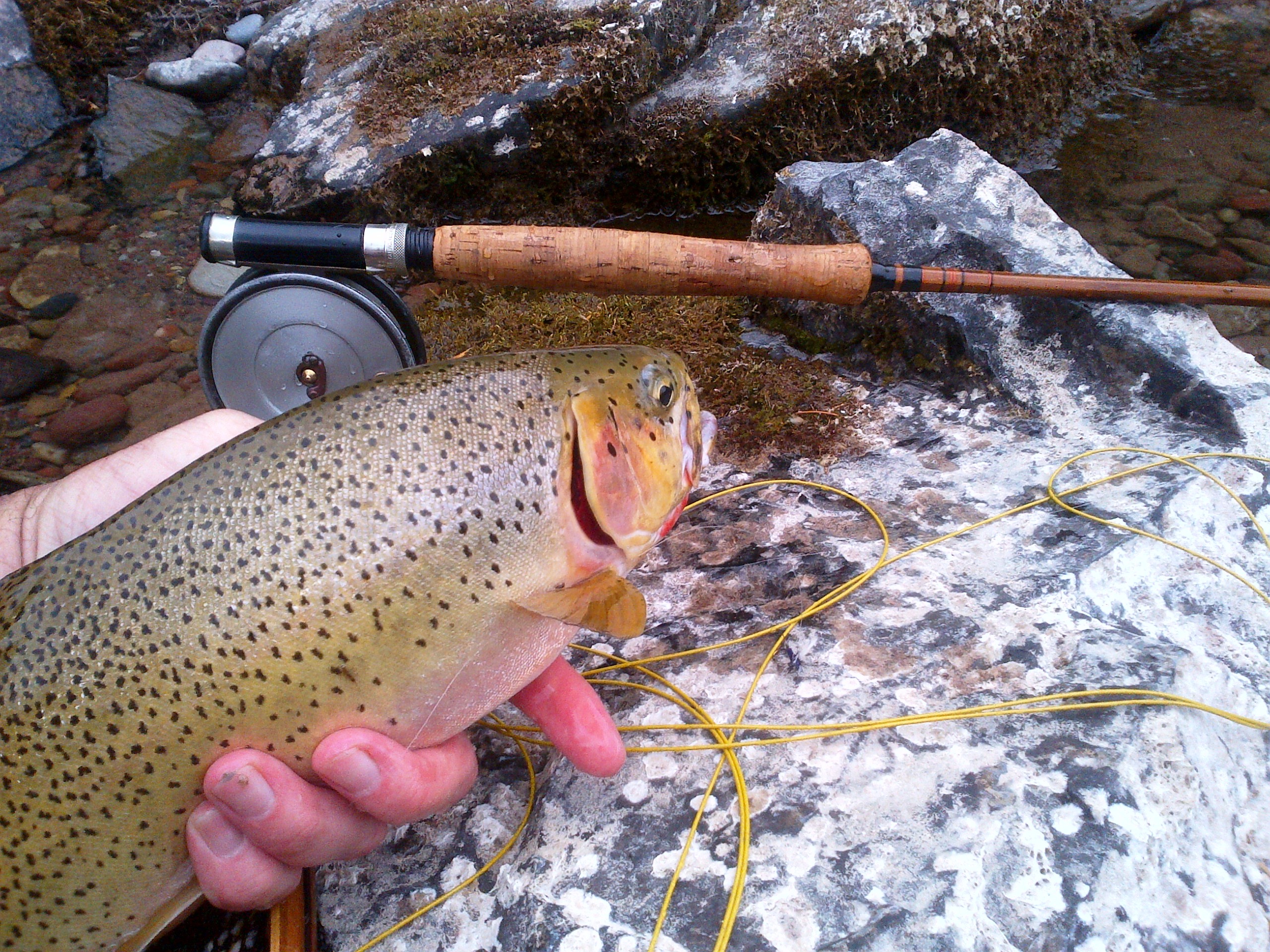
At our family cabin, I spend a lot of time looking out at the lake in the evenings, waiting to spot rising cutthroat trout. In the dog days of summer, the wait can be long. There have been, and still are, times when the wait is difficult, due to my eagerness to fish. However, watching the activity on and around the lake with my daughter, her hand in mine, makes for a very different experience. The wait almost disappears altogether, and the time becomes one of appreciation for what already is.

I’m proud to have a three-year-old daughter who knows such things as the difference between a grizzly bear and a black bear. A daughter who knows the difference between a rod and a pole.  A daughter who knows what patience is and how one can best pass the time, when waiting at such places as our cabin.  I have taught her some of these things.  But she has taught me others.

The things you find, when you’re not even looking ….

August 9, 2013

My wife and I have been exploring Washington State University and the surrounding communities this past week. We have been considering relocating and taking jobs at WSU.  Of course, I sought out some fly fishers to get as much information as possible about local fishing (the answer, in short: lots of steel head).

One of the fly fishers with whom I spoke mentioned that the WSU library had one of the largest collections of angling literature in the world. Since I had never heard this before, I was a bit skeptical. So, after a meeting today, I swung by the Manuscripts, Archives, and Special Collections Department in library.

Sure enough, WSU received 15,000 volumes over the past two years, donated by Joan and Vernon Gallup (no doubt, many of you already knew this). These, as yet, mostly uncatalogued texts will be added to the existing collections of angling and other outdoor literature. I direct you to a news release published by the International League of Antiquarian Booksellers, since ILAB is such a strong source of information on these matters: “Largest Rare Book Collection ever Donated to Washington State University.” While the Gallups are described in this and other news releases as Spokane residents, my understanding is that the collection may have been housed at their home in Bigfork, Montana.

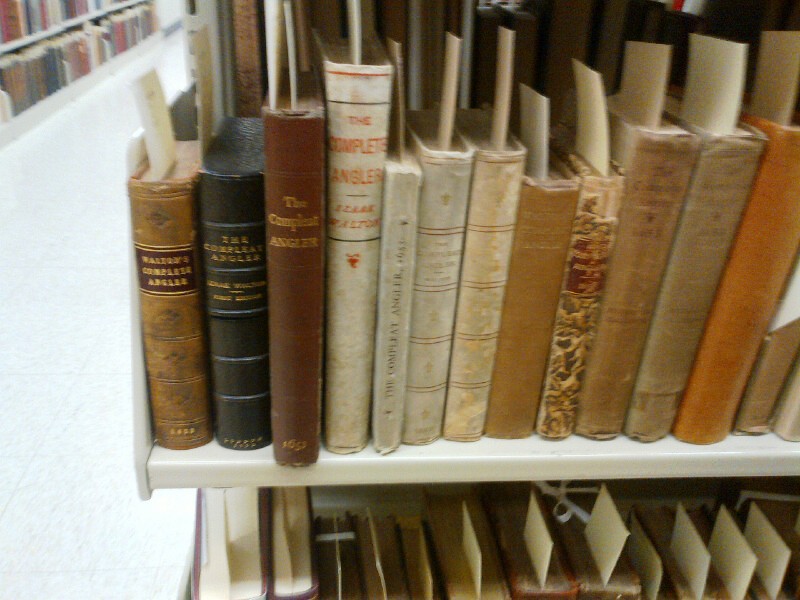
I was stunned by some of the titles found in WSU’s storage stacks. The number of editions of the The Compleat Angler alone is absolutely staggering. When I woke up this morning I had no idea I would be perusing two first editions (1653) of Izaak Walton’s masterpiece by the end of the day.

Two first editions of The Compleat Angler, on the far left (one rebound and the other in a black clamshell box)

Two first editions of The Compleat Angler, on the far left (one rebound and the other in a black clam-shell box).

Freedom and Wildness

August 8, 2013
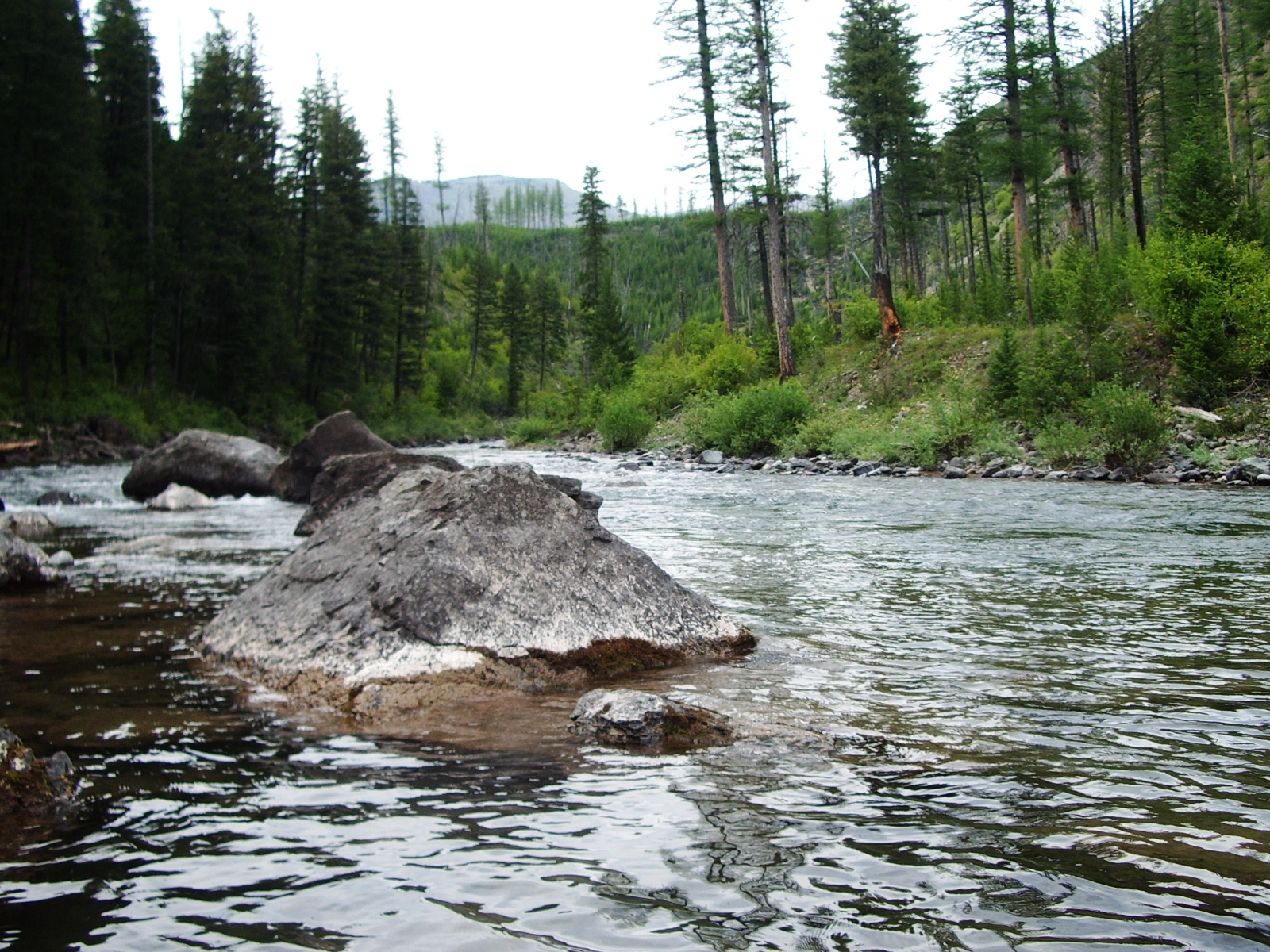
My "home water," flowing from the Scapegoat Wilderness in Montana.

My “home water,” flowing from the Scapegoat Wilderness in Montana.

“The Peace of Wild Things.”

When despair for the world grows in me
and I wake in the night at the least sound
in fear of what my life and my children’s lives may be,
I go and lie down where the wood drake
rests in his beauty on the water, and the great heron feeds.
I come into the peace of wild things
who do not tax their lives with forethought
of grief. I come into the presence of still water.
And I feel above me the day-blind stars
waiting with their light. For a time
I rest in the grace of the world, and am free.

Wendell Berry, from Collected Poems, 1957-1982.

A wild, native denizen of my "home water."

A wild, native denizen of my “home water.”

Robert and Penel: Antoine de Saint Exupery, Wildness, and Discovery

July 2, 2013

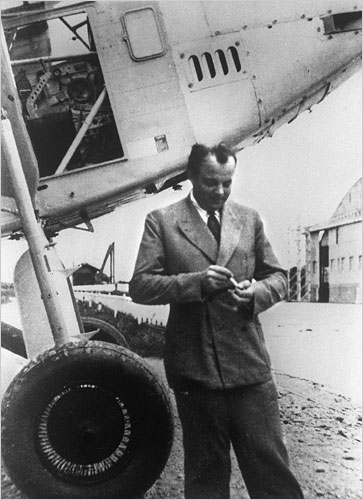
Years ago, my wife gave me a copy of Antoine de Saint Exupery’s The Little Prince, a book of which I was already a great fan.  Saint Exupery, of course, was a renowned French aviator and author.  He disappeared on July 31, 1944, while flying a reconnaissance mission for the Allies during the Second World War. He published The Little Prince, originally in French, just the year before.

Saint ExuperyAs far as I know, this artist and adventurer, pictured left, was not an angler.  It was a fisherman, however, who found a bracelet of his and, later, the wreckage of his plane, near Marseille in the late 1990’s.  According to a 2008 New York Times article by John Tagliabue, researcher Lino van Gartzen eventually located the aging, former German pilot who may have shot down Saint Exupery’s plane (“Clues  to the mystery of a writer pilot who disappeared”).  For years, this former pilot had supposedly been greatly troubled by the knowledge that he may have caused Saint Exupery’s disappearance.  He was a devoted reader of Saint Exupery’s writings before the war started. This, he claimed, was why he kept his wartime downing of a plane resembling Saint Exupery’s — near the time and location that the French pilot was believed to have disappeared — secret until van Gartzen found him. (There is some doubt that Saint Exupery was actually shot down, and it is possible that the German pilot shot down  different Allied aviator).  

The finding of Saint Exupery’s plane, the location of the man who may have downed that plane, and that man’s own realization that he may have been the cause of Saint Exupery’s disappearance all represent curious discoveries.  When I opened the copy of The Little Prince given to me by my wife, I made another discovery. Inside the cover was the following inscription, dated 7/5/87:

For Robert,

who understands that ‘what is essential is invisible to the eye’…you have tamed me, and I will cry, but it has been worth it–‘Because of the color of the wheat-fields’…

Once in a while, not too often, but now and then, dream of me, curling yourself in a knot around your pillow, or if it should be, around whoever you may be with, and, as you stand on the edge of waking and sleep, pretend that it is

-Penel, who loved you best—

The person who wrote this inscription for Robert, who was clearly a former lover, alludes to several passages in the The Little Prince. In particular, she refers to a passage that occurs when “the little prince” (Saint Exupery’s capitalization), who is an interplanetary traveler recently arrived upon earth, encounters a fox.  The fox warns the boy that he is not tame. The boy then questions the fox:

“What does that mean–‘tame’?”

“You do not live here,” said the fox. “What is it that you are looking for?”

“I am looking for men, said the little prince. “What does that mean–‘tame’?”

“Men,” said the fox. “They have guns, and they hunt. It is very disturbing. They also raise chickens. These are their only interests. Are you looking for chickens’?”

“No,” said the little prince. “I am looking for friends. What does that mean–‘tame’?”

“It is an act too often neglected,” said the fox. “It means to establish ties.”

“‘To establish ties’?”

“Just that,” said the fox. “To me, you are still nothing more than a little boy who is just like a hundred thousand other little boys. And I have no need of you. And you, on your part, have no need of me. To you, I am nothing more than a fox like a hundred thousand other foxes. But if you tame me, then we shall need each other. To me, you will be unique in all the world. To you, I shall be unique in all the world…”

Needless to say, the boy “tames” the fox and they grow to love each other very much.

In my view, an implication of the passage I have quoted is that life is characterized by wildness. For this reason, it is also characterized by constant discovery–the more unusual discoveries that one can find in such places as books–and, of course, the discovery of love. As evidence of the latter I think of the discovery and eventual loss of love between Robert and Penel and the “little prince” and the “fox.”  I think too of the discovery of love between my wife and I, which I already know is much more enduring. A common fact associated with all these discoveries, as different as they are, is that they keep the world an interesting place and make our lives within this world worth living.

Maclean and Bachelard: Words, Water, and Life

June 9, 2013

Eventually, all things merge into one, and a river runs through it. The river was cut by the world’s great flood and runs over rocks from the basement of time. On some of the rocks are timeless raindrops. Under the rocks are the words, and some of the words are theirs.

Norman Maclean, A River runs Through It and Other Stories, 104.[1]

Liquidity is a principle of language; language must be filled with water.

Gaston Bachelard, Water and Dreams, 192.[2]

maclean

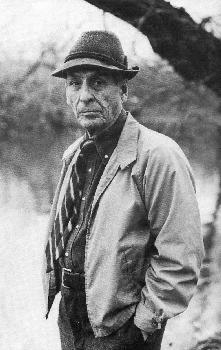
Norman Maclean

Those who have read Norman Maclean’s A River runs Through It know that the passage quoted above alludes to conversations between Maclean and his minister father about the very basis of reality. As Christians, they refer to the Book of Genesis, from the Hebrew Bible or Christian Old Testament, which explains that in the beginning of time there was only “spirit” and “water.”[3] They also refer to John 1:1, from the Christian New Testament. This verse reads, “In the beginning was the Word, and the Word was with God, and the Word was God.” Thus, Maclean and his father seem to be engaging in the same debate in which so many “Western” philosophers of language have also engaged: is there a physical reality beyond the words that allow us to discuss existence, or is language completely metonymic—is the world made real through language?

I don’t have an answer to such questions, though I do know that most mainstream Europeans and North Americans overlook the immense power and importance of language. Norman Maclean, as evidenced in his famous story, does not. He suggests at the end of A River, in the passage quoted above, that there is a mutually dependent relationship between language and reality: the words are under the rocks, and yet some of the words belong to the rocks.

What is just as important, though, is Maclean’s emphasis upon water. All things “merge” in the running waters of “the river.” Water is thus a metaphor, in Maclean’s mind, for the connections that are made possible in the physical world through the use of words—through language.

A River runs Though It is, of course, something more than mere words. It is both poetry and narrative. Both of these types of language are ideally full of movement. They work against reification. A story moves from beginning to end, and poetry pushes against the rules of language that so often deplete it of vitality. Water, too, is full of movement.

This evening I was pulling some books by Mircea Eliade off a shelf, as I thought about my recent fly fishing trip to Romania. I noticed, one shelf up, a series of books by the influential French philosopher Gaston Bachelard. In these books, Bachelard reflects upon the relationship between language, imagination, and the physical elements. Not being particularly moved by Eliade tonight, I decided to browse through Bachelard’s book on water, which I have not read for many years. I came across the second quote provided in the epigraph to this post.

Bachelard

Gaston Bachelard

In addition to the quote above, Bachelard writes, “Liquidity is, in my opinion, the very desire of language. Language needs to flow.”[4] For Bachelard, poetry – ideal, creative poetry – is the language that best embodies liquidity. He seems to acknowledge that narrative can do so as well.

I think, then, that Bachelard and Maclean share the view that language and reality are mutually dependent. However, the language that gives life to our world is the language of movement. It is narrative and poetry.

Toward the end of Maclean’s book, he describes another conversation with his father. This one has to do with the tragic death of Maclean’s brother Paul:

Once, for instance, my father asked me a series of questions that suddenly made me wonder whether I understood even my father whom I felt closer to than any other man I have ever known. “You like to tell true stories, don’t you?” he asked, and I answered, “Yes, I like to tell stories that are true.”

Then he asked, “After you have finished your true stories sometime, why don’t you make up a story and the people to go with it?

“Only then will you understand what happened and why.”[5]

Of course, A River is the story that Norman eventually “makes up,” in order to understand the death of his brother. While the book is very nearly autobiographical, Maclean does change certain elements of the actual story his family lived. Perhaps doing so allowed Maclean to give new vitality to his brother.

Now, all of the preceding might be taken as mere ramblings, on my part, about some favorite books and topics. Largely, that’s exactly to what all those words amount. But let me make a final points. Reading authors like Bachelard and Maclean, as different as they are, and looking towards teaching found in texts like the bible and even more commonly in the oral traditions of indigenous peoples, reminds us that language is powerful and important. When used to its full potential, it shapes our worlds, at the very least. So take language seriously. Your life depends upon it.

IMG_0389


[1] Norman Maclean, A River runs Through It and Other Stories, Twenty-fifth Anniversary Edition (Chicago: University of Chicago Press, 2001).

[2] Gaston Bachelard, Water and Dreams: An Essay on the Imagination of Matter, trans. Joanne Stroud (Dallas, The Pegasus Foundation, 1983. Originally published in 1942 as L’Eau e le rêves, essai sur l’imagination de la matiére.

[3] I am using the RSV, simply because it is handy. Maclean, however, tells us that his father was reading the bible in Greek.

[4] Bachelard, 187.

[5] Maclean, 104.

Brothers of the Angle.

May 20, 2013

In other words, for those who have a religious experience, all nature is capable of revealing itself as cosmic sacrality.

Mircea Eliade, Romanian author and  historian of religion, The Sacred and the Profane (Harcourt, 1959), 12. While some of his theories are now questioned, Eliade had an immense influence upon the academic study of religion.

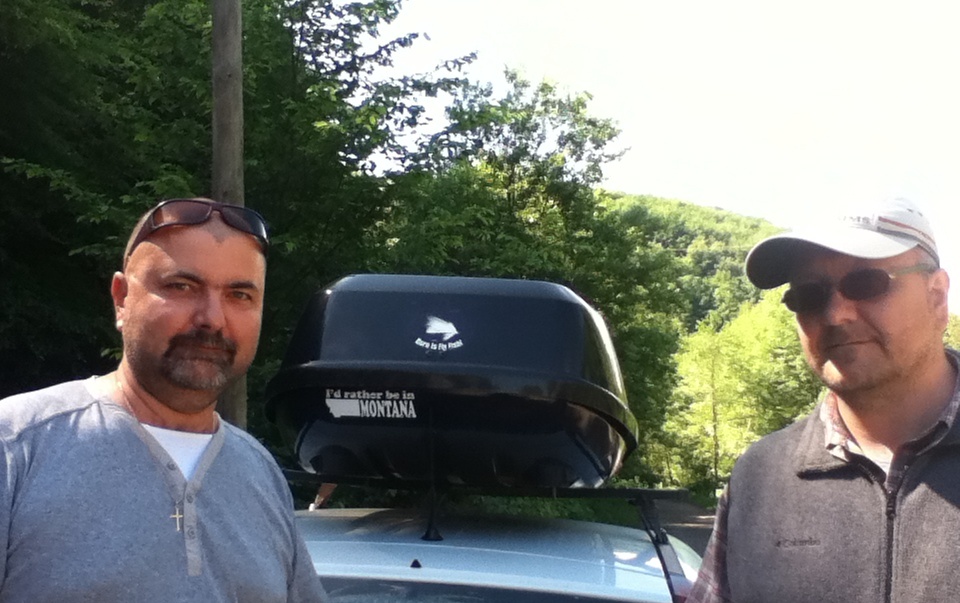
It has been a while since I have posted. I have been distracted by a variety of things, including fishing. For instance, last week I had the pleasure of meeting some people in Romania to fly fish. My thanks go to painter Claudiu Presecan, who helped arrange the trip, and to his gracious family. I extend thanks, also, to rod maker Paul Sas for fishing and keeping good company with Claudiu and me. Claudiu and Paul are fine men — great fishers and thoughtful human beings — and I look forward to spending more time with them in the future. I am also grateful to some of their fellow fly fishers in Transylvania, especially their friend Dan, who allowed us to spend a couple of nights in his cabin. Transylvania is a beautiful place.  Its people and wild salmonids are as well.

Transylvania.

Transylvania.

Transylvania.

Transylvania.

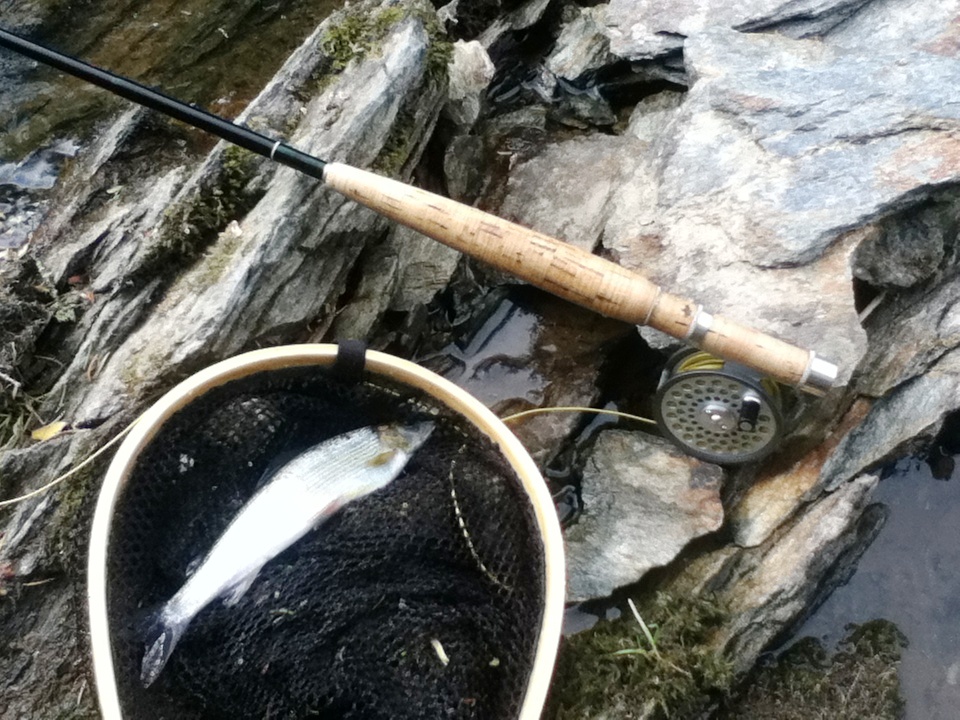
Wild grayling.

Wild grayling.

Claudiu and Paul

Claudiu and Paul.

I’ll write more about recent events soon.  At 5:00 tomorrow morning however, I will meet another friend here in Magyarorszag (Hungary) for a second days of fishing for asp on the Danube.

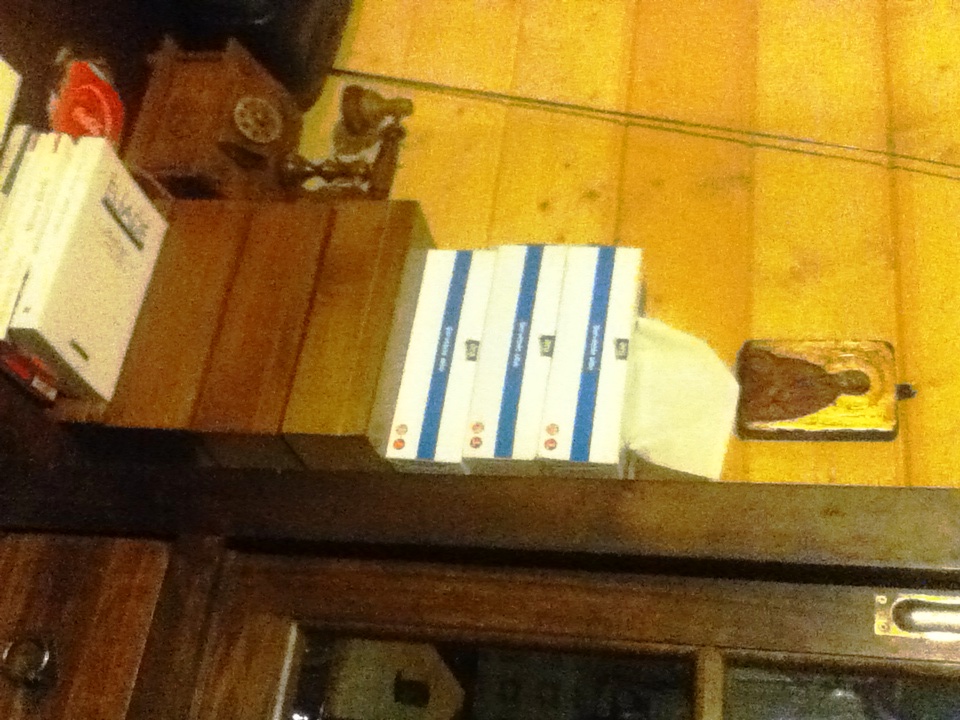
A fly rod, an icon, and a stack of books, by Mircea Eliade and Ioan Culianu, at the fishing cabin.

A fly rod, an icon, and a stack of books by Eliade and Culianu at the fishing cabin.

Local and Handmade (You don’t Hear it often Enough): Drawbaugh Outdoors Landing Nets

April 29, 2013

IMG-20130406-00049

IMG-20130406-00048

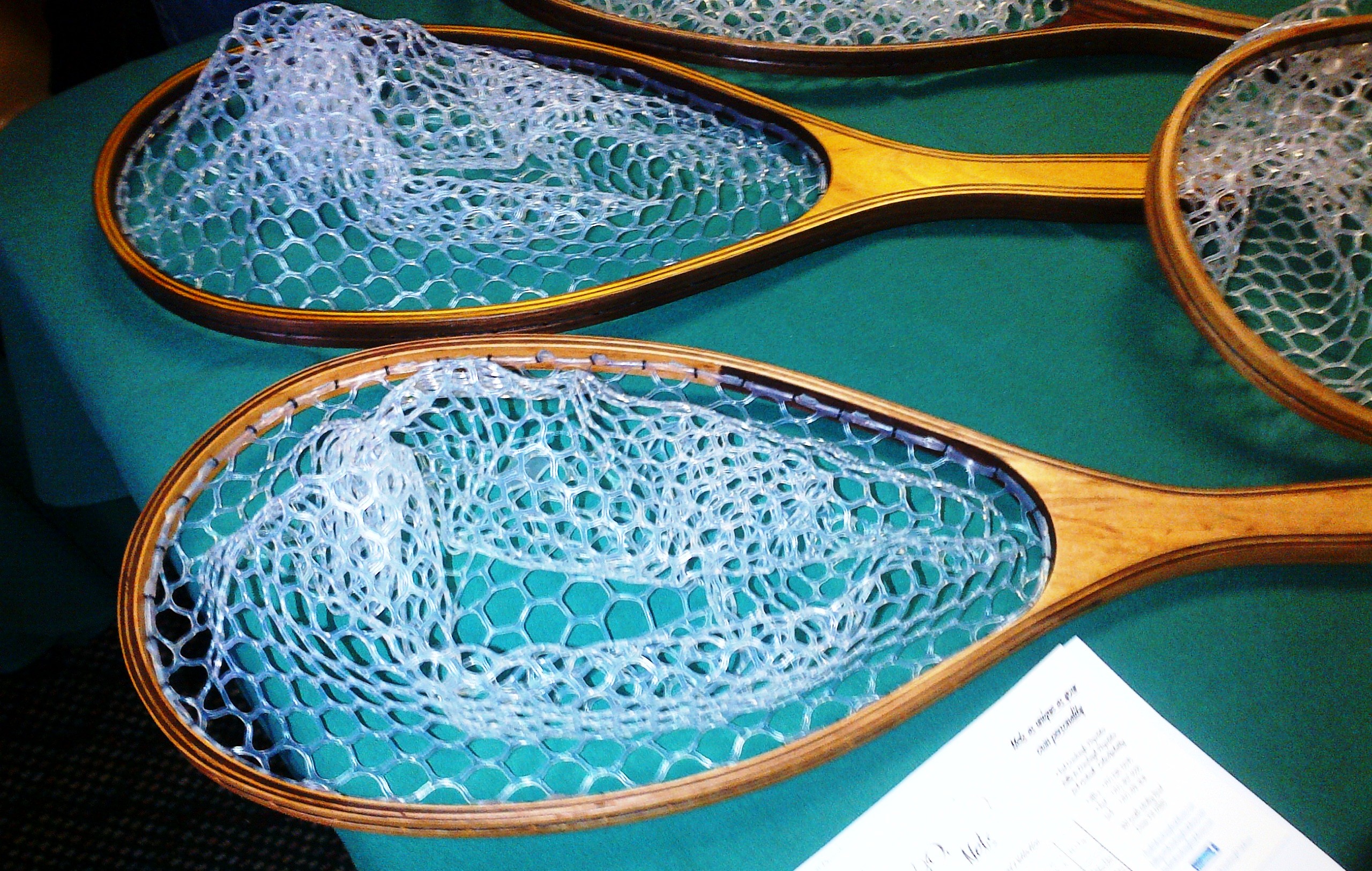
I recently went to the grand opening of the Pennsylvanian Fly Fishing Museum. There, I came across some wonderful landing nets from Drawbaugh Outdoors, based in Dover, PA. These beautiful nets are made by Chad and Billie Jo Drawbaugh (pictured), who are assisted in marketing and other matters by Jack Gotwalt.

The most obvious characteristics of D.O. Nets are their beauty and quality.  The picture above, which I took on my cellphone, does not do justice to them.  No doubt, if you contact Jack, Billie Jo, or Chad, they will be happy to provide you with better photos of their products. In such photos, you will see that D.O. nets are carefully constructed in pleasing and practical forms.

The fine construction of D.O. Nets contrasts greatly with that of many cheaper wooden and bamboo nets available today.  Looking at these latter nets, you can see with your own eye that they are often glued and varnished imperfectly.  Such problems in construction are no small thing; a few years back I picked up a cheap, wooden net after traveling to a fishing destination via plane.  During my trip, I stumbled and very briefly placed some of my weight upon the net. It broke and splintered in a break that was comparable to an explosion. I’m grateful that a portion of the splintered net didn’t pierce my upper arm, especially since I was fishing alone, in a remote area, in grizzly country. Of course, imperfect construction can lead to much more subtle problems, such as premature delamination (I say “premature” because even the finest nets should be treated with at least some care).

I am as impressed by the materials used in D.O. Nets as I am by their construction.  Chad and Billie Jo can make a net of whatever suitable woods that a customer prefers. Many fly fishers interested in handmade tackle prefer exotic woods.  I can understand this preference.  To me, though, fly fishing is largely about place.  It’s about getting to know a particular place–a particular ecosystem. This knowledge is necessary to successful fishing.  But appreciating a particular place is what makes it pleasurable.  Thus, I am most interested in tackle that reflects my relationship to the places I fish.  In other words, I prefer domestic and often local materials.  Drawbaugh Outdoors makes their standard nets of such woods.

My profession is not one that typically brings great wealth, to put it mildly. As a man of modest means, I am very mindful of what I pay for fly fishing related items. It’s true, of course, that quality products are generally more expensive than inferior ones.  And it’s also true that quality products will last much longer than inferior ones. Fortunately, D.O. Nets are both high quality and fairly priced.  And while I have yet to purchase my own, I am willing to bet that D.O. nets will serve you every bit as well or better than a more expensive one.  And, if you’re like me — if you are mindful of your relationship to place — the materials used in the nets might bring you some added pleasure too.

You can contact Drawbaugh Outdoors at 717-580-5595 or at info@drawbaughoutdoors.com.  You can also find them on facebook at http://www.facebook.com/DrawbaughOutdoors.  If you’re in the market for a landing net that is both beautiful and practical, get a hold of Billie Jo, Chad, or Jack.  They can provide you with a net that is suitable for landing anything from native brook trout to wild salmon and steelhead.  They offer both nylon and rubber “catch-and-release” netting material.

Short Reading List of Angling and other Environmental Literature. Recommendations?

April 24, 2013

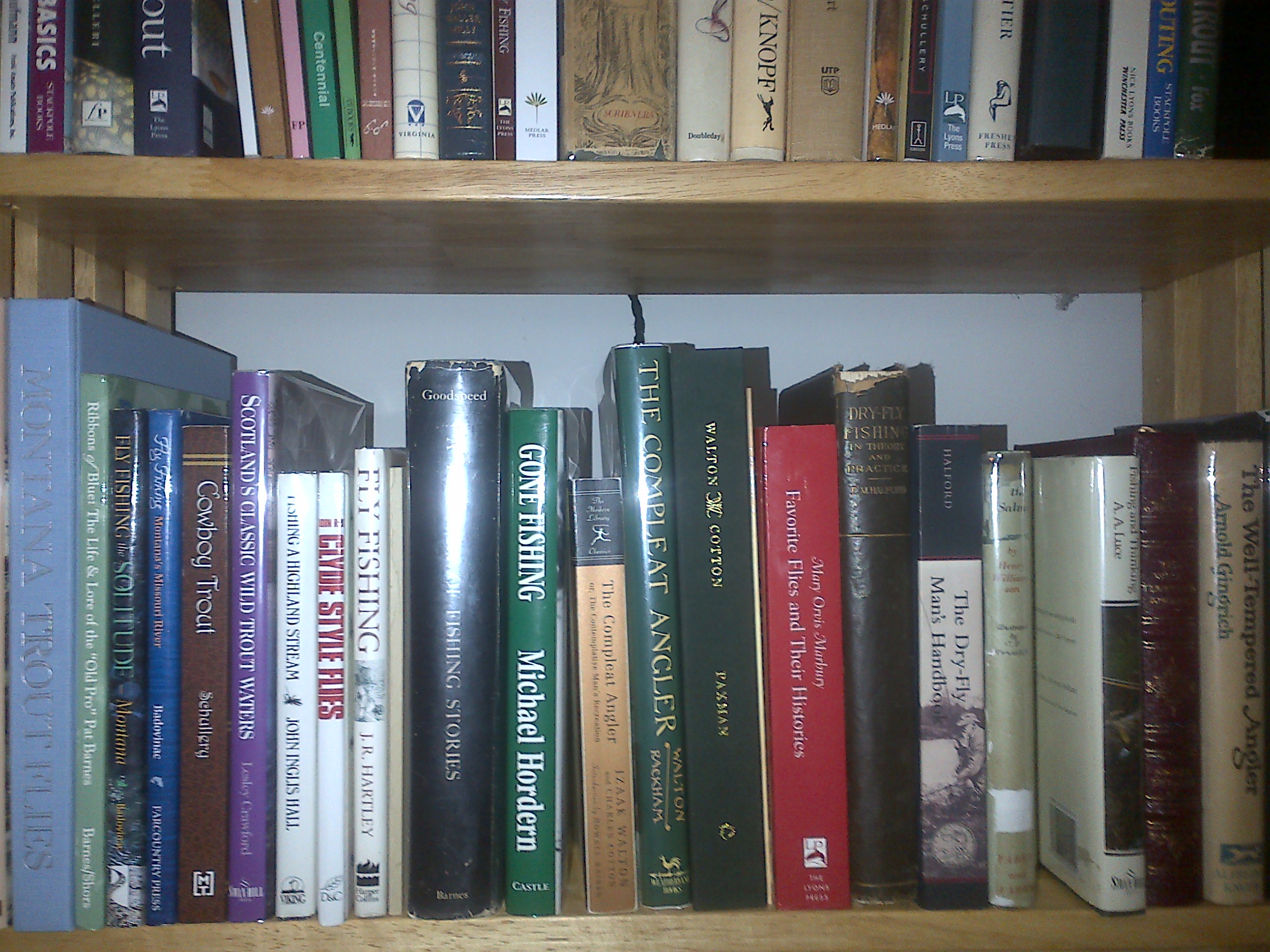
As the semester comes to a close, I am providing my “Religion, Nature, and Environment” students (the theme is fly fishing literature) with a bibliography of selected readings.  If you feel that there are any important texts that must be included in a reading list on the topics mentioned, please let me know. Of course, the wonderful texts we’ve already read in class are not included here.  Note that I will add titles, as I think of them and as they are recommended to me.
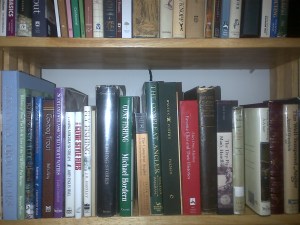
IMG-20130424-00094

Bibliography of Selected Angling, Environmental, and other Outdoor Literature (to serve as supplements to assigned readings).

RELI 438, Spring 2013

Henry David Thoreau, Walden, 1854.

Essays produced during transcendentalist Thoreau’s two-year stay at Walden Pond, in MA.

Antoine de Saint-Exupery, Wind, Sand, and Stars, 1939.

Early reflections by acclaimed aviator, best known for writing The Little Prince.

Beryl Markham, West with the Night, 1942.

Amazing memoir by aviation pioneer, who spent her childhood and young adult years in Africa.

Aldo Leopold, A Sand County Almanac, and Sketches Here and There, 1949.

Foundational book in American conservationism.

Heinrich Harrar, Seven Years in Tibet, 1952.

Austrian Mountaineer and Himalayan explorer (and then member of the Nazi Ahnenerbe) described his escape from Allied  internment in India, and subsequent years spent in Lhasa with the Dalai Lama (book was made into film starring Brad Pitt).

Henry Bugbee, The Inward Morning: A Philosophical Exploration in Journal Form, 1958.

Lyrical wilderness philosophy, in the existentialist vein, from University of Montana professor and angler.

Thomas Merton, Thoughts in Solitude. Farrar, Straus & Cudahy. 1958.

One of many books on contemplation by Trappist monk and nature mystic.

Rachel Carson, Silent Spring, 1962.

Book that helped launch the modern environmentalist movement.

John McDonald, Quill Gordon, 1972.

Historical essays on fly fishing literature by economist and Fortune magazine contributor.

Barry Lopez, Arctic Dreams: Imagination and Desire in a Northern Landscape, 1986.

National Book Award winner by prolific author of environmental literature.

Arnold Gingrich, The Fishing in Print, 1974.

Detailed, bibliographic tour of angling literature through the centuries, by founding editor of Esquire magazine and early promoter of Hemingway and others.

Robert Traver (John Voelker), Trout Magic, 1974.

Entertaining essays by circuit-court judge and famed author of Anatomy of a Murder.

Peter Mattheissen, The Snow Leopard, 1978.

Chronicles personal and professional Himalayan quest by founder of The Paris Review literary magazine.

Gaston Bachelard, Water and Dreams: an Essay on the Imagination of Matter,  1983 (orig. published in French, 1942).

Influential French philosopher and historian of science considers the epistemological significance (or significations) of water.  The text is part of a larger series.

Russell Chatham, Dark Waters: Essays, Stories, and Articles, 1988.

Successful artist and angler reflects upon past experiences and friendships with such figures as writer Richard Brautigan.

Harry Middleton, The Earth is Enough, 1989.

Moving memoir of a childhood spent with eccentric, fly fishing grandfather and uncle by the later nature writer, which now has a cult following.

Doug Peacock, The Grizzly Years: In Search of the American Wilderness, 1990.

Vietnam-era Special Forces medic retreats to the Glacier National Park area to find himself again and becomes grizzly expert along the way.  Peacock is the model for one of environmental writer Edward Abbey’s.

Pete Fromm, Indian Creek Chronicles: A Winter in the Wilderness, 1993.

Author leaves college to work alone in Idaho’s Selway-Bitterroot Wilderness.

Lyla Foggia, Reel Women: The World of Women who Fish, 1997.

Addresses various female figures in the world of fishing, from Juliana Berners to living individuals.

John Krakauer, Into Thin Air, 1997.

Book based upon tragic 1996 deaths on Mount Everest.  Krakauer was there as a journalist for Outside magazine.  He also authored Into the Wild.

Craig Nova, Brook Trout and the Writing Life, 1999.

Describes the place of fish and family in Nova’s early years as a writer.

Thomas McGuane, Some Horses: Essays, 2000.

Reflections upon individual horses loved and admired by McGuane.

Kathy Scott, Moose in the Water/Bamboo on the Bench : a Journal and a Journey, 2000.

Reflective essays upon craft[wo]manship and nature.

Thomas McGuane, The Longest Silence, 2001.

An acclaimed series of essays on angling by one of America’s best know Western writers.

Jamling T. Norgay, Touching My Father’s Soul: A Sherpa’s Journey to the Top of Everest, 2002.

Book by son of Tenzing Norgay, Sherpa who was first to summit Mt. Everest, alongside Sir Edmund Hillary.

 Yvon Chouinard, Let My People Go Surfing, 2005.

Patagonia’s founder explains how he came to understand that sustainable business can be profitable.

Steven Kotler, West of Jesus: Surfing, Science, and the Origins of Belief, 2007.

Book explores the phenomenon of “soul surfing,” and other forms of outdoor recreation often described as religious, from a biological perspective.

Wayne K. Sheldrake, Instant Karma: The Heart and Soul of a Ski Bum (Ghost Road Press, 2007).

Religiously oriented memoir of an avid skier’s early years.

Paul Schullery, Royal Coachman, 1999.

Essays on fly fishing history in the U.S.

Maximillian Werner, Black River Dreams, 2009.

Reflective, religiously oriented essays on angling by creative-writing professor.

Anders Halverson, An Entirely Synthetic Fish, 2010.

Highly acclaimed book on the role of non-native fish in changing the American landscape.

Erin Block.  The View from Coal Creek, 2011.

The writer describes her angling centered life in Colorado.

Eric Eisenkramer and Michael Attas, Fly-Fishing, the Sacred Art: Casting a Fly as a Spiritual Practice, 2012.

Co-authored by a Reform Rabbi and an Episcopal Priest/MD.