Archive for the ‘The Arts’ Category

How many Books are inspired by Television Commercials?

May 6, 2013

The popular Yellow Pages television commercial posted below aired in the UK in 1983.  Actor Norman Lumsden portrays JR Hartley, a man trying to locate a bookstore that stocks a book he wrote.

A 27 September 2009 article in The Telegraph, “Title Deed: How the Book got its Name,” by Gary Dexter, explains how the commercial led to a series of actual books authored by Michael Russel and published under the fictional Hartley’s name:

Fly Fishing was at first just a title: it appeared in the famous Yellow Pages ad in which an old man, one JR Hartley, makes telephone calls to bookshops asking for a book of that name and, after much searching, finally finds it and announces himself as its author. Then the sports-writer Roddy Bloomfield sensed an opportunity. He contacted a bona fide fly-fisherman, Michael Russell, to write the book of the ad, and in Christmas 1991 Fly Fishing by JR Hartley shifted an eye-watering 130,000 copies in hardback. It was followed by two sequels, JR Hartley Casts Again and Golfing by JR Hartley. Two other examples of ‘fictional’ titles spawning real books are L Sprague de Camp’s Necronomicon, drawn from the non-existent book by HP Lovecraft, and Philip José Farmer’s Venus on the Half-Shell, a realization of a fictional work by Kilgore Trout (himself the fictional creation of Kurt Vonnegut).

Despite the unusual source of inspiration for the book, Russel’s Fly Fishing, is really a great read. I recommend it very highly to fly fishers on non-fishers alike. Incidentally, the book and its sequels were best sellers.  The out-of-print Fly Fishing is now a collectible title.
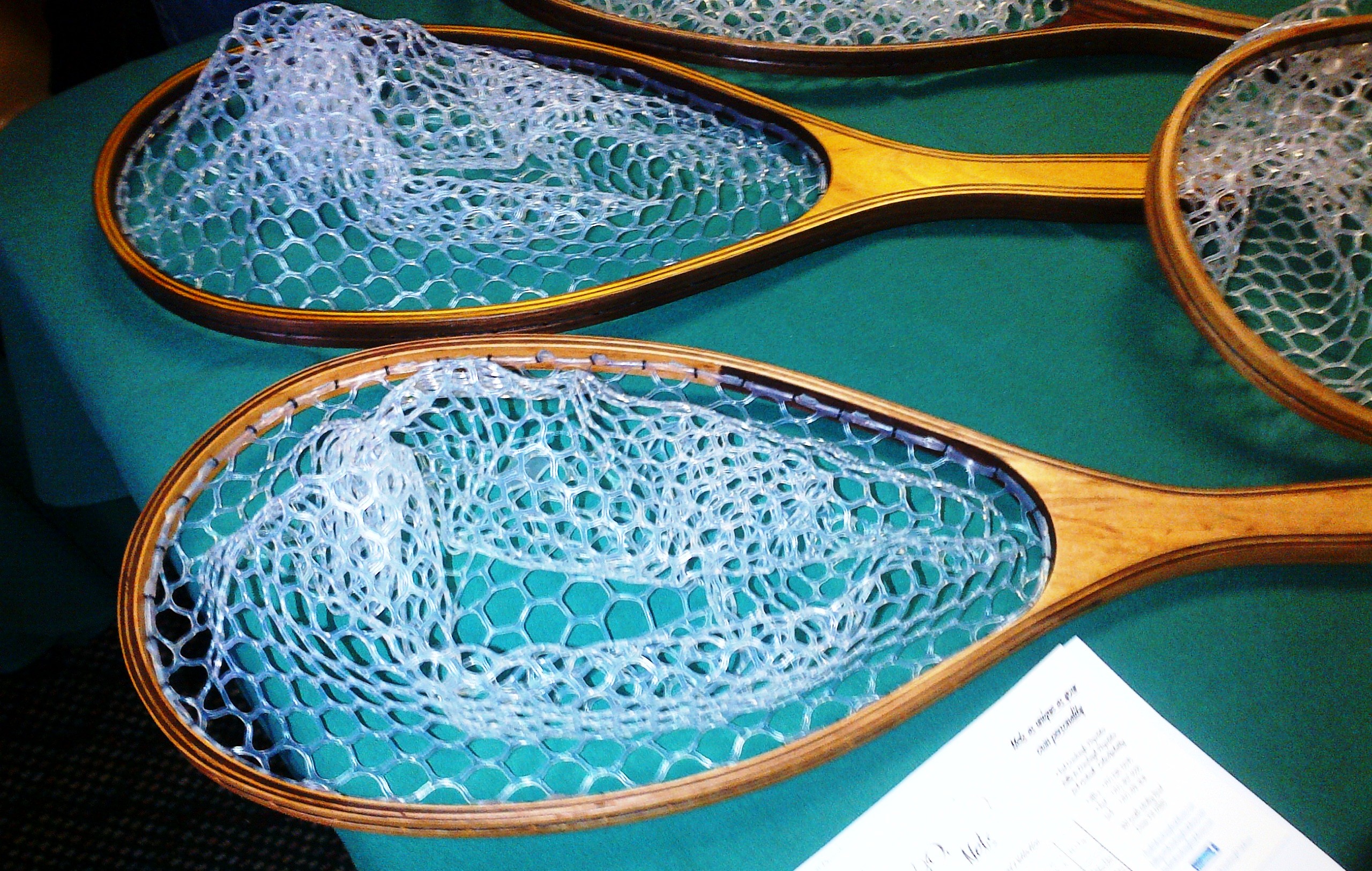
Local and Handmade (You don’t Hear it often Enough): Drawbaugh Outdoors Landing Nets

April 29, 2013

IMG-20130406-00049

IMG-20130406-00048

I recently went to the grand opening of the Pennsylvanian Fly Fishing Museum. There, I came across some wonderful landing nets from Drawbaugh Outdoors, based in Dover, PA. These beautiful nets are made by Chad and Billie Jo Drawbaugh (pictured), who are assisted in marketing and other matters by Jack Gotwalt.

The most obvious characteristics of D.O. Nets are their beauty and quality.  The picture above, which I took on my cellphone, does not do justice to them.  No doubt, if you contact Jack, Billie Jo, or Chad, they will be happy to provide you with better photos of their products. In such photos, you will see that D.O. nets are carefully constructed in pleasing and practical forms.

The fine construction of D.O. Nets contrasts greatly with that of many cheaper wooden and bamboo nets available today.  Looking at these latter nets, you can see with your own eye that they are often glued and varnished imperfectly.  Such problems in construction are no small thing; a few years back I picked up a cheap, wooden net after traveling to a fishing destination via plane.  During my trip, I stumbled and very briefly placed some of my weight upon the net. It broke and splintered in a break that was comparable to an explosion. I’m grateful that a portion of the splintered net didn’t pierce my upper arm, especially since I was fishing alone, in a remote area, in grizzly country. Of course, imperfect construction can lead to much more subtle problems, such as premature delamination (I say “premature” because even the finest nets should be treated with at least some care).

I am as impressed by the materials used in D.O. Nets as I am by their construction.  Chad and Billie Jo can make a net of whatever suitable woods that a customer prefers. Many fly fishers interested in handmade tackle prefer exotic woods.  I can understand this preference.  To me, though, fly fishing is largely about place.  It’s about getting to know a particular place–a particular ecosystem. This knowledge is necessary to successful fishing.  But appreciating a particular place is what makes it pleasurable.  Thus, I am most interested in tackle that reflects my relationship to the places I fish.  In other words, I prefer domestic and often local materials.  Drawbaugh Outdoors makes their standard nets of such woods.

My profession is not one that typically brings great wealth, to put it mildly. As a man of modest means, I am very mindful of what I pay for fly fishing related items. It’s true, of course, that quality products are generally more expensive than inferior ones.  And it’s also true that quality products will last much longer than inferior ones. Fortunately, D.O. Nets are both high quality and fairly priced.  And while I have yet to purchase my own, I am willing to bet that D.O. nets will serve you every bit as well or better than a more expensive one.  And, if you’re like me — if you are mindful of your relationship to place — the materials used in the nets might bring you some added pleasure too.

You can contact Drawbaugh Outdoors at 717-580-5595 or at info@drawbaughoutdoors.com.  You can also find them on facebook at http://www.facebook.com/DrawbaughOutdoors.  If you’re in the market for a landing net that is both beautiful and practical, get a hold of Billie Jo, Chad, or Jack.  They can provide you with a net that is suitable for landing anything from native brook trout to wild salmon and steelhead.  They offer both nylon and rubber “catch-and-release” netting material.

The Romantics, Blake, and Water

April 10, 2013
Sabrina's Silvery Flood

“Sabrina’s Silvery Flood,” from Robert John Thornton’s “The Pastorals of Virgil.” William Blake, 1821.

In preparing a lecture on the possible relationship between the Romantic Movement and the eventual embrace of outdoor recreation (other than field sports) in the United States, I found myself thinking of William Blake. Blake is certainly not one of the optimistic romantics, such as transcendentalist Henry David Thoreau, who might normally come to mind when thinking about outdoor recreation. Still, Blake’s poetry and visual art are stunning. In his song “Memory, hither come,” composed when he was just a boy, Blake captures the sense of mystery that all moving water embodies with just a few words.

“Memory, hither come” (1783)

Memory, hither come,
And tune your merry notes;
And, while upon the wind
Your music floats,

I’ll pore upon the stream
Where sighing lovers dream,
And fish for fancies as they pass
Within the watery glass.

I’ll drink of the clear stream,
And hear the linnet’s song;
And there I’ll lie and dream
The day along:

And, when night comes, I’ll go
To places fit for woe,
Walking along the darken’d valley
With silent Melancholy.

W.B. Yeats’ “The Fisherman”

March 20, 2013

I was reading A.A. Luce’s Fishing and Thinking (19590 today. Luce considered himself a great empiricist, inspired by philosopher George Berkeley. It stuck me as odd, then, that Luce was a fan of W.B. Yeats’ poetry. Yeats had a rather fanciful imagination.

Luce reflects upon the meaning of Yeats’ poem, “The Fisherman,” and wonders why this boyhood acquaintance and later colleague wrote about a fly fisher, instead of some other figure. Ultimately, he decides it is because angling “takes us out of ourselves, and confronts us with the comforting blank wall of something not ourselves, to which our sensing, imagining, thinking and action must conform” (Fishing and Thinking, 82).

Luce continues:

The fresh air, the open spaces, the physical exercise, the nature of the occupation and the objectivity of the chase combine to make angling a sedative and a general tonic for the occupational dis-ease of the man of letters; and if W.B. Yeats had found it so, as seems probable, it is no wonder that in later life he turned back nostalgically to the sport of his young and active days, and idealized it. (Fishing and Thinking, 83)

I do not agree with Luce about many things — I suppose I am more of a romantic than an empiricist — but I do share his admiration of Yeats and his belief that fly fishing calms our souls by connecting us with what something real, that is beyond ourselves.

“The Fisherman,” by W.B. Yeats, first published in Poetry, 1916.

Although I can see him still—

The freckled man who goes

To a gray place on a hill

In gray Connemara clothes

At dawn to cast his flies—

It’s long since I began

To call up to the eyes

This wise and simple man.

All day I’d looked in the face

What I had hoped it would be

To write for my own race

And the reality:

The living men that I hate,

The dead man that I loved,

The craven man in his seat,

The insolent unreproved—

And no knave brought to book

Who has won a drunken cheer—

The witty man and his joke

Aimed at the commonest ear,

The clever man who cries

The catch cries of the clown,

The beating down of the wise

And great Art beaten down.

Maybe a twelve-month since

Suddenly I began,

In scorn of this audience,

Imagining a man,

And his sun-freckled face

And gray Connemara cloth,

Climbing up to a place

Where stone is dark with froth,

And the down turn of his wrist

When the flies drop in the stream—

A man who does not exist,

A man who is but a dream;

And cried, “Before I am old

I shall have written him one

Poem maybe as cold

And passionate as the dawn.

Oh, Sleep. Come on me soon.

February 13, 2013

I must get more sleep.  My tiredness is manifesting itself in my dreams.  Last night, I dreamt that I was nodding off while fly fishing in a stream.  The realization that a huge  rainbow trout (not unlike one I caught the other day, in my wakened life) was crossing the stream to take my fly brought me to attention.  Of course, just as the dream was getting good, my daughter woke me up.  It was much nicer being woken by the dream trout.

As I head to bed, then, I share this David Gilmour song, “So far Away.”   In the lyrics, Gilmour pleads, “Oh, Sleep. Come on me soon.”  Beautiful song.