Archive for the ‘The Arts’ Category

Kiss the Water Film Review

October 11, 2013

Recently, I noted that a film about the eccentric and revered Scottish salmon fly tier Megan Boyd, titled Kiss the Water: A Love Story, will soon be released to the public. The director and coproducer Eric Steel (with Kate Swan), very kindly let me preview the movie. I enjoyed the film immensely, and I want to share my impression of it here, in hopes that others will see it as soon as they can.

Megan Boyd spent much of her life living alone in the village of Kintradwell, near the River Brora, in the North West Highlands of Scotland. She did not fly fish, herself, but as a child she learned to tie flies for her father — a riverkeeper — and his friends. Her skill in tying made her flies popular among locals and eventually among fly fishers throughout the world.  Prince Charles was, perhaps, the most famous admirer and user of her flies. Boyd’s reputation as a fly tier was so great that she was memorialized in a New York Times obituary upon her passing in 2001. In fact, it was this obituary that inspired Eric Steele to make Kiss the Water even though, like Boyd, he does not fly fish.

Steele’s finished film is a piece of art, in itself. The movie tells the story of Boyd’s life through a series of interviews with close friends, fly tiers, and others.  The narrative is woven together by a strand of truly amazing animation by  Em Cooper, Sharon Liu, and Veseslina Dashinova of the Film Club Productions studio. The music, by composer Paul Cantelon, complements the interviews, the scenes of nature in Scotland, and the animation perfectly.  Of course, the music is wonderful in its own right, as well.

Boyd’s story, as told by Steel, is so compelling that Kiss the Water should appeal to a wide variety of audiences, well beyond those composed of fly tiers and fly fishers.  It touches upon the themes of artistic genius, nature and ethics, and much more.  Needless to say, the film addresses Boyd’s eccentricity as well. Yet it does so in a loving and understanding way. For instance, one interviewee acknowledges that Boyd “preferred the solitude.”  But then he adds, “And she was never alone. … She had her seasons. You know?”

You can visit kiss-the-water.com to learn more about Kiss the Water, to see the screening schedule and, eventually, to buy your own copy. This weekend, you can see it at the Hamptons International Film Festival in Sag Harbor and East Hampton, New York and at the Hot Springs Documentary Film Festival in Hot Springs, Arkansas. The trailer for the film is below.

Kind Words, Special Places

September 26, 2013
Photo by Mike Seplelak.

Photo by Mike Sepelak.

I fished the other day in a special spot, with a good friend.  Today, in his blog, Mike’s Gone Fishin’ … Again” he reflects upon place and, very kindly, friendship.  Mike is not only a gifted writer, he also takes some great  pictures.  Check out his latest blog entry here: http://www.mikesgonefishing.com/2013/09/i-forget.html.

Megan Boyd and Kiss the Water

September 5, 2013

Megan Boyd was a legendary, Scottish tier of salmon flies.  As a boy, I saw a picture of her in an article about Scotland, and I have been somewhat fascinated with this amazing and eccentric woman ever since (when she was to be awarded the British Empire Medal by Queen Elizabeth II, she declined the invitation to Buckingham Palace, claiming there was no one to watch her dog).  Her life and the stories surrounding her are summed up well in her 2001 New York Times obituary.

Soon, a biographical film about Boyd will be released.  Judging by the trailer, it will be an interesting and even beautiful film about a unique woman.  The film, Kiss the Water, is made by American Eric Steel.  Steel, though not a fly fisher and having no ties to Scotland, was captivated by Boyd’s NYT obituary and, many years later, decided to make a documentary about her.  You can visit the film’s website to learn more about it and to see some of Boyd’s incredibly beautiful flies.

William Davenant’s Fishing Giant

September 1, 2013

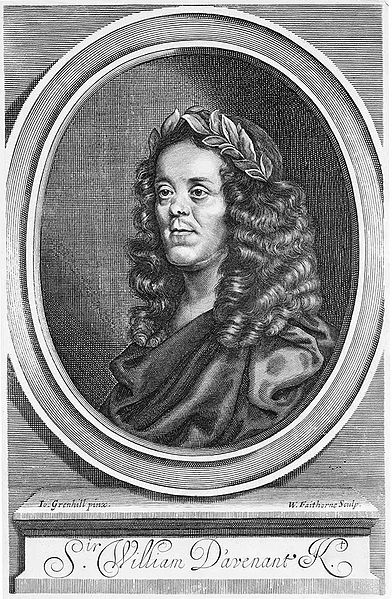
392px-William_Davenant

“The Giant’s Fishing”

by Sir William Davenant

This day, a day as fair as heart could wish,

This giant stood on shore of sea to fish.

For angling rod he took a sturdy oak,

For line a cable that in storm ne’er broke;

His hook was such as heads the end of pole,

To pluck down house ere fire consumes it whole.

This hook was baited with a dragon’s tail;

And there on rock he stood to bob for whale,

Which straight he caught and nimbly home did pack

With ten cart load of dinner on his back.

William Davenant or D’Avenant (1606-1668) was a contemporary of Izaak Walton’s and lived through the same tumultuous times surrounding the Civil War(s) in England. Davenant, a monarchist and Anglican, who later converted to Roman Catholicism, did not negotiate the social upheavals quite as smoothly as Walton did. He was imprisoned several times, yet he eventually overcame each political difficulty. In fact, he served as a politician himself on several occasions.

The poem above, certainly not Davenant’s most profound work, is part of his masque, Britannia Triumphans. While the poem is lighthearted, Britannia was a serious piece of writing, produced in serious times. It was the first masque to be performed at the Palace of Whitehall, on 17 January 1638, after a two-year suspension of masqueing. King Charles I enacted this suspension primarily because the Banqueting House at the Palace was dirty from consistent use. He may have decided to have masqueing resume, however, for political reasons. The image driven masques were a way of controlling the perception of the monarchy held by those elite persons invited to attend (and perhaps of reinforcing Charles illusions, as well). Notably, the great architect Inigo Jones, who also collaborated (and feuded) with playwright and poet Ben Jonson, designed the scenery and costumes for Britannia. As it happens, he designed the banqueting hall for Charles’ father, James I, as well.

Incidentally, Charles I was executed by the Rump Parliament, in front of the Banqueting House, in 1649. Davenant was imprisoned the following year, and remained in the Tower of London until the Civil War(s) concluded (though he was imprisoned again, later).

The things you find, when you’re not even looking ….

August 9, 2013

My wife and I have been exploring Washington State University and the surrounding communities this past week. We have been considering relocating and taking jobs at WSU.  Of course, I sought out some fly fishers to get as much information as possible about local fishing (the answer, in short: lots of steel head).

One of the fly fishers with whom I spoke mentioned that the WSU library had one of the largest collections of angling literature in the world. Since I had never heard this before, I was a bit skeptical. So, after a meeting today, I swung by the Manuscripts, Archives, and Special Collections Department in library.

Sure enough, WSU received 15,000 volumes over the past two years, donated by Joan and Vernon Gallup (no doubt, many of you already knew this). These, as yet, mostly uncatalogued texts will be added to the existing collections of angling and other outdoor literature. I direct you to a news release published by the International League of Antiquarian Booksellers, since ILAB is such a strong source of information on these matters: “Largest Rare Book Collection ever Donated to Washington State University.” While the Gallups are described in this and other news releases as Spokane residents, my understanding is that the collection may have been housed at their home in Bigfork, Montana.

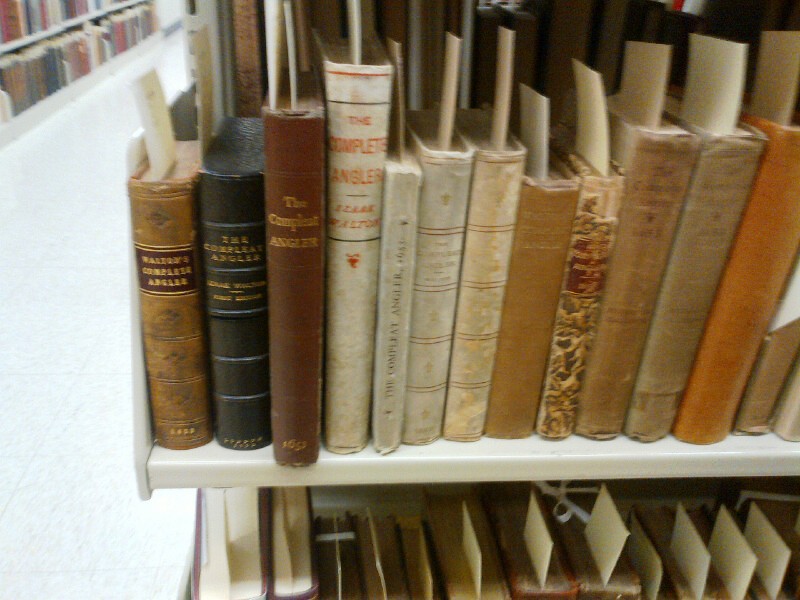
I was stunned by some of the titles found in WSU’s storage stacks. The number of editions of the The Compleat Angler alone is absolutely staggering. When I woke up this morning I had no idea I would be perusing two first editions (1653) of Izaak Walton’s masterpiece by the end of the day.

Two first editions of The Compleat Angler, on the far left (one rebound and the other in a black clamshell box)

Two first editions of The Compleat Angler, on the far left (one rebound and the other in a black clam-shell box).

Roland Barthes, Plastic, and Wheatley Fly Boxes

July 22, 2013
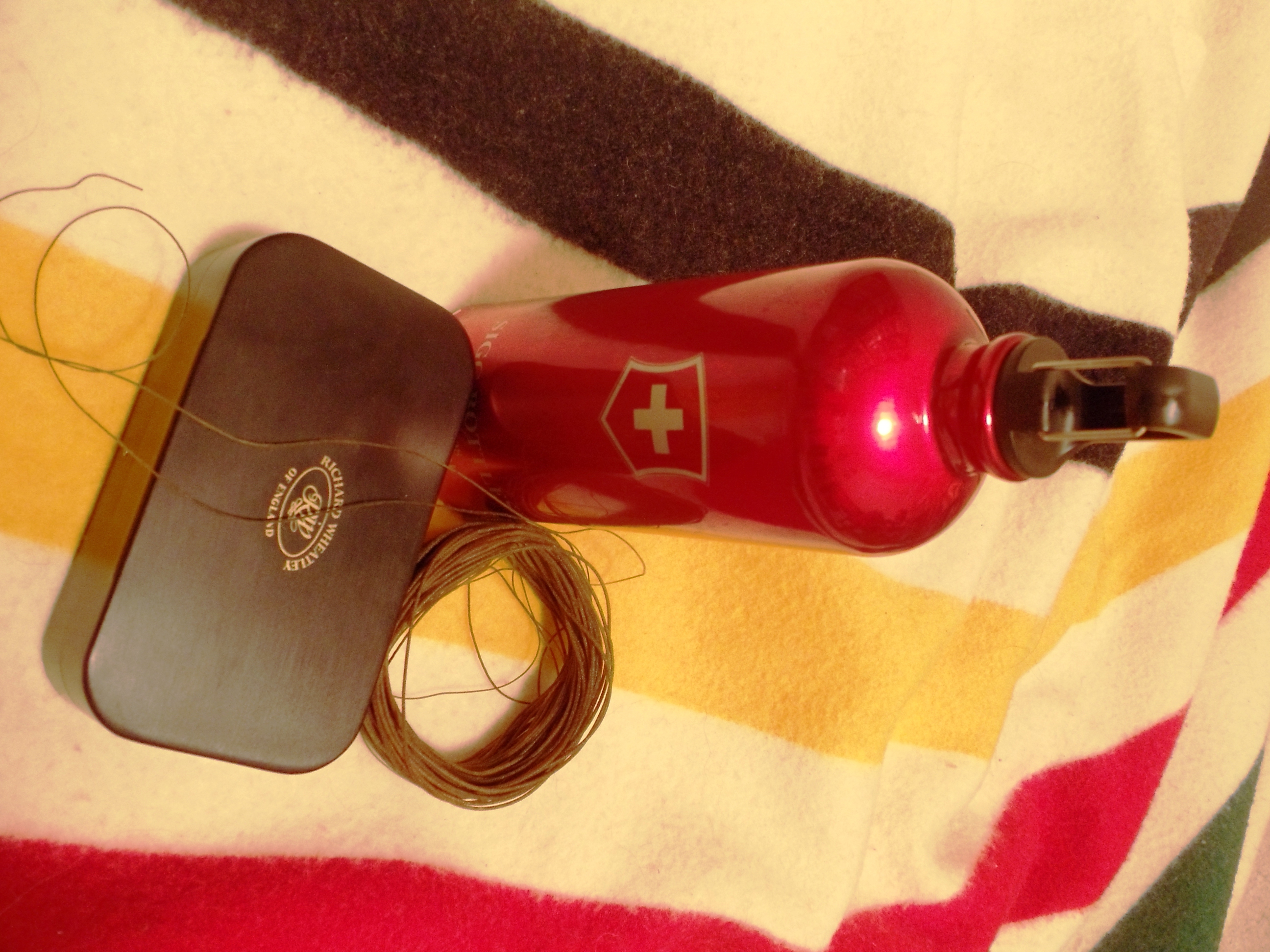
A Wheatley fly box, a Thebault silk fly line, a classic Sigg bottle, and a Pendleton blanket. None of them are plastic. All of them will serve their purpose for a century or more.

A Wheatley fly box, a Thebault silk fly line, a classic Sigg bottle, and a Pendleton blanket. None of them are plastic. All of them will serve their purpose for a century or more.

The influential French thinker Roland Barthes examined what he considered as the ideologies connected to numerous materials in his 1957 text, Mythologies.  The text, translated to English in 1972, served as an important stepping stone in the development of what we now know as postmodern philosophy, which emerged in the 1970’s.   Among other things, Postmodernism contested the “Western” cultural narrative of scientific “progress,” which, among many other things, suggests that humans might move away from a reliance upon natural materials, as they achieve greater ability to manipulate more artifactual materials. Postmodernism has lost much of its influence, in part because it became an odd sort of narrative of progress itself. And the narrative of scientific progress still dominates much of the world. In regards to how this latter persistent narrative still shapes our view of material, just think about the excitement displayed over the development of 3D printing.

In one of the essays included in Mythologies, Barthes wrote critically about the highly artifactual material–what he called an “imitation material”–plastic:

In the hierarchy of the major poetic substances, it figures as a disgraced material, lost between the effusiveness of rubber and the flat hardness of metal; it embodies none of the genuine produce of the mineral world: foam, fibres, strata.  It is a ‘shaped’ substance: whatever its final state, plastic keeps a flocculent appearance, something opaque, creamy, curdled, something powerless ever to achieve the triumphant smoothness of Nature.  But what best reveals it for what it is is the sound it gives, at once hollow and flat; its noise is its undoing, as are its colours, for it seems capable of retaining only the most chemical-looking ones.

I am not a postmodernist.  I am not a post-anything.  But, like Barthes and later philosophers, I am concerned about the dominant narrative of “progress.”  And, simply put, I’m not a fan of plastic.  I should note for flyfishing readers that I am also not one of those elitists who maligns graphite rods by mislabeling them as “plastic.” Clearly, graphite rods do not fit into Barthes’ descriptions of plastic.  I like graphite, glass, and bamboo rods, so long as all of them are things have been crafted or worked with care, rather than simply molded or “shaped.”

Why am I then rambling on about such things, you may ask.  It is because I was recently thinking about how much I enjoy things that are crafted to last–to take hard knocks but to still function for many, many years. Plastic lasts, of course.  But it also breaks, deteriorates, and otherwise ages in ways that make it no longer useful.  What prompted me to think about all of this was my putting some flies into a Wheatley fly box.  These boxes have been made for well over a hundred years, and many of the earliest examples are still perfectly functional.  Dented and scuffed, yes.  But irreparably broken? No.

Part of the narrative of progress seems to involve a movement toward greater convenience and disposability. For many of the same reasons that Roland Barthes criticized the world around him, I reject that narrative.


Robert and Penel: Antoine de Saint Exupery, Wildness, and Discovery

July 2, 2013

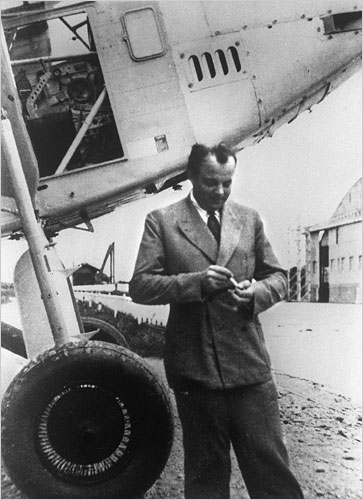
Years ago, my wife gave me a copy of Antoine de Saint Exupery’s The Little Prince, a book of which I was already a great fan.  Saint Exupery, of course, was a renowned French aviator and author.  He disappeared on July 31, 1944, while flying a reconnaissance mission for the Allies during the Second World War. He published The Little Prince, originally in French, just the year before.

Saint ExuperyAs far as I know, this artist and adventurer, pictured left, was not an angler.  It was a fisherman, however, who found a bracelet of his and, later, the wreckage of his plane, near Marseille in the late 1990’s.  According to a 2008 New York Times article by John Tagliabue, researcher Lino van Gartzen eventually located the aging, former German pilot who may have shot down Saint Exupery’s plane (“Clues  to the mystery of a writer pilot who disappeared”).  For years, this former pilot had supposedly been greatly troubled by the knowledge that he may have caused Saint Exupery’s disappearance.  He was a devoted reader of Saint Exupery’s writings before the war started. This, he claimed, was why he kept his wartime downing of a plane resembling Saint Exupery’s — near the time and location that the French pilot was believed to have disappeared — secret until van Gartzen found him. (There is some doubt that Saint Exupery was actually shot down, and it is possible that the German pilot shot down  different Allied aviator).  

The finding of Saint Exupery’s plane, the location of the man who may have downed that plane, and that man’s own realization that he may have been the cause of Saint Exupery’s disappearance all represent curious discoveries.  When I opened the copy of The Little Prince given to me by my wife, I made another discovery. Inside the cover was the following inscription, dated 7/5/87:

For Robert,

who understands that ‘what is essential is invisible to the eye’…you have tamed me, and I will cry, but it has been worth it–‘Because of the color of the wheat-fields’…

Once in a while, not too often, but now and then, dream of me, curling yourself in a knot around your pillow, or if it should be, around whoever you may be with, and, as you stand on the edge of waking and sleep, pretend that it is

-Penel, who loved you best—

The person who wrote this inscription for Robert, who was clearly a former lover, alludes to several passages in the The Little Prince. In particular, she refers to a passage that occurs when “the little prince” (Saint Exupery’s capitalization), who is an interplanetary traveler recently arrived upon earth, encounters a fox.  The fox warns the boy that he is not tame. The boy then questions the fox:

“What does that mean–‘tame’?”

“You do not live here,” said the fox. “What is it that you are looking for?”

“I am looking for men, said the little prince. “What does that mean–‘tame’?”

“Men,” said the fox. “They have guns, and they hunt. It is very disturbing. They also raise chickens. These are their only interests. Are you looking for chickens’?”

“No,” said the little prince. “I am looking for friends. What does that mean–‘tame’?”

“It is an act too often neglected,” said the fox. “It means to establish ties.”

“‘To establish ties’?”

“Just that,” said the fox. “To me, you are still nothing more than a little boy who is just like a hundred thousand other little boys. And I have no need of you. And you, on your part, have no need of me. To you, I am nothing more than a fox like a hundred thousand other foxes. But if you tame me, then we shall need each other. To me, you will be unique in all the world. To you, I shall be unique in all the world…”

Needless to say, the boy “tames” the fox and they grow to love each other very much.

In my view, an implication of the passage I have quoted is that life is characterized by wildness. For this reason, it is also characterized by constant discovery–the more unusual discoveries that one can find in such places as books–and, of course, the discovery of love. As evidence of the latter I think of the discovery and eventual loss of love between Robert and Penel and the “little prince” and the “fox.”  I think too of the discovery of love between my wife and I, which I already know is much more enduring. A common fact associated with all these discoveries, as different as they are, is that they keep the world an interesting place and make our lives within this world worth living.

Quality and Artistry

June 30, 2013

As I have noted before, I am a fan of Tim Pantzlaff’s Spey Company fly reels because of their classic styling, bullet-proof construction, and affordability. In the past months, Tim has added features to his reels such as telephone latches — most famously associated with the second generation of Hardy “Uniqua” reels, knurled palming rims, handle material resembling ivory, and more. Currently, you can see some of these features on his 4 inch “Circle Spey” reel.

Tim makes every reel himself.  While obviously a fine craftsman, his artistry also extends to music.  Tim recently created a video of his reels in production and in action, for which he also made an acoustic guitar soundtrack:

I really like my “Single Spey” reel, to which I had Tim add a new ivory-like handle.  As a possible change in location may mean that I’ll be using a two-handed rod regularly, I see one of his larger spey reels in my future too.  And if I stay where I am, I may make use of his ability to create salt-water safe reels.

Mind you, I gain nothing by drawing your attention to these reels.  I simply like to see hard-working people, who make fine art and/or other high quality products at affordable prices, succeed. As the world is increasingly occupied with plastic, disposable, soul-less materials, I feel more strongly about this every day.  That said, if you are in the market for a reel, be sure to look at the Spey Company.

Maclean and Bachelard: Words, Water, and Life

June 9, 2013

Eventually, all things merge into one, and a river runs through it. The river was cut by the world’s great flood and runs over rocks from the basement of time. On some of the rocks are timeless raindrops. Under the rocks are the words, and some of the words are theirs.

Norman Maclean, A River runs Through It and Other Stories, 104.[1]

Liquidity is a principle of language; language must be filled with water.

Gaston Bachelard, Water and Dreams, 192.[2]
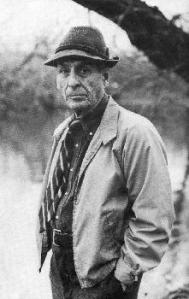
maclean

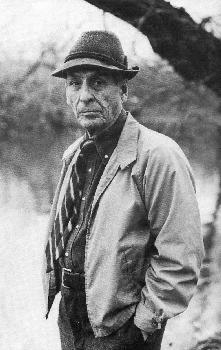
Norman Maclean

Those who have read Norman Maclean’s A River runs Through It know that the passage quoted above alludes to conversations between Maclean and his minister father about the very basis of reality. As Christians, they refer to the Book of Genesis, from the Hebrew Bible or Christian Old Testament, which explains that in the beginning of time there was only “spirit” and “water.”[3] They also refer to John 1:1, from the Christian New Testament. This verse reads, “In the beginning was the Word, and the Word was with God, and the Word was God.” Thus, Maclean and his father seem to be engaging in the same debate in which so many “Western” philosophers of language have also engaged: is there a physical reality beyond the words that allow us to discuss existence, or is language completely metonymic—is the world made real through language?

I don’t have an answer to such questions, though I do know that most mainstream Europeans and North Americans overlook the immense power and importance of language. Norman Maclean, as evidenced in his famous story, does not. He suggests at the end of A River, in the passage quoted above, that there is a mutually dependent relationship between language and reality: the words are under the rocks, and yet some of the words belong to the rocks.

What is just as important, though, is Maclean’s emphasis upon water. All things “merge” in the running waters of “the river.” Water is thus a metaphor, in Maclean’s mind, for the connections that are made possible in the physical world through the use of words—through language.

A River runs Though It is, of course, something more than mere words. It is both poetry and narrative. Both of these types of language are ideally full of movement. They work against reification. A story moves from beginning to end, and poetry pushes against the rules of language that so often deplete it of vitality. Water, too, is full of movement.

This evening I was pulling some books by Mircea Eliade off a shelf, as I thought about my recent fly fishing trip to Romania. I noticed, one shelf up, a series of books by the influential French philosopher Gaston Bachelard. In these books, Bachelard reflects upon the relationship between language, imagination, and the physical elements. Not being particularly moved by Eliade tonight, I decided to browse through Bachelard’s book on water, which I have not read for many years. I came across the second quote provided in the epigraph to this post.

Bachelard

Gaston Bachelard

In addition to the quote above, Bachelard writes, “Liquidity is, in my opinion, the very desire of language. Language needs to flow.”[4] For Bachelard, poetry – ideal, creative poetry – is the language that best embodies liquidity. He seems to acknowledge that narrative can do so as well.

I think, then, that Bachelard and Maclean share the view that language and reality are mutually dependent. However, the language that gives life to our world is the language of movement. It is narrative and poetry.

Toward the end of Maclean’s book, he describes another conversation with his father. This one has to do with the tragic death of Maclean’s brother Paul:

Once, for instance, my father asked me a series of questions that suddenly made me wonder whether I understood even my father whom I felt closer to than any other man I have ever known. “You like to tell true stories, don’t you?” he asked, and I answered, “Yes, I like to tell stories that are true.”

Then he asked, “After you have finished your true stories sometime, why don’t you make up a story and the people to go with it?

“Only then will you understand what happened and why.”[5]

Of course, A River is the story that Norman eventually “makes up,” in order to understand the death of his brother. While the book is very nearly autobiographical, Maclean does change certain elements of the actual story his family lived. Perhaps doing so allowed Maclean to give new vitality to his brother.

Now, all of the preceding might be taken as mere ramblings, on my part, about some favorite books and topics. Largely, that’s exactly to what all those words amount. But let me make a final points. Reading authors like Bachelard and Maclean, as different as they are, and looking towards teaching found in texts like the bible and even more commonly in the oral traditions of indigenous peoples, reminds us that language is powerful and important. When used to its full potential, it shapes our worlds, at the very least. So take language seriously. Your life depends upon it.
IMG_0389


[1] Norman Maclean, A River runs Through It and Other Stories, Twenty-fifth Anniversary Edition (Chicago: University of Chicago Press, 2001).

[2] Gaston Bachelard, Water and Dreams: An Essay on the Imagination of Matter, trans. Joanne Stroud (Dallas, The Pegasus Foundation, 1983. Originally published in 1942 as L’Eau e le rêves, essai sur l’imagination de la matiére.

[3] I am using the RSV, simply because it is handy. Maclean, however, tells us that his father was reading the bible in Greek.
[4] Bachelard, 187.

[5] Maclean, 104.

Mon enfant! Will you come travel with me?

June 3, 2013
Szofi and I stuck at JFK after returning from Europe. Picture by Szofi's mommy.

Szofi (“mon enfant”) and I stuck at JFK after returning from Europe. Picture by Szofi’s mommy.

Following are some selected stanzas from “Poem of the Road,” by Walt Whitman.  The version from which these stanzas are excerpted is found in the 1860 edition of Whitman’s Leaves of Grass.  The selected words remind me of the transformative power of travel, companionship, and family.


Allons! the road is before us!

It is safe—I have tried it—my own feet have tried it well.

Allons! be not detain’d!

Let the paper remain on the desk unwritten, and the book on the shelf unopen’d!

Let the tools remain in the workshop! let the money remain unearn’d!

Let the school stand! mind not the cry of the teacher!

Let the preacher preach in his pulpit! let the lawyer plead in the court, and the judge expound the law.

Mon enfant! I give you my hand!

I give you my love, more precious than money,

I give you myself, before preaching or law;

Will you give me yourself? will you come travel with me?

Shall we stick by each other as long as we live?