Archive for the ‘Fly Fishing’ Category

Simple Fly Fishing in Japan

April 26, 2017

Yuzo Sebata has been a tenkara fisherman for over fifty years. Tenkara, of course, is a traditional Japanese from of fly fishing, using a long rod with no reel. Fishing Vision, a Japanese Media company, has recently produced a video in which Sebata takes the viewer fishing in the mountains north of Tokyo for iwana trout (Salvelinus leucomaenis) . Sebata also spends some time in the film sharing his views of the natural world. Sebata is well-known and respected in the tenkara world, and you can read more about him at Tenkara USA. Follow the link below to watch the film, Tenkara “Do”: The Greybeard who lives Life with Nature (do = “way,” in Japanese). The film is professional dubbed in English.

https://fishingvision.tv/video/tenkara/tenkara-do.php


Conservation, Redband Trout, and Art

April 17, 2017

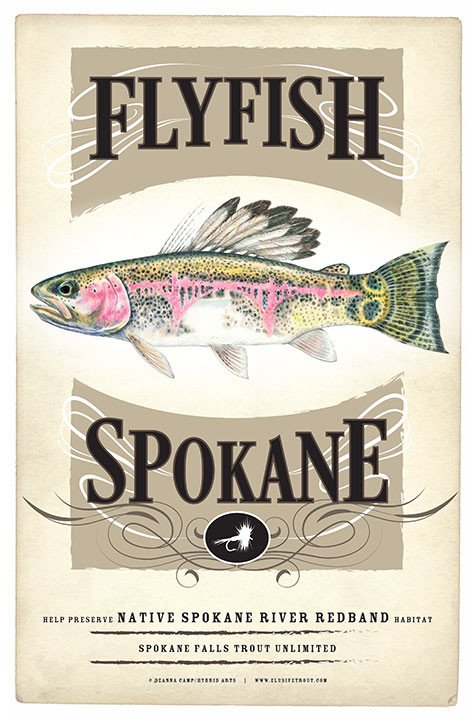
Recently, at Modern Tipi, a Native-American owned store in Spokane, WA, featuring Native artists and Native-themed art, I ran across a beautifully framed picture of a Columbia River redband rainbow trout (Onchohynchus mykiss gardnerii). These redband trout inhabit the Spokane River and other regional waterways. The picture is the central element on a poster produced by Spokane Falls Trout Unlimited to raise awareness and conservation funds for the trout. The stylized picture incorporates Spokane’s famous Monroe Street bridge into the trout’s red band and feathers into its dorsal fin. The feathers are a nod to the local Spokane Tribe of Indians, whom themselves are deeply engaged in regional conservation, often in collaboration with the other tribes comprising the Upper Columbia United Tribes. The artist behind the picture is Deanne Camp. You can find much more of her amazing art online at www.elusivetrout.com. If you are in the area, be sure to visit Modern Tipi, as well. Support your local artists, tribes, and trout.

By the way, you can now follow The Literary Fly Fisher on Facebook. Go here, or click the “follow” button in the menu to the right of this page.

“Flyfish Spokane Poster,” by Deanna Camp, https://www.elusivetrout.com/products/flyfish-spokane-poster

Montana Fishing Exhibit

February 23, 2017

http://mtstandard.com/lifestyles/montana-s-fishing-history-displayed-in-new-exhibit-at-montana/article_48a9f397-1e99-5ec4-8c6d-845d83cdcf64.html

A Visitor’s Fly Fishing Memories in Film

February 13, 2017

Last summer, my friend Claudio Presecan visited. Claudio is from Cluj, Romania, and I have enjoyed fly fishing with him and his friends in Transylvania a couple of times. Therefore, it was a pleasure to finally be able to show him around my own waters. Claudio, is a very accomplished artist. So, it is not surprising that the digital film he made of his time fishing in Montana is filled with so many beautiful images. You can follow the link below, to see the video. And to see his paintings in the US, visit the Fountainhead Gallery (you can view them online).


<p><a href=”https://vimeo.com/203692918″>A fly fishing journey… Montana, August 2016</a> from <a href=”https://vimeo.com/prese”>Presecan</a&gt; on <a href=”https://vimeo.com”>Vimeo</a&gt;.</p>

A Reader’s Thoughts on Angling Ethics

January 26, 2017

quote-conservationRecently, a reader in Europe asked if she could contribute a post on conservation, about which she is passionate. Since, in my mind, there are few more important topics,  I am happy to share her post. US readers should know her views are informed by fishing in Europe, where the dearth of public lands often results in an even greater need for angling ethics. Of course, practicing those ethics (and not only ethics), is important no matter where you are, and I surely agree with her suggestions here. Thanks for sharing your thought in this post, Sara.

Fly Fishing and Conservation

It’s no secret, fly fishing gained a lot more popularity over the last decades. Once only practiced by the wealthy, you will find people of every social class enjoying this recreational activity today. With more and more fly fishing enthusiasts going after trout all over the US, the eco-systems those trout inhabit are facing new challenges. While it’s great that outdoor sports gain popularity, everyone should realize that the conservation of the environments they take place in, is more important than it ever was.

The Rise of Fly Fishing and its Consequences

As stated earlier, fly fishing developed from an almost exclusive privilege for wealthier people in the 20th century, to a sport practiced by the masses. Similar to many other outdoor activities, it provides rest and relaxation as compensation to the stressful everyday life most of us have. Although we see a steady rise in equipment prices, in today’s age people seem generally more willing to spend money for things they are passionate about. The industry, which evolved around this whole sport, grew consistently and recently saw revenues of up to 850 million in 2015, alone in the US. (http://flyfishing-blog.com/flyfishing-blog.com/2016/07/18/us-fly-fishing-equipment-market-worth-over-850-million-dollars-in-2015/)

All that being said, there are participants that struggle to keep up with the monetary demands. Businesses spend top dollar marketing their new products, driving sales to all time highs, fish hatcheries and wildlife management lack those resources. As a result they struggle to maintain healthy fish populations, have to eliminate jobs and face budget cuts for often essential projects.

The solution for those problems? Since wildlife management, can’t exactly grow like companies do, they are forced to raise fees. This might include taxes but usually, over half their budget comes from hunting and fishing licenses (http://www.denverpost.com/2016/08/27/colorado-parks-wildlife-hunting-fishing-licenses-cost/) and that’s why states like Colorado consider to double up their license fees. At the same time the number of fish you are allowed to take home might decrease and in general more and more regulations might be necessary to maintain healthy rivers. Have a look at northern Europe, if you are interested in what that looks like. Although we saw a drop in 2013, the number of active anglers recovered and takemefishing.org(https://www.takemefishing.org/getmedia/827c415a-a372-497f-a86c-8ec90d3fc0e3/2015SpecialReportOnFishing_FV.aspx) predicts them to remain like that for a while.

What Can You Do?

Besides contributing with your license fees there are also a few other things you can do, to indirectly support wildlife management and hatcheries in your area. Conservation starts with every one of us and regulations become less important, if more people stick to a few basic guidelines while fly fishing.

Practice Catch & Release

If you want to keep your impact as low as possible, catch and release is the way to go. With a survival rate of up to 90% there is a good chance that the fish you just caught sees another day and maybe another fly.

Correct Handling

Noticed how I said UP to 90%? This rate can be drastically reduced, depending on how stressful the whole process is to your catch. To keep the survival rate high, you should bring fish in as quickly as possible and keep them wet. If you touch them, wet your hands and avoid using landing nets, since those can damage their scales resulting in infections.

Go Easy On Fish During Spawning Periods

Learn how to spot redds, the areas where trout place their eggs, and avoid them. Trout usually protect those places and catching them in that situation is ridiculously easy. They want to protect their eggs and even casting in those areas, although not illegal, shouldn’t even be considered. Just don’t!

Wade With Care

Besides those nesting areas you might damage there are also plenty of other aquatic organisms, which don’t survive a wading boot trampling walking over them. Since those organisms provide a main food resource for trout, it’s in your interest that they are present and considering you aren’t the only one wading in that area, your overall impact might be bigger than you think. Wade only as much as necessary and if you are interested about what exactly lives below your boots, check out this article about the impact of wading fly fishers (http://www.wadinglab.com/impact-of-wading-fly-fishers/).

Don’t Leave Anything Behind

If someone would pay me a dollar, every time I had to pick up trash left behind by other anglers, I could probably quit my job. Both, you and trout, enjoy a clean river. Trash in form of plastic, hooks, bait/flies or line can be dangerous to wildlife. Just leave it as you found it and maybe even pick up some trash others failed to take home with them.

Doesn’t Sound That Hard, Right?

I don’t get tired of preaching those five rules. Why? Because it would be so easy to maintain a healthy ecosystem with plenty of fish, if everyone would stick to them. Trust me, you don’t want regulations like those common in most parts of Europe. It’s only fair to conserve what we all enjoy, so it’s still there if one day your grandchildren decide to go fishing.

Tight lines!

Sara

Contributor Profile:

Based in Oregon, I picked up fly fishing pretty early in my life. Since then I am pretty much hooked, always looking for the next pool to fish. I am currently travelling Europe and when time allows, I enjoy writing about topics like conservation or fly fishing gear. Occasionally I get some work published on different fly fishing blogs and might start my own in the future

End-of-Day

August 29, 2016
Night at the Cabin

The Evening Scene, at the Cabin


“When Day is Done”

If the day is done,
if birds sing no more,
if the wind has flagged tired,
then draw the veil of darkness thick upon me,
even as thou hast wrapt the earth with the coverlet of sleep
and tenderly closed the petals of the drooping lotus at dusk.

By Rabindranath Tagore, 1913 Nobel Prize-winning Bengali poet.

Samurais, Fishing Poles, and The Loss of Tradition

August 18, 2016

Craftmanship online magazine recently published an article on a type of traditional Japanese fishing pole, known as Edo wazau, and its construction. Author Yukari Iwatani Kane takes the reader on a journey through their history. He also explores the current, diminishing state of the craft behind their construction. Explaining the poles origins, he writes:

The Edo-wazao is estimated to have started 228 years ago, by a samurai named Tosaku Matsumoto. All of today’s top masters trace their roots back to Tosaku. From the beginning, Edo-wazao were a luxury item for the wealthy, for whom fishing had been a popular pastime akin to polo or golf. While the working class used rough, homemade bamboo poles, nobility, kabuki masters, and prominent politicians used rods tailor-made to each season and fish species.

The article it titled, “Japan’s gorgeous, precarious fishing  poles.” (Yes, “poles.” These are not fly rods). It is accompanied by the authors excellent photography. Follow the link, below, to read it.

http://craftsmanship.net/bamboo-take-two-japans-gorgeous-precarious-fishing-poles/

Worrying, in Good Company

July 27, 2016

IMG_2128[1]


I am one of many fly fishers who pays intimate attention to snow packs, water levels, air and water temperatures, and so on. Most people do so simply in order to identify the most effective times to wet their flies. However, I have a more general concern about the survival of the very river I love to fish. No doubt, many would consider me alarmist, but I am genuinely shocked by how low the water is in my favorite Montana river this summer. This, coupled with my realization that the river is being “discovered” by a mass of people approaching a “critical” number, has me pretty sad.

Of course, I am not alone with my concerns. A recent article in the June 16th edition of The Economist confirms this fact. When the editors of a financial news magazine based in England address Montana’s low water and its impact upon fish and fishing, you can be sure things are real.  Read The Economist’s article for yourself.

North Idaho

June 15, 2016

I spent last weekend with a local friend, AJ Morris, fly fishing his favorite river in North Idaho. He has fished it for years and seems to know its every nuance. I have visited the river only a few times since moving to the region, myself, though I have enjoyed fishing there each time. Since fishing, for me, consists of more than catching trout, this means I have also enjoyed the beauty surrounding the river, the animals giving life to that beauty, the companionship of my friend, and so on.

My views are not unique. Archaeologists have confirmed that the river’s drainage has been inhabited for some 12,000 years. The Nez Perce or Nimiipuu, descendants of those ancient inhabitants, live there still. And I know that my Nez Perce friends find the area just as important to their lives as their ancestors did, despite profound changes brought by settlement, dam-building, and other damaging activities.

Author and Trout Unlimited CEO Chris Hunt describes Northern Idaho, from a fly fisher’s perspective, in Fly Fishing Idaho’s Secret Rivers (The History Press, 2014). He writes:

From a fishing standpoint, northern Idaho is defined by the Clearwater River drainage. The Clearwater itself is a legendary steelhead river, even today, with all the impediments facing Idaho’s oceangoing rainbow trout. But all the rivers and streams that come together to form the Clearwater have a fishy legacy that rivals that of any system in the state.

Hunt is the Director of National Communications for Trout Unlimited, and his words ring true. In fact, these rivers and streams really rival those found in many other parts of the world, too. The same can be said of their beauty.

Octavio Paz, the Break, and Nature

May 12, 2016


Octavio Paz besökte Malmö Internationella Poesifestival 1988, John Leffmann.

Octavio Paz besökte Malmö Internationella Poesifestival 1988, John Leffmann.

Octavio Paz (1914-1998), the 1990 Nobel Prize for Literature winner, was a Mexican poet and intellectual. He served in the Mexican diplomatic service, lectured at Cambridge and Harvard, and was awarded many prizes for his writings. While I do not support some of his later political stances, I find his poetry insightful and occasionally intoxicating. Here, I share a short poem, from a larger series of similar poems, first published in 1955. It is titled “Objetos” or “Objects.” In three lines, Pas captures our tendency to objectify the world around us, in our daily lives. And he indicates how powerful it is, when we break this tendency and recognize the vitality of our surroundings, human and otherwise. For me, fly fishing and spending time in “nature” (by which I mean “places-less-influenced-by-humans”) provides that break.


OBJECTS

They live alongside us
we do not know them, they do not know us
But sometimes they speak with us.

(this translation from the Spanish is taken from Selected Poems, Eliot Weinberger ed. (New Directions, 1984), 6.