Archive for the ‘Environmental Literature’ Category

Adventure Books

August 28, 2014

In January of 2003, Outside Magazine published a list of recommended “adventure” books, in an article titled “The 25 (Essential) Books for the Well-Read Explorer.” Antoine de Saint-Exupéry’s Wind, Sand, and Stars, published in 1939 (first in French and then in English, in the same year), was at the top of their list. In the article, Brad Wieners describes Saint-Exupéry’s classic:

Antoine de Saint-Exupéry

Antoine de Saint-Exupéry

Wind, Sand and Stars is so humane, so poetic, you underline sentences: “It is another of the miraculous things about mankind that there is no pain nor passion that does not radiate to the ends of the earth. Let a man in a garret but burn with enough intensity and he will set fire to the world.” Saint-Exupéry did just that. No writer before or since has distilled the sheer spirit of adventure so beautifully. True, in his excitement he can be righteous, almost irksome like someone who’s just gotten religion. But that youthful excess is part of his charm. Philosophical yet gritty, sincere yet never earnest, utterly devoid of the postmodern cop-outs of cynicism, sarcasm, and spite, Saint-Exupéry’s prose is a lot like the bracing gusts of fresh air that greet him in his open cockpit. He shows us what it’s like to be subject and king of infinite space.

I have written before about Saint-Exupéry, and I’m happy that Outside included one of his books in their list (he is, most famously, the author of The Little Prince). Truly, Wind, Sand and Stars conveys a sense of what most of us would describe as adventure. However, the books that Outside recommended, and which other publication have recommended in similar lists, might better be classified as “environmental” or “outdoor literature.” After all, “adventure” is a term that is as hard to define as “art,” “nature,” or “love.”

Regardless, if  you find yourself house-bound or otherwise restricted from enjoying the outdoors yourself,  you can find some fine reading material in Outside’s old list. By using the search function on their webpage, you can locate several other lists of recommended readings as well. Also, take a look at the extensive list of “adventure” books published online by National Geographic in 2004 (notice, there is a link to more recent recommendations at the bottom of their webpage).


Tom Morgan Rodsmiths and Religion

August 4, 2014

CBS Evening News has done an On the Road segment, entitled “Legendary Fishing Rod Creator shares a Special Secret,” on Tom and Gerry Morgan, of Tom Morgan Rodsmiths.  It is always interesting to see such stories in the mainstream media. In this particular case, the commentator, Steve Hartman, makes reference to the connection between religion and fly fishing that so many writers have claimed for so many centuries. Sadly, though, Hartman then describes a Tom Morgan rod as the “Holy Grail.” Of course, those who attribute deep meaning to fly fishing are inspired to do so by the experience, not the sometimes very expensive tackle. The commentator’s view reflects our society’s misplaced obsession with material wealth. No doubt, this obsession is often brought to the sport by certain tackle collectors and even by those who seem more concerned about what they look like on the stream than they are with the water and the life all around them. The inherent value of the living environment is so much greater that the merely symbolic value of our possessions.

Keepers

July 18, 2014

In my university courses, I often ask students to look critically at writing–to consider that the strength of traditions based upon writing depends upon people reading their culture’s texts. And I point out to students that our libraries are filled with books that are never touched. Academic books that go unread are typically books that deal with obtuse, unimportant topics.  Books written for popular audiences that go unread are often books that are simply written poorly. Of course, these are the often same reasons that certain journals, magazines, and websites go unread as well.

trout 2

Personally, I only subscribe to one magazine: The Flyfish Journal. The articles published therein are generally interesting and very well-written. I also receive Trout magazine, as part of my membership in the conservation organization, Trout Unlimited. However, in the past, I did not look at the articles in Trout very carefully. There were even times when I put the magazine directly into the recycling bin without getting past the contents page. It was not a magazine to which I would have chosen to subscribe. Fortunately, this has changed. The current editorial staff members–Kirk Deeter, Samantha Carmichael, and Erin Block–have made some great decisions about what to publish (and it is great to see their work, too, especially the very talented Erin’s) .

I was particularly happy that I looked through the latest issue of Trout more carefully than I looked at previous editions. In the Summer 2014 issue, I found articles by two close fly fishing friends. “Bad Boyfriend”, by Mike Sepelak, is an immensely creative, metaphorical essay about the dangers of introducing others to the disease we call fly fishing. In my opinion, Mike is a truly gifted writer, and I am very happy each time I see a new piece of his in print.  It does not seem that long ago that he was telling me about the writing class he had just enrolled in at our town’s community college. Now, he could probably teach that class. “A Fly-Fishing Pilgrimage to Montana,” by Rabbi Eric Eisenkramer, is an autobiographical essay, in which Eric relates the reasons behind his visit to the Big Blackfoot River and other Montana haunts of writer Norman Maclean.  As someone with a Ph.D. in Religious Studies, Eric’s reflections upon the deeper meanings that many of us–past and present–ascribe to fly fishing have long intrigued me. Some years ago, I invited  him to speak to my students, in a college course on fishing literature. In turn, he invited me to speak to his congregation.  Of course, we have also fished together. So, I enjoy his company as much in person as I do in print.

Mike and Eric are two angling writers who should be read. Their unique perspectives upon fly fishing and the reasons we fish, as well as their writing skills, place them among those authors whose works should not simply gather dust on a shelf. Indeed, their works serve to strengthen the traditions associated with fly fishing, one of which is writing itself.

Taken by Fairies and Fishing

July 11, 2014

Walter Yeeling Evans-Wentz (1878-1965) wrote his doctoral dissertation at Oxford University on Celtic views of and practices associated with “fairies.” He later expanded his work and published it as The Fairy-Faith in Celtic Counties, in 1911. He was undoubtedly influenced by the romanticism that also influenced mentor and poet William Butler Yeats and so many other Irish and other Northern European intellectuals at the time.  This romanticism is very evident in The Fairy-Faith, manifested in a great number of biases both in the ethnography and its interpretation.  Evans-Wentz was also influenced by mysticism, as presented by the American philosopher and psychologist William James, another of his mentors. And yet, Evans-Wentz displays a remarkable desire to take seriously the Celtic views of and practices surrounding fairies, which were and are dismissed by so many. This desire led him to record an immense amount of information presented directly from informants of Celtic descent in Ireland, Scotland, Isle of Man, Cornwall, and Brittany. So, while we might set aside many of his interpretations, and while we must also treat the quotations of his informants (particularly those translated from Gaelic languages) with caution, there is much to be gleaned from The Fairy-Faith.  Moreover, it is simply a fascinating read, for those of us who love the green, misty, mountainous places that Evans-Wentz’s informants associated with fairies.

Evans-Wentz later went on to work on Tibetan Buddhism, popularizing its study among European and American academics. His work there, too, must be treated cautiously, as his attitudes toward Tibet and Buddhism were perhaps even more romantic than his attitude toward Celtic views and practices.  This is partly due to the fact that “Madame” Helena Blavatsky’s imaginative, Asian and Spiritualist influenced “Theosophy” was a significant part of his life.

Walter_Evans-Wentz_and_Lama_Kazi_Dawa_Samdup_photographed_circa_1919

While Evans-Wentz apparently spent a great deal of time on the banks of the Delaware River as a boy — even claiming to have had an “ecstatic” experience there — I do not know if there is direct evidence of him having been a fisherman, as his mentors Yeats and James certainly were. However, the Celtic informants whose voices are recorded in his first book, spoke often of fish in their broader discussions of fairies and other non-human persons that animated their landscapes. And it is these voices which interest me the  most.

Following, is a “testimony” about the fairies that Evans-Wentz  attributes to an anonymous “Peasant Seer” in County Sligo, Ireland:

Another time I was alone trout-fishing in nearly the same region when I heard a voice say, “It is — barefooted and fishing.” Then there came a whistle like music and a noise like the beating of a drum, and soon one of the gentry came and talked with me for half and hour. He said, “Your mother will die in eleven months, and do not let her die unanointed.” And she did die within eleven months. As he was going away he warned me, “You must be in the house before sunset. Do not delay! Do not delay! They can do nothing to you until I get back in the castle.” As I found out afterwards, he was going to take me, but hesitated because he did not want to leave my mother alone.

trout

As it does for the informants met by Evans-Wentz over a  hundred years ago, going trout fishing or simply going to the places where trout are found, feels like a sort of boundary crossing to me. There is a sense, too, of being taken or, more precisely, not wanted to return back across the boundary.  Mind you, I am not one to draw a hard distinction between nature and culture or even so-called “super-nature.”  I am not speaking, then, of entering and wanting to remain in another reality.  Rather, fishing for me simply involves entering an area dominated by others–the fish, bears, birds, and perhaps even fairies, though I have yet to meet one of the latter (there are, however, many traditions among Indigenous Americans that involve little people and other human-like beings, both malevolent and kind).

Regardless, my thoughts are often focused upon the very animated world around me, when I am visiting trout streams and their environs.  I know that I am not alone in this.  As evidence, I present a picture of a fairy house made by my wife, at our cabin, while I was catching the sort of fish that you will see in the picture above. Perhaps my wife’s purely artistic creation of the fairy house will serve to propitiate any other-than-human beings, who might be responsible for my often feeling “taken” with fly fishing.

House

Accidental Waters

June 30, 2014

As in marriage, so in fishing; one’s choice is made by accident. One opens the door of a room; and there, for better or for worse, the lady sits. One sees a river from a train, a car, one halts to stretch one’s legs and is lost.

John Inglis Hall, Fishing a Highland Stream; a Love Affair with a River (Putnam and Co, 1960).


In Fishing a Highland Stream, John Inglis Hall writes of his love affair with the River Truim, a tributary of Scotland’s famous River Spey. If you have traveled between Perth and Inverness, you have probably seen this river. However, when Hall first began to fish the Truim in the 1940’s, its course was less widely known by the public.

Photo 4

My own home waters remain more remote. But like Hall, I first came to them accidentally. My family chose to build a cabin on the banks of what is now my favorite trout lake and just over the ridge from my favorite river. Naturally, I grew familiar with these waters over time, and I have come to love them as much as Hall loved the River Truim.

I visited these waters last weekend, and I look forward to doing so again in a few days. Included here are a few pictures, which will explain my love.

Photo 2


Photo 3


photo 1


Photo 5


John Montague’s “The Trout”

June 2, 2014

This morning, in my readings, I was reminded of poet John Montague. This inspired me to write a bit about him. Following, then, I share some biographical information about and a poem by Montague.

Montague is one of Ireland’s most respected, living poets. Montague was born to a Roman Catholic Irish immigrant father in New York, in 1929. A few years later, he was sent to live with his father’s relatives in County Tyrone, Northern Ireland. His studies eventually brought him back to the US, for a brief time, before he returned to Europe and Ireland. In 1998, he was awarded the first “Ireland Chair of Poetry.” This professorial appointment is sponsored by Trinity College Dublin, Queen’s University Belfast, and University College Dublin.

Montague’s “The Trout,” was first published in 1967’s A Chosen Light. The “Barrie Cooke” mentioned in the dedication is the well-known Irish artist, who passed just this year. Cooke was a passionate fly fisherman and friend of Montague’s.  You can find an online selection of Cooke’s paintings via Dublin’s Kerlin Gallery.

“The Trout”

for Barrie Cooke

Flat on the bank I parted
Rushes to ease my hands
In the water without a ripple
And tilt them slowly downstream
To where he lay, tendril-light,
In his fluid sensual dream.

Bodiless lord of creation,
I hung briefly above him
Savouring my own absence,
Senses expanding in the slow
Motion, the photographic calm
That grows before action.

As the curve of my hands
Swung under his body
He surged, with visible pleasure.
I was so preternaturally close
I could count every stipple
But still cast no shadow, until
The two palms crossed in a cage
Under the lightly pulsing gills.
Then (entering my own enlarged
Shape, which rode on the water)
I gripped. To this day I can
Taste his terror on my hands.

Recommended Reading

April 7, 2014

Fly Fish Journal


When I was looking through The Flyfish Journal that arrived in the mail last week, I came across a pleasant surprise. As I neared the end of the magazine, thinking how I really needed to be in bed, I came across a piece written by a friend, Mike Sepelak. The next day, I realized there were two more pieces by him in the same issue.

Until recently, Mike and I were nearly neighbors (by semi-rural/small town standards, at least). We have fly fished together quite a bit, in saltwater, warmwater, and coldwater. All along, I have followed his writing. You can, too, by looking at his website, Mike’s Gone Fishin’ … Again. There, you will find some great essays. I know Mike has put a lot of work into them, but I also know that choice words come easier to him than they do to many.

It’s very gratifying to see Mike’s writing in print. I have urged him to put together a collection of essays for publication as a book someday, and I continue to hope he does so. Read an essay such as “Shattered,” and  you will understand why. Few people can write something so emotional, yet so well crafted at the same time.

Meanwhile, pick up Volume Five, Issue Three of The Flyfish Journal. It’s a great publication, and it’s all the better with Mike’s work in it.


Presidents’ Day

February 17, 2014

January can be cold and dry, but it can also be a very wet month, a month of heavy rain or quick thaw and freshet-guarded rivers. February is more dependable…. And February is likely to have splendid days of bright sun after frost, with the first faint feelings of spring in the them, for the sap is rising in the maples again and the willow shoots are scarlet with it and the alders and fruit trees budded with it.

February is a good month too because Washington was born on the twenty-second, and that means that my brother-in-law Buck Elmore will probably be able to take time out and come up to try for a fish.

Roderick Haig-Brown, A River Never Sleeps, 1946.

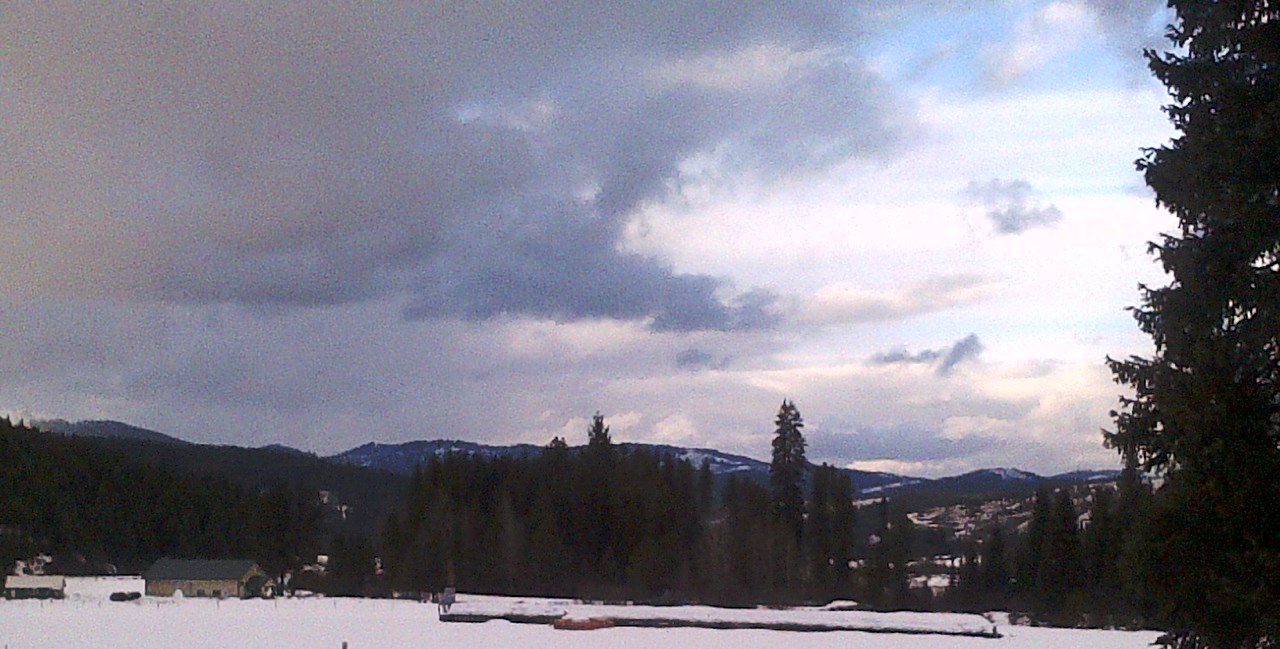
Unlike Haig-Brown’s brother-in-law, I had to work on what is now Presidents’ Day.   However, I  did some exploring with my wife and daughter yesterday– a sort of Sunday drive–and I surely agree with Haig-Brown’s

assessment of February.  It is a solidly winter month; the evidence of this is everywhere.  Yet, the month is also pregnant with the feeling that spring is just around the corner.

IMG-20140216-00459

IMG-20140202-00440   IMG-20140216-00467

Burns Night, 2014

January 26, 2014
DSC02809

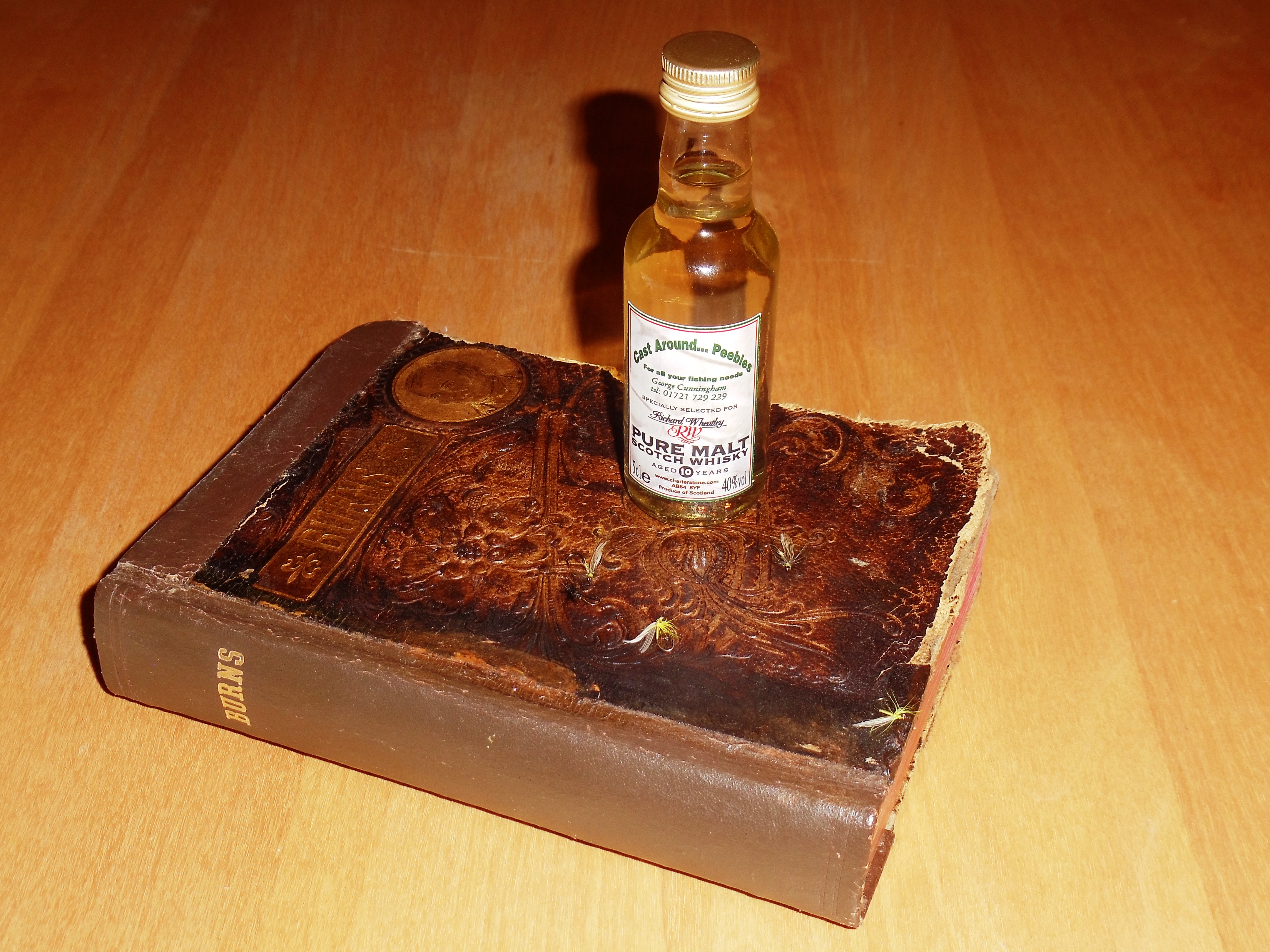
My Grandfather’s Burns book, a bottle of Scotch from a Wheatley fly box I purchased in Peebles, Scotland, and a few Clyde style flies tied by Andy Gunderson.

Once again, it is that time of year when fans of Robert Burns celebrate Scotland’s most famous bard. My love of his writing springs not only from his writing talent, but from his ability to speak as one close to the land, the people who toil upon it, that animals, and even the plants.

In “Nature’s Law,” Burns acknowledges the inspiration that the world-less-cultivated provides him. More directly, though, he honors life. Specifically, he honors life (with no small amount of pride) as it is shared with and manifested in his twins, just born to him and his future wife, Jean Armour.

“Nature’s Law. A Poem Humbly Inscribed to G.H. Esq., ” 1786.

Let other heroes boast their scars,
The marks of sturt and strife:
And other poets sing of wars,
The plagues of human life;
Shame fa’ the fun; wi’ sword and gun
To slap mankind like lumber!
I sing his name, and nobler fame,
Wha multiplies our number.

Great Nature spoke, with air benign,
‘Go on, ye human race!
‘This lower world I you resign;
‘Be fruitful and increase.
‘The liquid fire of strong desire
‘I’ve pour’d it in each bosom;
‘Here, on this hand, does Mankind stand,
‘And there, is Beauty’s blossom.’

The Hero of these artless strains,
A lowly bard was he,
Who sung his rhymes in Coila’s plains,
With meikle mirth an’ glee;
Kind Nature’s care had given his share
Large, of the flaming current;
And, all devout, he never sought
To stem the sacred torrent.

He felt the powerful, high behest
Thrill, vital, thro’ and thro’;
And sought a correspondent breast,
To give obedience due;
Propitious Powers screen’d the young flow’rs,
From mildews of abortion;
And lo! the Bard – a great reward –
Has got a double portion!

Auld cantie Coil may count the day,
As annual it returns,
The third of Libra’s equal sway,
That gave another Burns,
With future rhymes, an’ other times,
To emulate his sire;
To sing auld Coil in nobler style,
With more poetic fire.

Ye Powers of peace, and peaceful song,
Look down with gracious eyes;
And bless auld Coila, large and long,
With multiplying joys.
Lang may she stand to prop the land,
The flow’r of ancient nations;
And Burnses spring, her fame to sing,
To endless generations!