Author Archive

The Romantics, Blake, and Water

April 10, 2013
Sabrina's Silvery Flood

“Sabrina’s Silvery Flood,” from Robert John Thornton’s “The Pastorals of Virgil.” William Blake, 1821.

In preparing a lecture on the possible relationship between the Romantic Movement and the eventual embrace of outdoor recreation (other than field sports) in the United States, I found myself thinking of William Blake. Blake is certainly not one of the optimistic romantics, such as transcendentalist Henry David Thoreau, who might normally come to mind when thinking about outdoor recreation. Still, Blake’s poetry and visual art are stunning. In his song “Memory, hither come,” composed when he was just a boy, Blake captures the sense of mystery that all moving water embodies with just a few words.

“Memory, hither come” (1783)

Memory, hither come,
And tune your merry notes;
And, while upon the wind
Your music floats,

I’ll pore upon the stream
Where sighing lovers dream,
And fish for fancies as they pass
Within the watery glass.

I’ll drink of the clear stream,
And hear the linnet’s song;
And there I’ll lie and dream
The day along:

And, when night comes, I’ll go
To places fit for woe,
Walking along the darken’d valley
With silent Melancholy.

Museums, Nature, and the Substance of the Things we Love.

April 9, 2013

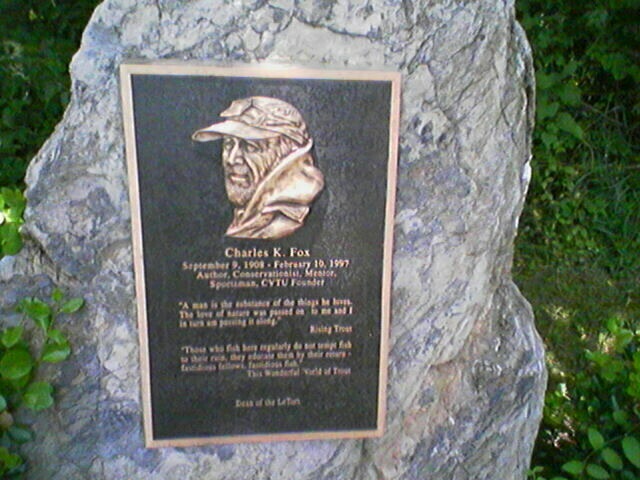
A man is the substance of the things he loves. The love of Nature was passed on to me and I in turn am passing it along. Maybe in their overcrowded world my boy and girl will discover escape from the concentrations and complications of people and revel in their own outdoors.

Charlie Fox, “By Way of Introduction” (no page number), Rising Trout (Carlisle: Foxcrest, 1967).

Charlie Fox Memorial, Letort

Charlie Fox Memorial, Letort Spring Run

This last weekend, I visited Central Pennsylvania, where I used to work and live for much of each year, to attend the 66th Anniversary Banquet of the Fly Fisher’s Club of Harrisburg.  I have written about this club, founded by Charlie Fox and Vince Marinaro, before.   Being in attendance at the dinner of this second oldest fly fishing club in America is always a somewhat humbling experience, when considered in the light of the figures who attended in the past.

This year, many of those figures were honored at the grand opening of the Pennsylvania Fly Fishing Museum (the website is not yet updated), now permanently installed at the Allenberry Resort in Boiling Springs, PA.  Of course, the museum will remain open henceforth.

IMG-20130406-00050

George Harvey Display

IMG-20130406-00060

Vince Marinaro Display

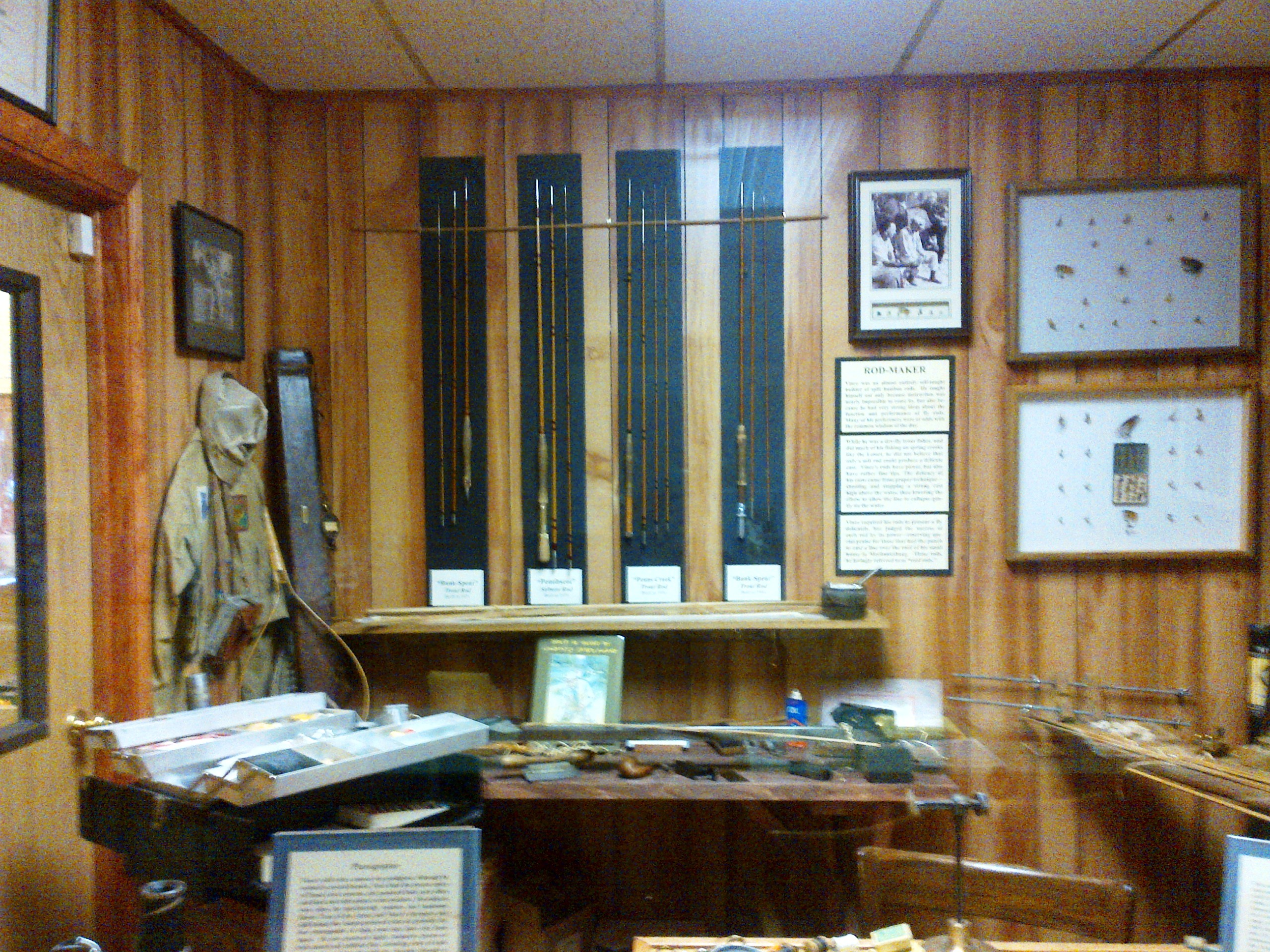
Visitors to the museum can enjoy the incredible displays focusing upon George Harvey and Vince Marinaro.  Both of these displays are reconstructions of these figures’ respective fly tying and rod building rooms.  In the latter, the visitor can see no less than four of Marinaro’s own, incredibly rare bamboo rods.  Between these two displays are shelves and full display cases devoted to other famous figures in Pennsylvania fly fishing history.  Of course, many of these figures influenced the development of fly fishing techniques, associated literature, and cold water conservation well beyond the boundaries of their state.

IMG-20130406-00056

Gene Utech Display

IMG-20130406-00054

Ed Shenk Display

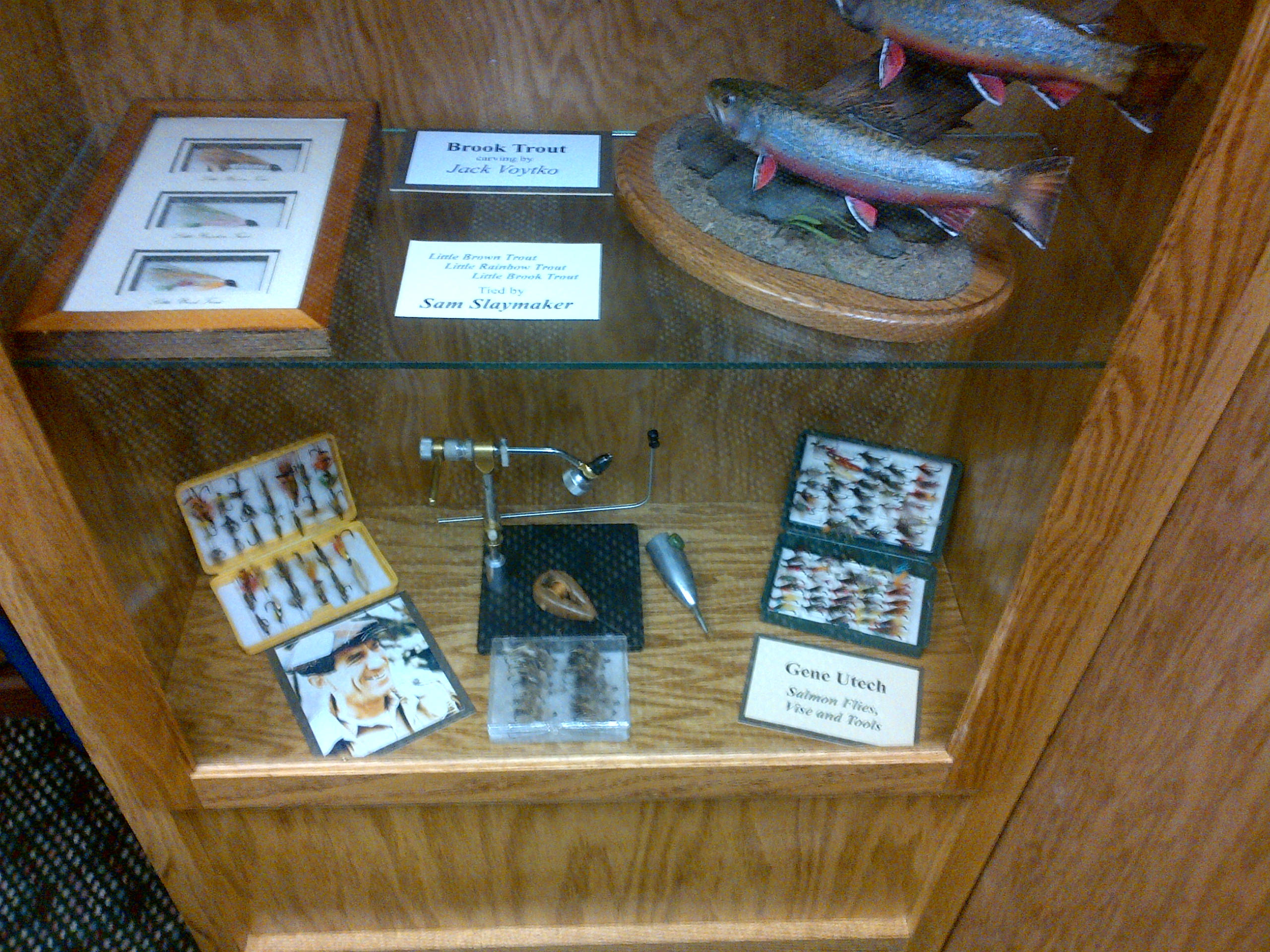
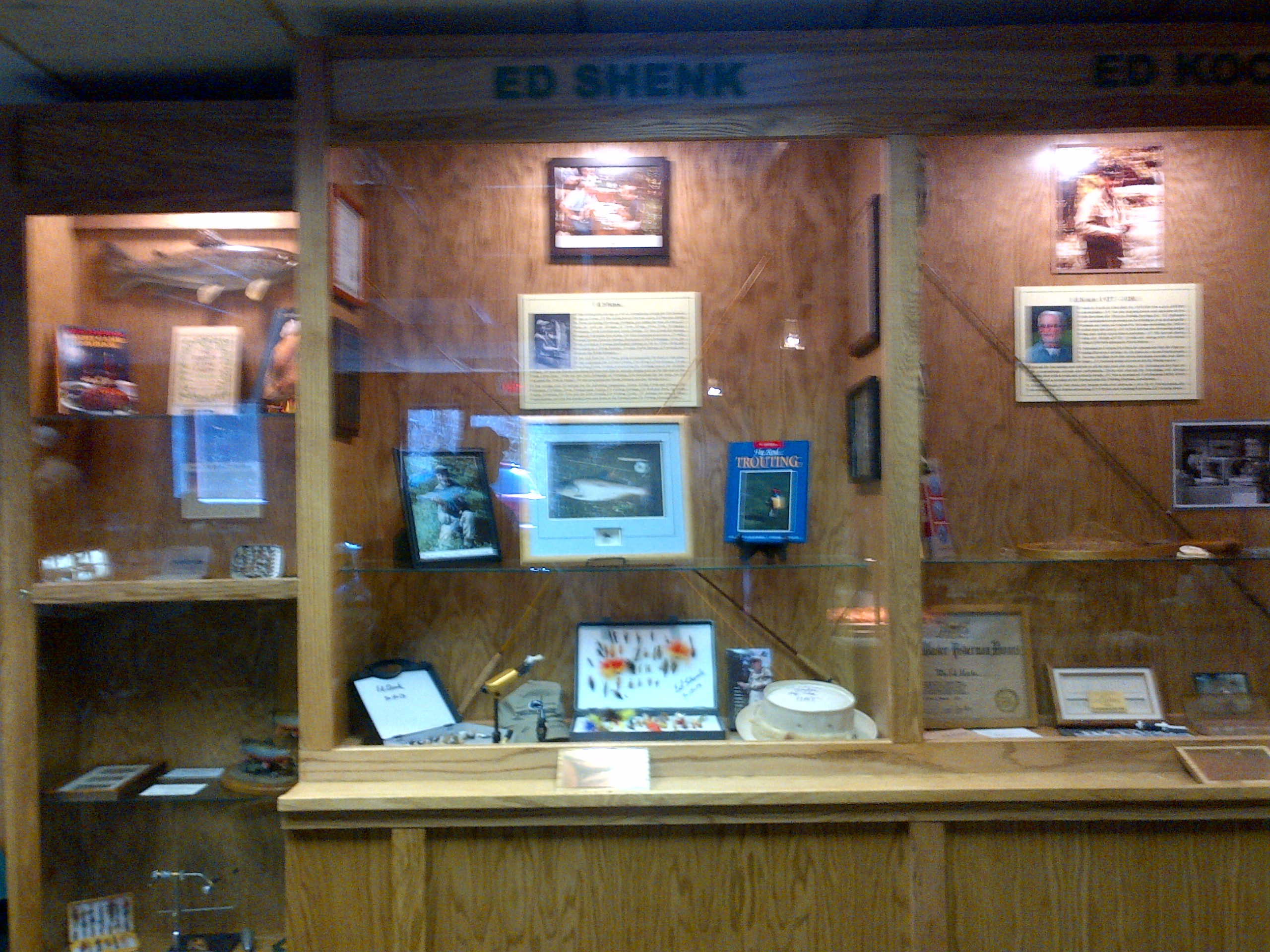
For me, the highlights of the visit included seeing a shelf devoted to Gene Utech, a master of wet fly fishing techniques.  Gene was a close friend, to whom I was introduced by fishing buddy John Bechtel.  Gene, sadly, is now deceased, but I am immensely happy his love of fly fishing will live on in this museum.  A second highlight of the visit was shaking Ed Shenk’s hand.  While I have done so numerous times before, shaking Ed’s aging hand at this particular time, after viewing the display devoted to him, held special significance.  The final highlight included meeting (or renewing acquaintances with) the numerous visitors who were sharing their handmade bamboo rods, flies, landing nets, and art with the public. I was particularly impressed with the affordable (truly affordable — no lie) yet stunning nets offered by Drawbaugh Outdoors (info@drawbaughoutdoors.com).  I will devote a separate post to them, however, as honest, affordable, handmade products deserve special attention these days.

Gene Utech's 80th, Yellow Breeches 3

Gene Utech’s 80th Birthday, on the Yellow Breeches

Any angler or lover of the outdoors (notice my avoidance of the term “nature,” the meaning of which is so very complicated) would enjoy the PA Fly Fishing Museum.  But it is equally true that such people would enjoy the literature produced by many of the people honored there.  One will find no more sincere a lover of the outdoors than Charlie Fox, who is quoted in the epigraph.  If you are a tree hugger and clean water lover — if you love the substances of this world, of which we are all made — he is your man.

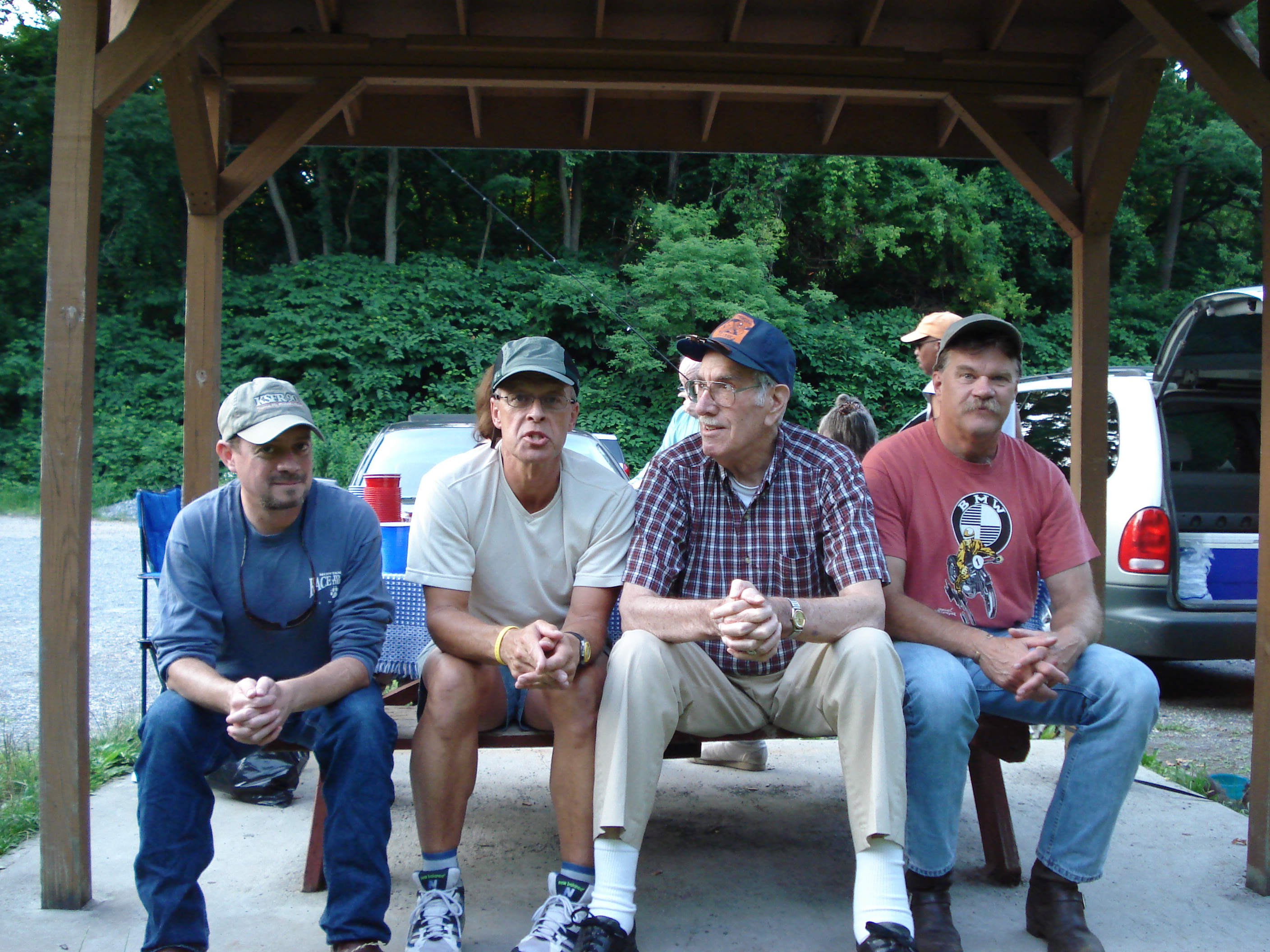
Please forgive the poor quality photos.  Most of them, with the exception of the birthday party photo by Leslie Bechtel, were taken on a camera phone.  I am simply too lazy (or focused upon the present) to carry a decent camera around.

Springtime and Wildness in Appalachia

April 1, 2013
IMG-20130330-00038

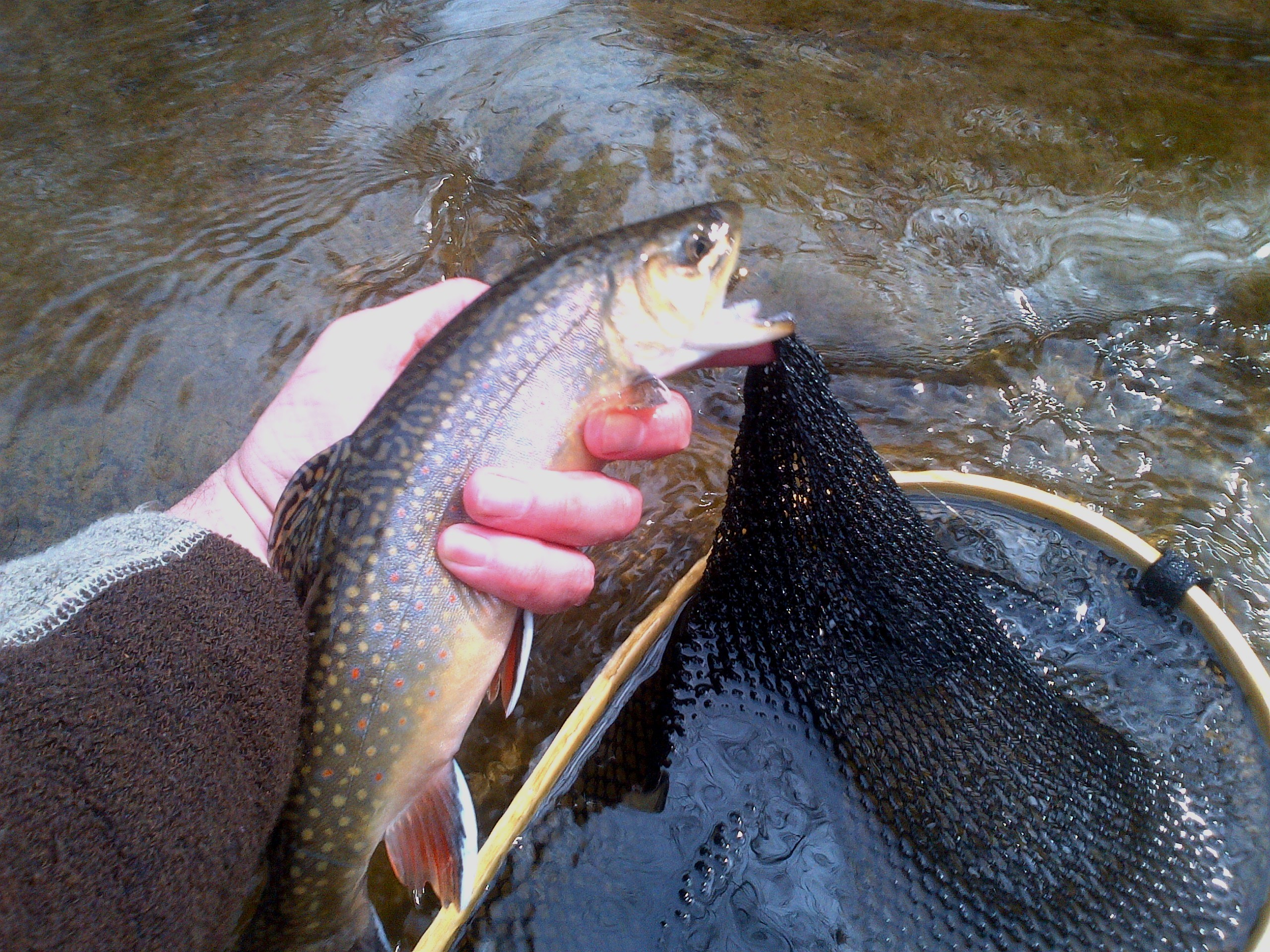
Wild, native Appalachian brook trout, caught last week (on a fly I first learned about while living in Arizona).

A tame animal is already invested with a certain falsity by its tameness. By becoming what we want it to be, it takes a disguise which we have decided to impose upon it.

Even a wild animal, merely “observed,” is not seen as it really is, but rather in the light of our investigation (color changed by fluorescent lighting).

But people who watch birds and animals are already wise in their way.

I want not only to observe but to know living things, and this implies a dimension of primordial familiarity which is simple and primitive and religious and poor.

This is the reality I need, the vestige of God in His Creatures.

Fr. Thomas Merton, O.C.S.O.  When the Trees say Nothing, edited by Kathleen Deignam (Notre Dame: Sorin Books, 2003), 45.  From Merton’s diaries, written at The Trappist Abbey of our Lady of Gethsemani, Kentucky.

IMG-20130330-00037

Black bear paw print at my favorite Southern Appalachian Stream. It’s an encouraging fact that black bears and brook trout still persist among all the other human and non-human immigrants to the American Southeast.

W.B. Yeats’ “The Fisherman”

March 20, 2013

I was reading A.A. Luce’s Fishing and Thinking (19590 today. Luce considered himself a great empiricist, inspired by philosopher George Berkeley. It stuck me as odd, then, that Luce was a fan of W.B. Yeats’ poetry. Yeats had a rather fanciful imagination.

Luce reflects upon the meaning of Yeats’ poem, “The Fisherman,” and wonders why this boyhood acquaintance and later colleague wrote about a fly fisher, instead of some other figure. Ultimately, he decides it is because angling “takes us out of ourselves, and confronts us with the comforting blank wall of something not ourselves, to which our sensing, imagining, thinking and action must conform” (Fishing and Thinking, 82).

Luce continues:

The fresh air, the open spaces, the physical exercise, the nature of the occupation and the objectivity of the chase combine to make angling a sedative and a general tonic for the occupational dis-ease of the man of letters; and if W.B. Yeats had found it so, as seems probable, it is no wonder that in later life he turned back nostalgically to the sport of his young and active days, and idealized it. (Fishing and Thinking, 83)

I do not agree with Luce about many things — I suppose I am more of a romantic than an empiricist — but I do share his admiration of Yeats and his belief that fly fishing calms our souls by connecting us with what something real, that is beyond ourselves.

“The Fisherman,” by W.B. Yeats, first published in Poetry, 1916.

Although I can see him still—

The freckled man who goes

To a gray place on a hill

In gray Connemara clothes

At dawn to cast his flies—

It’s long since I began

To call up to the eyes

This wise and simple man.

All day I’d looked in the face

What I had hoped it would be

To write for my own race

And the reality:

The living men that I hate,

The dead man that I loved,

The craven man in his seat,

The insolent unreproved—

And no knave brought to book

Who has won a drunken cheer—

The witty man and his joke

Aimed at the commonest ear,

The clever man who cries

The catch cries of the clown,

The beating down of the wise

And great Art beaten down.

Maybe a twelve-month since

Suddenly I began,

In scorn of this audience,

Imagining a man,

And his sun-freckled face

And gray Connemara cloth,

Climbing up to a place

Where stone is dark with froth,

And the down turn of his wrist

When the flies drop in the stream—

A man who does not exist,

A man who is but a dream;

And cried, “Before I am old

I shall have written him one

Poem maybe as cold

And passionate as the dawn.

Chasing “mamiiksi” near Raven’s Home

March 15, 2013

DSC02430

I visit Southern Alberta, in Canada, regularly.  My family has roots in the area, primarily on the other side of the Alberta/Montana border, in Glacier National Park and on the Blackfeet Reservation. Also, my academic work has brought me to this area many times over the years to visit with Blackfoot religious leaders and practitioners, primarily among the North Piikani Blackfoot band. These days, my visits are also personally motivated.  I have many friends here, and there is some pretty great fishing too.

In the Blackfoot language, the word for fish (plural) is mamiiksi. There are a lot of them in Blackfoot Country, though  their abundance does not mean that they are easily caught. In addition to the wiliness and strength of the mamiiksi, anglers must deal with some truly brutal winds and generally unpredictable weather.

DSC02401

I managed to make a couple of very quick trips to my favorite rivers in Southern Alberta this week.  I did so in between bouts of bad weather and grading different stacks of midterm exams and papers.  I had hoped to get out again today, but the temperature dropped thirty degrees.  Still, my short times at the rivers were enjoyable.

IMG-20130313-00019

My priority during these visits to Alberta is to enjoy the company of friends and to learn from them.   Much of what I have learned actually complements my fishing excursions.  This is because, for me, fly fishing is about experiencing a place and its inhabitants, not just catching fish.

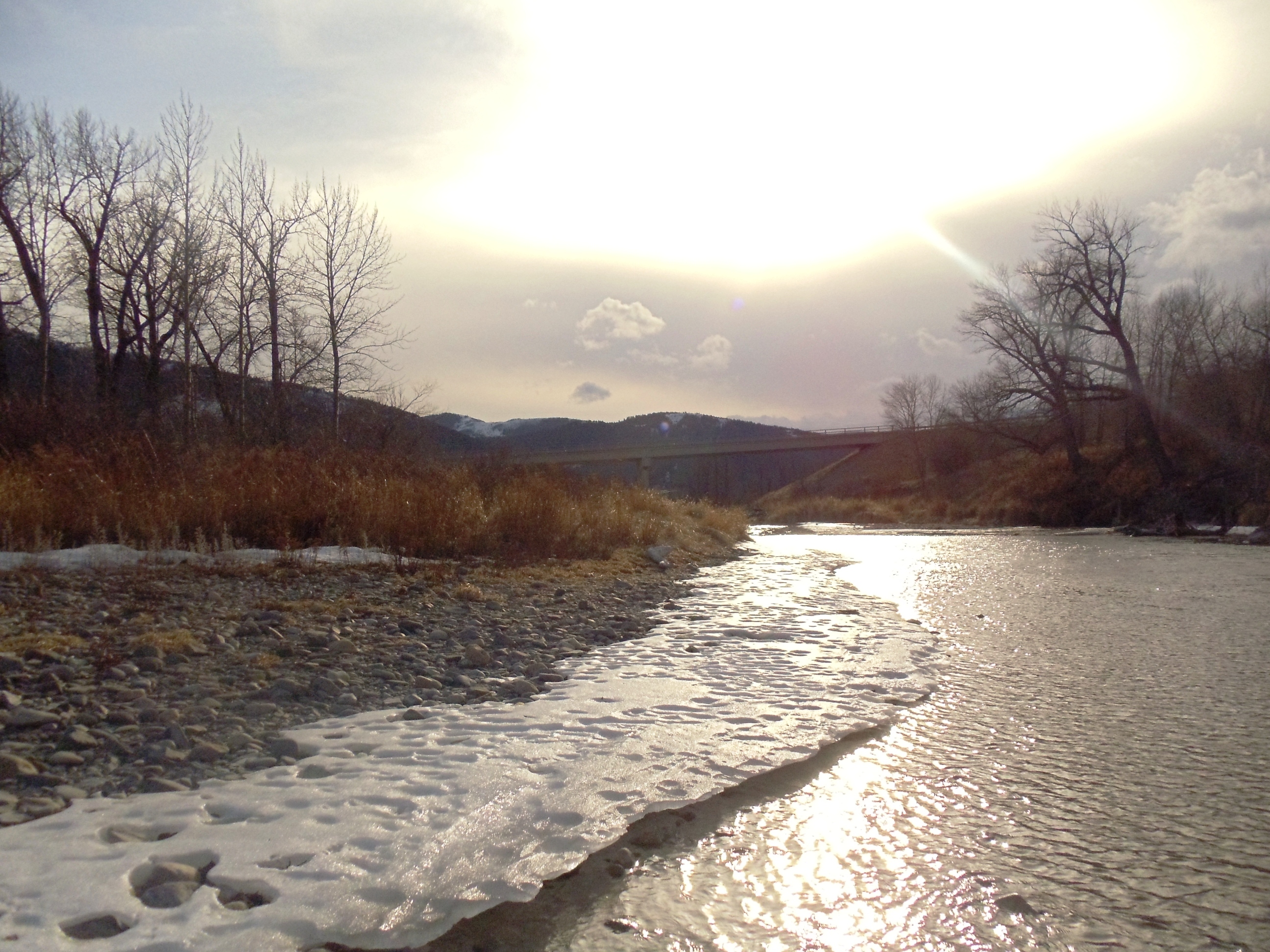
One of my favorite rivers in the area — the river in which I hooked an 18-inch rainbow (pictured above) with a size 20 thread midge yesterday — is the Crowsnest River.  This river flows through an area that is particularly sacred to the Blackfeet.  It’s best not to talk in detail about such places, but let me just say that it is associated with Omahkai’stoo or Raven (literally, “big crow”). Thus, in a sense, the entire area is Raven’s back yard.  He happens to have jurisdiction over winter, as well.  But the rivers are not his. They are the dominion of the “Underwater People.” Fortunately for me, the Underwater People were willing to share some mamiiksi with me during this trip.

DSC02415

I thank my wife for allowing me these trips that are so important to me, professionally and personally.  Of course, I thank my many human friends here, and the non-human persons too, for being such wonderful hosts.  But, it isn’t all roses (FYI, the province calls Southern Alberta “Wild Rose Country”).

Last night, I was leaving a store when a young Piikani man approached me and said, “You look like a nice, kind cowboy.”  He then asked me for some money to get back to the reserve, up the road.  Of course, I’ve been hit up for money by people all around the world.  But this guy had a really pained look in his eyes.  He wasn’t a regular drunk; he was a guy who was wrapping up a particularly bad bender.  He probably knew that he had caused a lot of people a lot of pain in the past few days.  He apologized for asking for money from me with tears in his eyes.  I saw him again this morning, as I had a coffee with a Piikani friend.  The young man came over and greeted my friend in the Blackfoot language, before saying that he needed some help.  My friend asked him what sort of help he needed.  For a moment, I thought that the young man had made an important decision to improve his life.  You see, my friend is a traditional religious elder. Unfortunately, the young man just wanted some more money. Anyway, I hope he made it home. And I hope he is working hard to mend the many things he probably broke during his bender.

In many ways, I consider this area and neighboring northwestern Montana — where I grew up and where my family lives — home. For now, though, life circumstances dictate that I am a visitor. And as much I love it here, I am eager to get back “home” to my beautiful wife, my wonderful daughter, and my fuzzy dog in the East. I’m sure I’ll be back here soon enough, chasing mamiiksi once again very near to Raven’s own home.

“The Retirement”

March 3, 2013

Izaak Walton first published his immensely popular The Compleat Angler or, The Contemplative Man’s Recreation in 1653.  In 1676, he published the fifth edition of his book, with an added section on fly fishing.  This section, as anyone familiar with the book knows, was authored at Walton’s invitation by poet Charles Cotton.

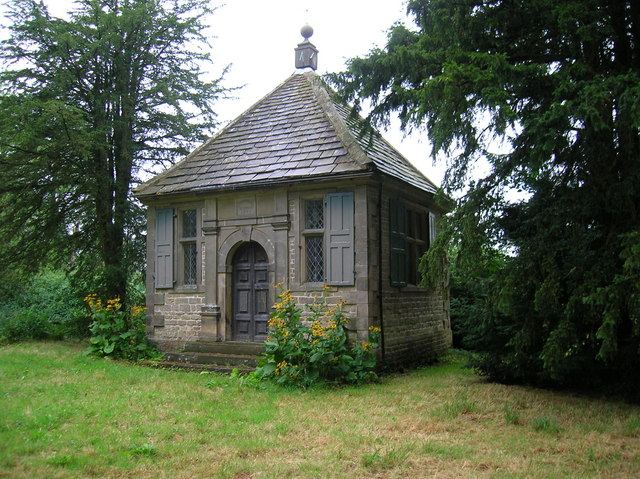
Walton and Cotton were very close.  Cotton described himself, in correspondence between the two, as Walton’s “son.”  He also dedicated one of his own poems to his much older “father,” mentor, and fishing companion.  This poem is entitled “The Retirement.”  In content, it seems to speak to Walton’s profound love for the English country landscape, and specifically The River Dove, which the two friends fished together (Cotton’s fishing house, which he shared with Walton, is pictured below).

   © Copyright neil gibbs

Creative Commons Licence [Some Rights Reserved]   © Copyright neil gibbs

Upon a close reading, though, it is clear that many of the sentiments are, understandably, Cotton’s.  In his section of The Compleat Angler, Walton praises intimate companionship with fellow sportsmen as highly as he does the landscape created by his “God of Nature.”  (His attitude is remarkably sunny, considering that he published the book just after the conclusion of the long, bloody English Civil War).  Yet, in “The Retirement,”  Cotton speaks longingly of the “solitude,” “safety,” and “privacy” that he can sometimes find on The River Dove.  Moreover, it is quite clear that Walton had no interest in “retirement,” whether on a stream or elsewhere.  After all, he spent many of his last years working on further editions of The Compleat Angler.  In fact, he was 83 years old, when he published the fifth edition.  Still, “The Retirement” is a lovely and all-too-often overlooked poem, which Walton no doubt appreciated, even if it didn’t precisely capture his feelings about fishing and old age.

“The Retirement”*

I.

Farewell, thou busy world! and may
We never meet again;
Here I can eat and sleep, and pray,
And do more good in one short day,
Than he, who his whole age outwears
Upon the most conspicuous theaters,
Where naught but vanity and vice do reign.

II.

Good God! how sweet are all things here!
How beautiful the fields appear!
How cleanly do we feed and lie!
Lord! what good hours do we keep!
How quietly we sleep!
What peace! what unanimity!
How innocent from the lewd fashion
Is all our business, all our recreation!

III.

O, how happy here’s our leisure!
O, how innocent our pleasure!
O ye valleys! O ye mountains!
O ye groves, and crystal fountains!
How I love at liberty,
By turns to come and visit ye!

IV.

Dear solitude, the soul’s best friend,
That man acquainted with himself dost make,
And all his Maker’s wonders to entend,
With thee I here converse at will,
And would be glad to do so still,
For it is thou alone that keep’st the soul awake.

V.

How calm and quiet a delight
Is it alone
To read, and meditate, and write;
By none offended, and offending none!
To walk, ride, sit, or sleep at one’s own ease,
And, pleasing a man’s self, none other to displease!

VI.

O my beloved nymph, fair Dove!
Princess of Rivers! how I love
Upon thy flowery banks to lie,
And view thy silver stream,
When gilded by a summer’s beam
And in it all thy wanton fry
Playing at liberty;
And, with my angle, upon them,
The all of treachery
I ever learned industriously to try.

VII.

Such streams, Rome’s yellow Tiber cannot show,
The Iberian Tagus, or Ligurian Po;
The Maese, the Danube, and the Rhine,
Are puddle-water all, compared with thine;
And Loire’s pure streams yet too polluted are
With thine, much purer, to compare;
The rapid Garonne and the winding Seine,
Are both too mean,
Beloved Dove, with thee
To vie priority;
Nay, Thame and Isis, when conjoined submit,
And lay their trophies at thy silver feet.

VIII.

O my beloved rocks, that rise
To awe the earth and brave the skies!
From some aspiring mountain’s crown,
How dearly do I love,
Giddy with pleasure, to look down,
And from the vales to view the noble heights above!
O my beloved caves! from Dog-star’s heat,
And all anxieties, my safe retreat;
What safety, privacy, what true delight,
In th’ artificial night
Your gloomy entrails make,
Have I taken, do I take!
How oft, when grief has made me fly,
To hide me from society,
Ev’n of my dearest friends, have I
In your recesses’ friendly shade,
All my sorrows open laid,
And my most secret woes intrusted to your privacy!

IX.

Lord! would men let me alone,
What an over-happy one
Should I think myself to be,
Might I, in this desert place,
Which most men in discourse disgrace,
Live but undisturbed and free!
Here, in this despised recess,
Would I, maugre Winter’s cold,
And the Summer’s worst excess,
Try to live out to sixty full years old!
And, all the while,
Without an envious eye,
On any thriving under Fortune’s smile,
Contented live, and then–contented die.

C.C.

*This version of “Retirement” is taken from Izaak Walton and Charles Cotton, The Compleat Angler, or The Contemplative Man’s Recreation, with an Introduction by Howell Raines  (New York: The Modern Library, 1996).   The Modern Library’s text is based upon the 1889 edition of The Compleat Angler, published by James Russell Lowell.

Oh, Sleep. Come on me soon.

February 13, 2013

I must get more sleep.  My tiredness is manifesting itself in my dreams.  Last night, I dreamt that I was nodding off while fly fishing in a stream.  The realization that a huge  rainbow trout (not unlike one I caught the other day, in my wakened life) was crossing the stream to take my fly brought me to attention.  Of course, just as the dream was getting good, my daughter woke me up.  It was much nicer being woken by the dream trout.

As I head to bed, then, I share this David Gilmour song, “So far Away.”   In the lyrics, Gilmour pleads, “Oh, Sleep. Come on me soon.”  Beautiful song.

Blackfoot Country Fly

February 12, 2013

I have written before about the history of fishing in Niitawahssin — the historical territory in Montana and Alberta of the Niitsitapiiksi or Blackfoot People (the name actually means “Real People”).  Recently, I came across mention of a fly that seems to have originated there.

Not long ago, I acquired the hardbound version of the late George Grant’s book, Montana Trout Flies (Champoeg Press, 1981). This book is an amazing source of information about Montana fly fishing, written by one of the true masters of Montana’s unique fly tying styles.  This makes the book’s rarity very frustrating.  The interested person can purchase a reprint of Grant’s first edition (1971), which was self-published, from the Big Hole River Foundation.  Unfortunately, only the long out-of-print hardback copy includes colored plates of the historical flies described by Grant.

DSC02346

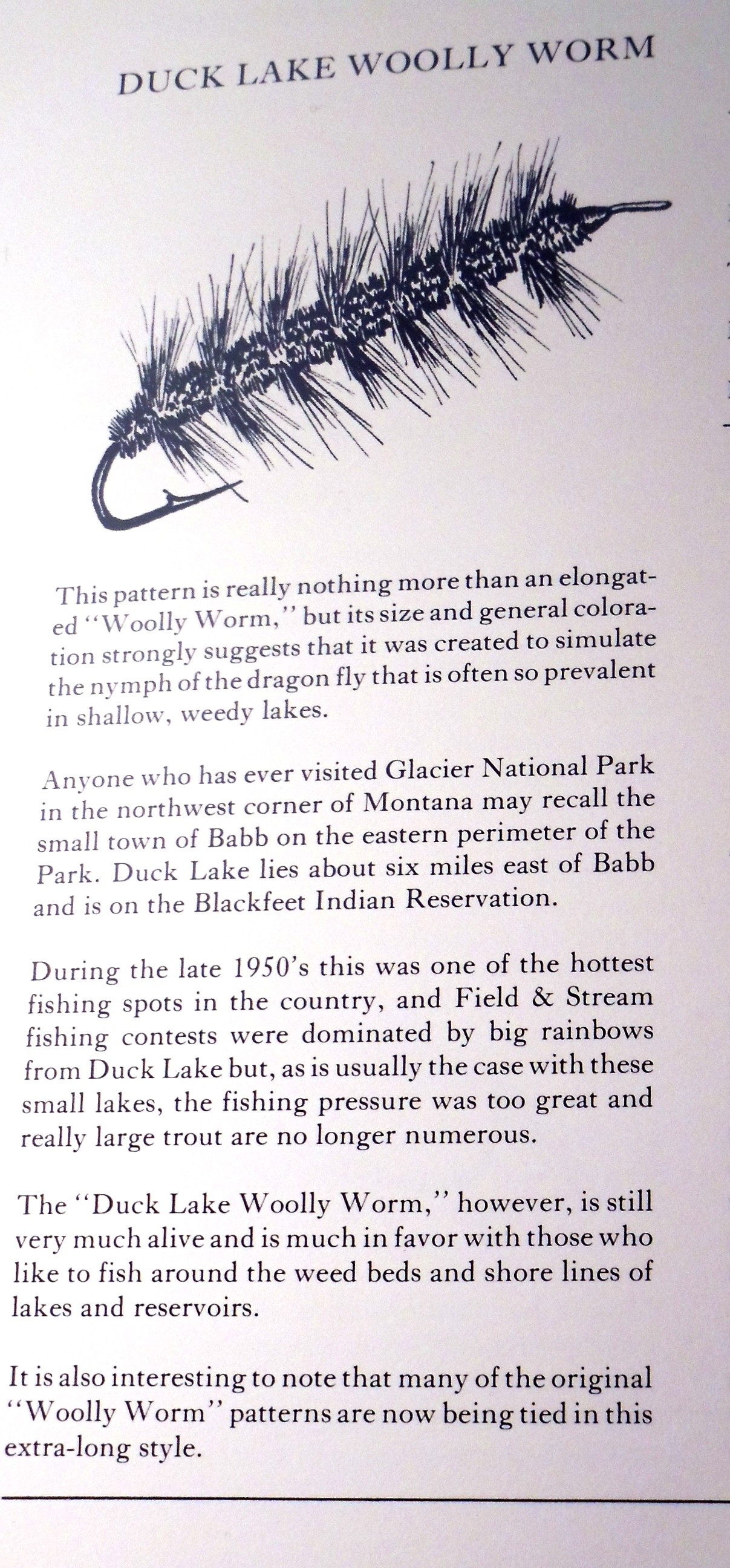
Among these is the “Duck Luck Woolly Worm.”  As most people know, Duck Lake is on the Blackfeet Reservation in Montana, and during certain periods (including now, I am told) it has been an amazing rainbow trout fishery.  Grant writes that the Duck Lake Woolly Worm was particularly popular among white sportfishers visiting the reservation in the 1950’s, but he does not address its origin.  As far as I can tell, fly fishing was practiced in the area as early as the 1870’s and was probably picked up by a few Blackfeet not long after.  It is entirely possible that the Duck Lake Woolly Worm was first tied by a tribal member.  Either way, it is exciting to see that a particular fly can be traced to Blackfoot Country.

DSC02355

After inspecting Grant’s color image of the Duck Lake Woolly Worm (unfortunately, he does not identify the maker of this particular fly), I remembered seeing several of them among my grandfather’s flies.  This makes perfect sense, since my grandfather spent a great deal of time on and near the Blackfeet Reservation.  He passed away when I was still young, however.  So, I obviously won’t be learning anything more about the fly from family sources.  If any one else has some information, please share it.  And if you are interested in fishing at Duck Lake, contact tribal member Joe Kipp, who runs Morning Star Outfitters.

Most Eloquent Insult ever Recorded in Fishing Literature.

February 1, 2013

I have been reading Dialogue between a Hunter and a Fisher, first published by Fernando Basurto in 1539.  It is translated from the Spanish by Richard C. Hoffman and can be found in his Fisher’s Craft and Lettered Art: Tracts of Fishing from the End of the Middle Ages (Toronto: University of Toronto Press, 1997).  I have resolved to memorize the Fisher’s (F’s) first line, below.  I think I could find plenty of use for it, both on and off the stream.

F: I am not such a fool that I am not very wise next to you, for you are not wise enough to understand me, nor I simple enough to understand you.  And if I answer you from Ephesians, it is because you question me from Corinthians. And above all you say that my works are low.  If you gentlemen hunters would judge you own [works] with discretion you would see that those of the poor fishers are of more carats than those of the rich hunters.

H: You are not right to say that ….

15th century German Fishing Humor

January 21, 2013

The “burlesque” below is taken from Wie man fisch und vögel fahen soll (How to Catch a Fish), by Jacob Köbel, Heidelberg, 1493.   This version is edited and translated by Richard C. Hoffman and can be found in Hoffman’s Fisher’s Craft and Lettered Art: Tracts of Fishing from the End of the Middle Ages (Toronto: University of Toronto Press, 1997).   I can, at least, agree with Köbel’s characterizations of the salmon, trout, and grayling.

This is a burlesque comparison of fish.

Item a stickleback is a king.  A fresh-run salmon a lord.  A carp a knave.  A pike a robber.  A barbell a tailor.  An eel a trickster.  A nose a scribe.  A roach a cat.  A dace a bastard.  A perch a knight.   A ruffe a goldsmith.  A lampern a child.  A gudgeon a virgin.  A miller’s thumb a horse nail.  A minor a grocer.  A bitterling the grocer’s helper.  A brook lamprey a piper.  A trout a forester.  A grayling a count of the Rhine.  A crayfish a digger.  A spined loach a watchman.  A burbot a thief.  A bleak a launderer.