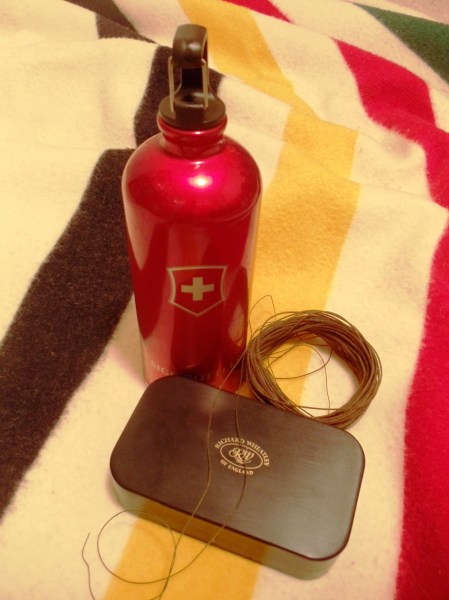
A Wheatley fly box, a Thebault silk fly line, a classic Sigg bottle, and a Pendleton blanket. None of them are plastic. All of them will serve their purpose for a century or more.
The influential French thinker Roland Barthes examined what he considered as the ideologies connected to numerous materials in his 1957 text, Mythologies. The text, translated to English in 1972, served as an important stepping stone in the development of what we now know as postmodern philosophy, which emerged in the 1970’s. Among other things, Postmodernism contested the “Western” cultural narrative of scientific “progress,” which, among many other things, suggests that humans might move away from a reliance upon natural materials, as they achieve greater ability to manipulate more artifactual materials. Postmodernism has lost much of its influence, in part because it became an odd sort of narrative of progress itself. And the narrative of scientific progress still dominates much of the world. In regards to how this latter persistent narrative still shapes our view of material, just think about the excitement displayed over the development of 3D printing.
In one of the essays included in Mythologies, Barthes wrote critically about the highly artifactual material–what he called an “imitation material”–plastic:
In the hierarchy of the major poetic substances, it figures as a disgraced material, lost between the effusiveness of rubber and the flat hardness of metal; it embodies none of the genuine produce of the mineral world: foam, fibres, strata. It is a ‘shaped’ substance: whatever its final state, plastic keeps a flocculent appearance, something opaque, creamy, curdled, something powerless ever to achieve the triumphant smoothness of Nature. But what best reveals it for what it is is the sound it gives, at once hollow and flat; its noise is its undoing, as are its colours, for it seems capable of retaining only the most chemical-looking ones.
I am not a postmodernist. I am not a post-anything. But, like Barthes and later philosophers, I am concerned about the dominant narrative of “progress.” And, simply put, I’m not a fan of plastic. I should note for flyfishing readers that I am also not one of those elitists who maligns graphite rods by mislabeling them as “plastic.” Clearly, graphite rods do not fit into Barthes’ descriptions of plastic. I like graphite, glass, and bamboo rods, so long as all of them are things have been crafted or worked with care, rather than simply molded or “shaped.”
Why am I then rambling on about such things, you may ask. It is because I was recently thinking about how much I enjoy things that are crafted to last–to take hard knocks but to still function for many, many years. Plastic lasts, of course. But it also breaks, deteriorates, and otherwise ages in ways that make it no longer useful. What prompted me to think about all of this was my putting some flies into a Wheatley fly box. These boxes have been made for well over a hundred years, and many of the earliest examples are still perfectly functional. Dented and scuffed, yes. But irreparably broken? No.
Part of the narrative of progress seems to involve a movement toward greater convenience and disposability. For many of the same reasons that Roland Barthes criticized the world around him, I reject that narrative.








 The Literary Fly Fisher