Archive for the ‘The Environment’ Category

Springtime and Wildness in Appalachia

April 1, 2013
IMG-20130330-00038

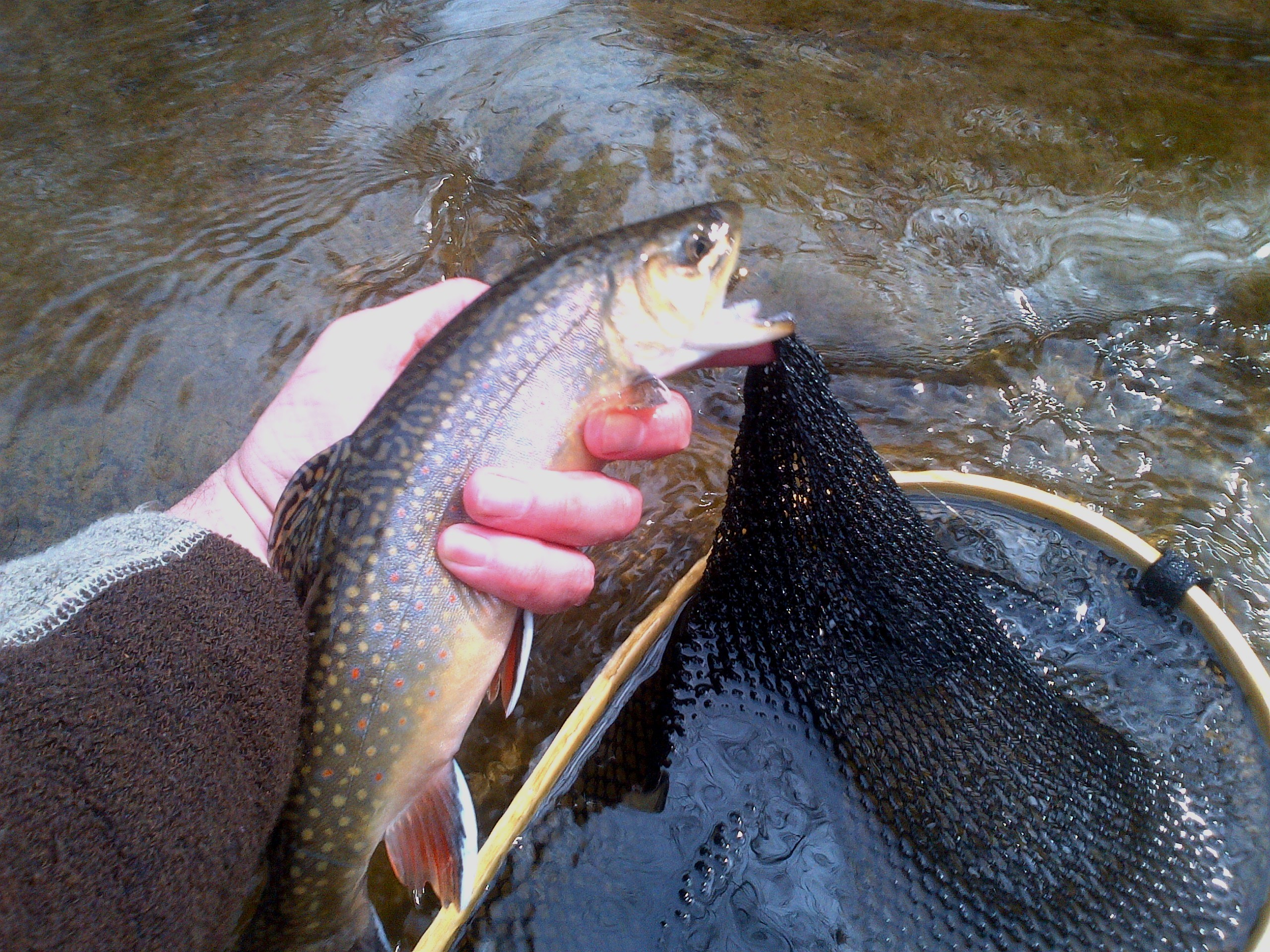
Wild, native Appalachian brook trout, caught last week (on a fly I first learned about while living in Arizona).

A tame animal is already invested with a certain falsity by its tameness. By becoming what we want it to be, it takes a disguise which we have decided to impose upon it.

Even a wild animal, merely “observed,” is not seen as it really is, but rather in the light of our investigation (color changed by fluorescent lighting).

But people who watch birds and animals are already wise in their way.

I want not only to observe but to know living things, and this implies a dimension of primordial familiarity which is simple and primitive and religious and poor.

This is the reality I need, the vestige of God in His Creatures.

Fr. Thomas Merton, O.C.S.O.  When the Trees say Nothing, edited by Kathleen Deignam (Notre Dame: Sorin Books, 2003), 45.  From Merton’s diaries, written at The Trappist Abbey of our Lady of Gethsemani, Kentucky.

IMG-20130330-00037

Black bear paw print at my favorite Southern Appalachian Stream. It’s an encouraging fact that black bears and brook trout still persist among all the other human and non-human immigrants to the American Southeast.

W.B. Yeats’ “The Fisherman”

March 20, 2013

I was reading A.A. Luce’s Fishing and Thinking (19590 today. Luce considered himself a great empiricist, inspired by philosopher George Berkeley. It stuck me as odd, then, that Luce was a fan of W.B. Yeats’ poetry. Yeats had a rather fanciful imagination.

Luce reflects upon the meaning of Yeats’ poem, “The Fisherman,” and wonders why this boyhood acquaintance and later colleague wrote about a fly fisher, instead of some other figure. Ultimately, he decides it is because angling “takes us out of ourselves, and confronts us with the comforting blank wall of something not ourselves, to which our sensing, imagining, thinking and action must conform” (Fishing and Thinking, 82).

Luce continues:

The fresh air, the open spaces, the physical exercise, the nature of the occupation and the objectivity of the chase combine to make angling a sedative and a general tonic for the occupational dis-ease of the man of letters; and if W.B. Yeats had found it so, as seems probable, it is no wonder that in later life he turned back nostalgically to the sport of his young and active days, and idealized it. (Fishing and Thinking, 83)

I do not agree with Luce about many things — I suppose I am more of a romantic than an empiricist — but I do share his admiration of Yeats and his belief that fly fishing calms our souls by connecting us with what something real, that is beyond ourselves.

“The Fisherman,” by W.B. Yeats, first published in Poetry, 1916.

Although I can see him still—

The freckled man who goes

To a gray place on a hill

In gray Connemara clothes

At dawn to cast his flies—

It’s long since I began

To call up to the eyes

This wise and simple man.

All day I’d looked in the face

What I had hoped it would be

To write for my own race

And the reality:

The living men that I hate,

The dead man that I loved,

The craven man in his seat,

The insolent unreproved—

And no knave brought to book

Who has won a drunken cheer—

The witty man and his joke

Aimed at the commonest ear,

The clever man who cries

The catch cries of the clown,

The beating down of the wise

And great Art beaten down.

Maybe a twelve-month since

Suddenly I began,

In scorn of this audience,

Imagining a man,

And his sun-freckled face

And gray Connemara cloth,

Climbing up to a place

Where stone is dark with froth,

And the down turn of his wrist

When the flies drop in the stream—

A man who does not exist,

A man who is but a dream;

And cried, “Before I am old

I shall have written him one

Poem maybe as cold

And passionate as the dawn.
Chasing “mamiiksi” near Raven’s Home

March 15, 2013

DSC02430

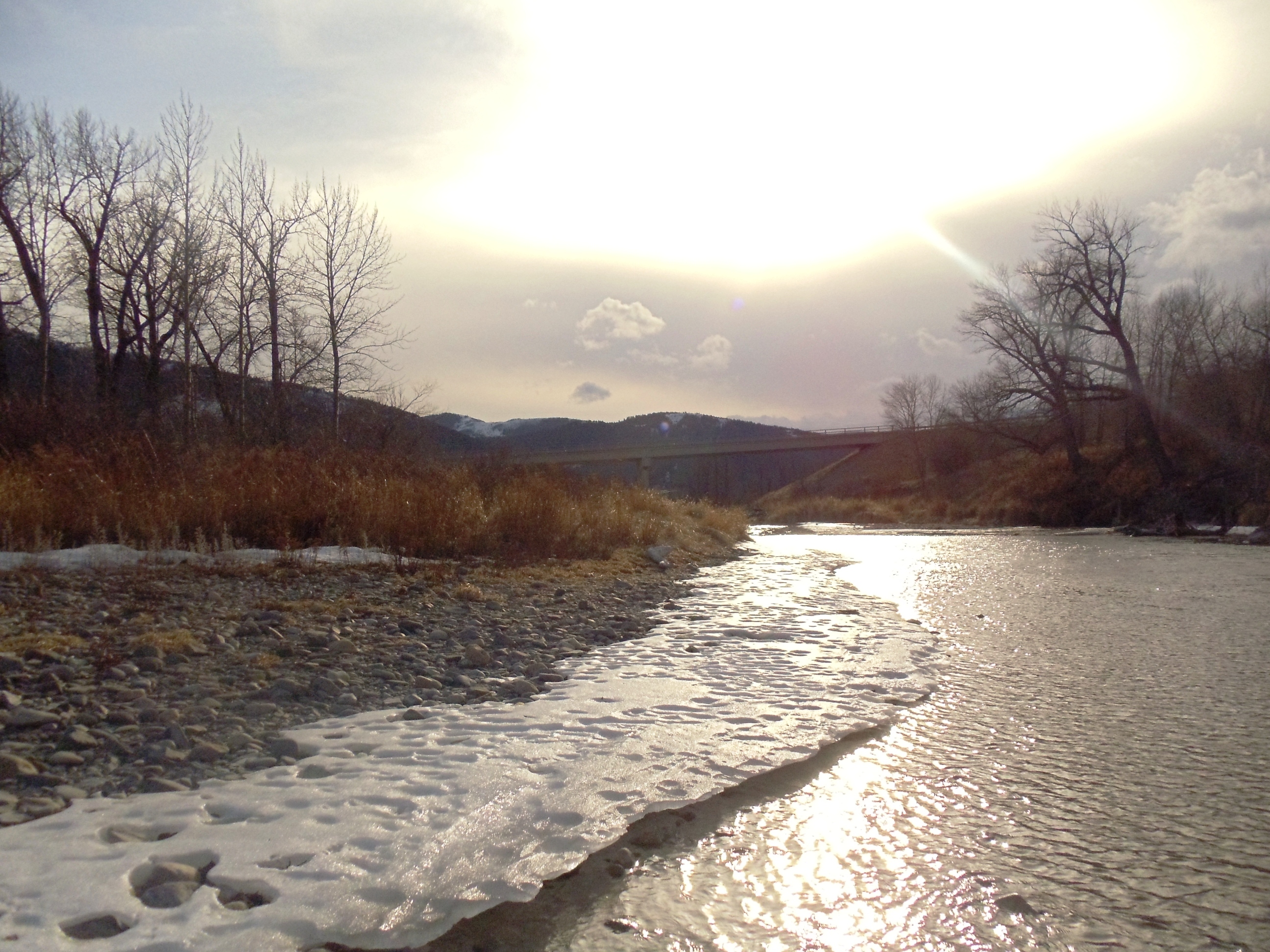
I visit Southern Alberta, in Canada, regularly.  My family has roots in the area, primarily on the other side of the Alberta/Montana border, in Glacier National Park and on the Blackfeet Reservation. Also, my academic work has brought me to this area many times over the years to visit with Blackfoot religious leaders and practitioners, primarily among the North Piikani Blackfoot band. These days, my visits are also personally motivated.  I have many friends here, and there is some pretty great fishing too.

In the Blackfoot language, the word for fish (plural) is mamiiksi. There are a lot of them in Blackfoot Country, though  their abundance does not mean that they are easily caught. In addition to the wiliness and strength of the mamiiksi, anglers must deal with some truly brutal winds and generally unpredictable weather.

DSC02401

I managed to make a couple of very quick trips to my favorite rivers in Southern Alberta this week.  I did so in between bouts of bad weather and grading different stacks of midterm exams and papers.  I had hoped to get out again today, but the temperature dropped thirty degrees.  Still, my short times at the rivers were enjoyable.

IMG-20130313-00019

My priority during these visits to Alberta is to enjoy the company of friends and to learn from them.   Much of what I have learned actually complements my fishing excursions.  This is because, for me, fly fishing is about experiencing a place and its inhabitants, not just catching fish.

One of my favorite rivers in the area — the river in which I hooked an 18-inch rainbow (pictured above) with a size 20 thread midge yesterday — is the Crowsnest River.  This river flows through an area that is particularly sacred to the Blackfeet.  It’s best not to talk in detail about such places, but let me just say that it is associated with Omahkai’stoo or Raven (literally, “big crow”). Thus, in a sense, the entire area is Raven’s back yard.  He happens to have jurisdiction over winter, as well.  But the rivers are not his. They are the dominion of the “Underwater People.” Fortunately for me, the Underwater People were willing to share some mamiiksi with me during this trip.

DSC02415

I thank my wife for allowing me these trips that are so important to me, professionally and personally.  Of course, I thank my many human friends here, and the non-human persons too, for being such wonderful hosts.  But, it isn’t all roses (FYI, the province calls Southern Alberta “Wild Rose Country”).

Last night, I was leaving a store when a young Piikani man approached me and said, “You look like a nice, kind cowboy.”  He then asked me for some money to get back to the reserve, up the road.  Of course, I’ve been hit up for money by people all around the world.  But this guy had a really pained look in his eyes.  He wasn’t a regular drunk; he was a guy who was wrapping up a particularly bad bender.  He probably knew that he had caused a lot of people a lot of pain in the past few days.  He apologized for asking for money from me with tears in his eyes.  I saw him again this morning, as I had a coffee with a Piikani friend.  The young man came over and greeted my friend in the Blackfoot language, before saying that he needed some help.  My friend asked him what sort of help he needed.  For a moment, I thought that the young man had made an important decision to improve his life.  You see, my friend is a traditional religious elder. Unfortunately, the young man just wanted some more money. Anyway, I hope he made it home. And I hope he is working hard to mend the many things he probably broke during his bender.

In many ways, I consider this area and neighboring northwestern Montana — where I grew up and where my family lives — home. For now, though, life circumstances dictate that I am a visitor. And as much I love it here, I am eager to get back “home” to my beautiful wife, my wonderful daughter, and my fuzzy dog in the East. I’m sure I’ll be back here soon enough, chasing mamiiksi once again very near to Raven’s own home.