Archive for the ‘The Arts’ Category

Opinel “Trout” Knife

October 5, 2014

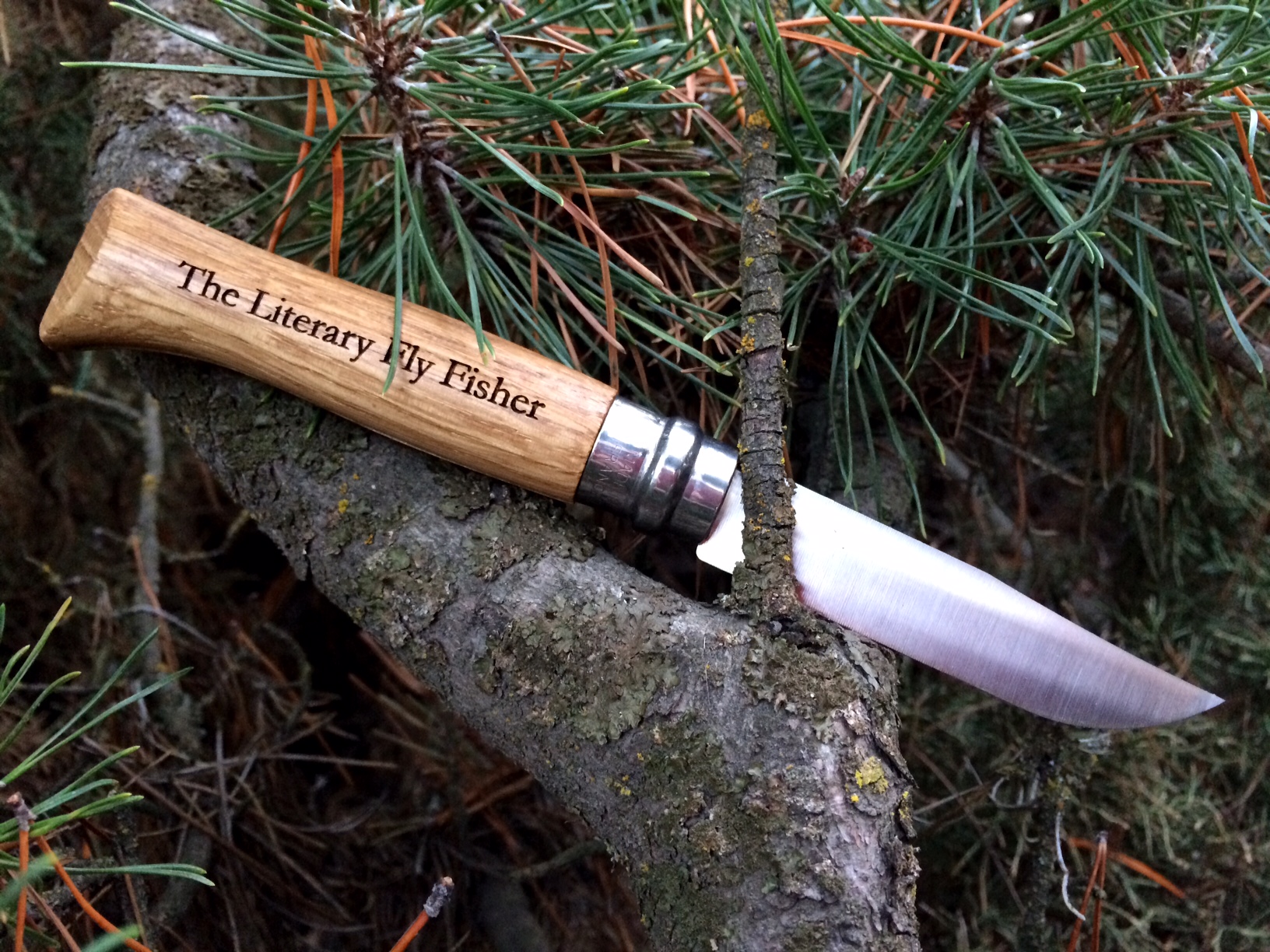
I discovered recently that the venerable French maker of  knives, Opinel, offers a model with trout engraved on an oak handle.  Opinel has made simple, folding knives, in a variety of numbered sizes, for over 100 years.  Despite their continued popularity and the fact that they are still made in France, Opinel knives remain very affordable to the working people for whom they were originally intended.

photo opinel 2

Today, Opinel knives are popular enough among outdoors persons that Patagonia sells them along with its own products.  Patagonia describes the Opinel No. 8 that they offer, online, they describe their Opinel No. 8:

If we made knives, this is the one we’d want to make. The Opinel folding knife, with its clean, simple design and remarkable utility, has been prized by adventurers, artists and chefs for more than 100 years. This modern version of the classic Opinel No8 features a 3-1/4” stainless steel blade and beautiful olive-wood handle. It fits easily in a pocket, but also comes with a leather belt sheath for easier access. Packaged in a wooden, slide-top box.

You can read about the Opinel No. 8, oak-handled “trout” knife, available directly (and much less expensively) from Opinel, at their website. You will notice that they offer custom engraving.  When ordering one, I could not resist making use of this service. It has been a handy companion during my time beyond the paved world.

photo opinel

A Father’s Songs and a Daughter’s Memoir

September 27, 2014
Stoddart

Thomas Tod Stoddart, as pictured in Angling Songs.

In 1889, Anna M. Stoddart published a loving memoir of her father, Thomas Tod Stoddart (1810-1880),  along with a collection of verses written by him (some of which were previously published).  Most of these verses have to do with fishing.  Thomas Stoddart was licensed to practice law, but he seems to have spent most of his life writing and engaged in fishing and fishing related activities. He was particularly involved in conservation. Living in Kelso, Scotland, the Rivers Tweed and Teviot received most of his attention. Besides his writer daughter, he had two other children-both boys. To illustrate how seriously the senior Stoddart took his identity as an angler, daughter Anna writes:

My father called one day on Henry Glassford Bell, and the genial Sheriff hailed him with the very natural question, “Well, Tom, and what are you doing now?” With a moment’s resentment, my father brought his friend to his bearings. “Doing? Man, I’m an angler.”

Angling Songs, with a Memoir

Angling Songs, with a Memoir

I can relate to Thomas Stoddart, as he responds to Bell. If my own daughter were ever to write a memoir about me after my death, she might very well include a similar story, to illustrate just how passionate about fly fishing I was. She could not describe me as a poet, however; in that way I am different from Thomas Stoddart.  Thus, due in part to my own lack of talent, I include two of the “songs” written by Thomas and published by Anna in Angling Songs, with a Memoir.

THE FAIRY ANGLER

I.
‘Twas a bland summer’s eve, when the forest I trod;
The dew-gems were starring the flowers of the sod,
And “faire mistress moone,” as she rose from the sea,
Shed apart the green leaves of each shadowing tree.

II.
I passed by a brook, where her silvers lay flung,
Among knolls of wild fern it witchingly sung,
While a long fairy angler with glimmering hand
From the odorous banks waved her delicate wand.

III.
In silence I watched, as with eager intent
O’er the moon-silvered water she gracefully bent,
And plied with green rush-rod, new torn from its bed,
Her line of the thorn-spider’s mystical thread.

IV.
A pannier of moss-leaves her shoulder’s bedecked,
The nest of some bird, with the night winds had wrecked,
Slung round with a tendril of ivy so gay,
And a belt of stream flowers bound her woodland array.

V.
No snow-flake e’er dropped from its cloud on the brook
So gently impelled as her moth-plumaged hood;
The pearl-sided parlet and minnow obeyed
The magical beck of that wandering maid.

VI.
And aye as her rush-rod she waved o’er the rill,
Sweet words floated round her, I treasure them still,
Tho’ like a bright moon-cloud resolved in the air,
Passed from me, regretted, the vision so faire.

THE RIVER

I.
Through sun-bright lakes,
Round islets gay,
The river takes
Its western way,
And the water-chime
Soft  zephyrs time
Each gladsome summer day.

II.
The starry trout,
Fair to behold,
Roameth about
On fin of gold;
At root of tree
His haunt you may see,
Rude rock or crevice old.

III.
And  hither dart
The salmon grey,
From the deep heart
Of some sea bay;
And herling wild
Is beguiled
To hold autumnal play.

IV.
Oh! ’tis a stream
Most fair to see,
As in a dream
Flows pleasantly;
And our hearts are woo’d
To a kind of sweet mood
By its wondrous witchery.

Adventure Books

August 28, 2014

In January of 2003, Outside Magazine published a list of recommended “adventure” books, in an article titled “The 25 (Essential) Books for the Well-Read Explorer.” Antoine de Saint-Exupéry’s Wind, Sand, and Stars, published in 1939 (first in French and then in English, in the same year), was at the top of their list. In the article, Brad Wieners describes Saint-Exupéry’s classic:

Antoine de Saint-Exupéry

Antoine de Saint-Exupéry

Wind, Sand and Stars is so humane, so poetic, you underline sentences: “It is another of the miraculous things about mankind that there is no pain nor passion that does not radiate to the ends of the earth. Let a man in a garret but burn with enough intensity and he will set fire to the world.” Saint-Exupéry did just that. No writer before or since has distilled the sheer spirit of adventure so beautifully. True, in his excitement he can be righteous, almost irksome like someone who’s just gotten religion. But that youthful excess is part of his charm. Philosophical yet gritty, sincere yet never earnest, utterly devoid of the postmodern cop-outs of cynicism, sarcasm, and spite, Saint-Exupéry’s prose is a lot like the bracing gusts of fresh air that greet him in his open cockpit. He shows us what it’s like to be subject and king of infinite space.

I have written before about Saint-Exupéry, and I’m happy that Outside included one of his books in their list (he is, most famously, the author of The Little Prince). Truly, Wind, Sand and Stars conveys a sense of what most of us would describe as adventure. However, the books that Outside recommended, and which other publication have recommended in similar lists, might better be classified as “environmental” or “outdoor literature.” After all, “adventure” is a term that is as hard to define as “art,” “nature,” or “love.”

Regardless, if  you find yourself house-bound or otherwise restricted from enjoying the outdoors yourself,  you can find some fine reading material in Outside’s old list. By using the search function on their webpage, you can locate several other lists of recommended readings as well. Also, take a look at the extensive list of “adventure” books published online by National Geographic in 2004 (notice, there is a link to more recent recommendations at the bottom of their webpage).


Johnny has Gone for a Soldier

June 6, 2014

“Johnny has Gone for a Soldier” is a well-known folk song. It was sung during the Revolutionary and Civil Wars. Some speculate that it may have originated among Irish Jacobites — the 17th and 18th century supporters of King James II and VI and of monarchical succession.[1]

A.A. Bondy covers “Johnny has Gone for a Soldier” on the excellent 2013 collection of contemporary, reinterpreted Civil War era songs, Divided and United.

In this song, Bondy sings:

Sell your rod, sell your reel,
Sell your chain of silver.
Buy your love a sword of steel.
Johnny has gone for a soldier.

In earlier versions of the song, the words cited above differ. Following are the lyrics of the early Irish version, Siúil a Rún, by Clannad:

I’ll sell my rock, I’ll sell my reel,
I’ll sell my only spinning wheel.
To buy my love a sword of steel
Is go dté tú mo mhúirnín slán.

In Clannad’s version, “rock” and “reel” refer to the distaff and spindle used in hand spinning. In Bondy’s Civil War era lyrics, “rod” might possibly refer to a distaff, which often takes the shape of a rod. However, spinning wheels had greatly improved and largely replaced the use of distaffs and spindles altogether by this time. Moreover, I can find no common historical evidence of the word “rod” being used interchangeably with “rock” or “distaff.”

I wonder, then, if the latter lyrics might refer to fishing tackle. By the time of the war, the split bamboo fly rod had been invented and the use of reels was common. Moreover, a fishing rod and reel was most certainly more valuable at the time than a spindle and, particularly, a distaff. Distaffs, after all, were usually very simply devices (at least those used predominantly in Western Europe and American were).

Regardless, hundreds of years after this song was first sung, it remains a moving one. And selling those things that are of the greatest monetary value to you, in order to arm yourself or a loved one is no small thing.  Sacrifices such as things are important to ponder, as we think back upon the even greater sacrifices made by soldiers at Normandy and elsewhere, 70 years ago today. In 17th century Ireland, England, and Scotland; in 18th and 19th century United States; in 1940’s Europe, Oceania, and Asia; and in far too many places in throughout the world right now, fishing tackle and even new clothing is a luxury that many cannot afford.[2]

[1] Numerous other posts describe the circumstances of the 17th century English speaking world. This is, after all, the world of Izaak Walton.

[2] Then again, there have been those soldiers who considered fishing tackle a fundamental necessity.  For instance, Charles K. Fox imagines the fate of  flyfishing soldiers before and after the battle of Gettysburg in This Wonderful World of Trout (1963). Charles Ritz describes the immense collection of tackle and guns brought to France during WWII by Lieutenant General Walter Bedell Smith (later Director of Central Intelligence) in A Flyfisher’s Life (1959).

John Montague’s “The Trout”

June 2, 2014

This morning, in my readings, I was reminded of poet John Montague. This inspired me to write a bit about him. Following, then, I share some biographical information about and a poem by Montague.

Montague is one of Ireland’s most respected, living poets. Montague was born to a Roman Catholic Irish immigrant father in New York, in 1929. A few years later, he was sent to live with his father’s relatives in County Tyrone, Northern Ireland. His studies eventually brought him back to the US, for a brief time, before he returned to Europe and Ireland. In 1998, he was awarded the first “Ireland Chair of Poetry.” This professorial appointment is sponsored by Trinity College Dublin, Queen’s University Belfast, and University College Dublin.

Montague’s “The Trout,” was first published in 1967’s A Chosen Light. The “Barrie Cooke” mentioned in the dedication is the well-known Irish artist, who passed just this year. Cooke was a passionate fly fisherman and friend of Montague’s.  You can find an online selection of Cooke’s paintings via Dublin’s Kerlin Gallery.

“The Trout”

for Barrie Cooke

Flat on the bank I parted
Rushes to ease my hands
In the water without a ripple
And tilt them slowly downstream
To where he lay, tendril-light,
In his fluid sensual dream.

Bodiless lord of creation,
I hung briefly above him
Savouring my own absence,
Senses expanding in the slow
Motion, the photographic calm
That grows before action.

As the curve of my hands
Swung under his body
He surged, with visible pleasure.
I was so preternaturally close
I could count every stipple
But still cast no shadow, until
The two palms crossed in a cage
Under the lightly pulsing gills.
Then (entering my own enlarged
Shape, which rode on the water)
I gripped. To this day I can
Taste his terror on my hands.

Fathers and Daughters

May 3, 2014


DSC02858

Some time ago, an author named Michael Mitchell contacted me. He said that he was writing a book containing advice to fathers, which would feature numerous pictures. He asked to use a picture of Szofi and me, and I gladly provided it to him.

Mr. Mitchell’s book, Life Lessons for Dad: Tea Parties, Tutus, & All Thing Pink, was released last week.  I just received a copy, and it has been fun to look through. Of course, it was exciting for Szofi to see herself in a book.

DSC02860

The published picture was taken by my wife at the Montana lake, where our family cabin is located. Needless, to say, we were fishing. Szofi was two years old then.  So fishing, for her, really meant “watching.” Mr. Mitchell’s words below the picture read, “Take her fishing. She will probably squirm more than the worm on your hook. That’s OK.”

DSC02862

Now, Szofi is four, and we live much closer to the cabin.  I am eager to get up there after some more snow melts, and to put a rod in Szofi’s hand. There will, by the way, be no worms involved. Regardless, I’m sure there will be more pictures, and we will enjoy looking through them in years to come.  But, of course, it’s the memories we’ll create that will be most important.

You can find more information about Michael Mitchell and his book at Mr. Mitchell’s popular website, Life to her Years.  You can find the book itself at retailers such as Amazon.

Burns Night, 2014

January 26, 2014
DSC02809

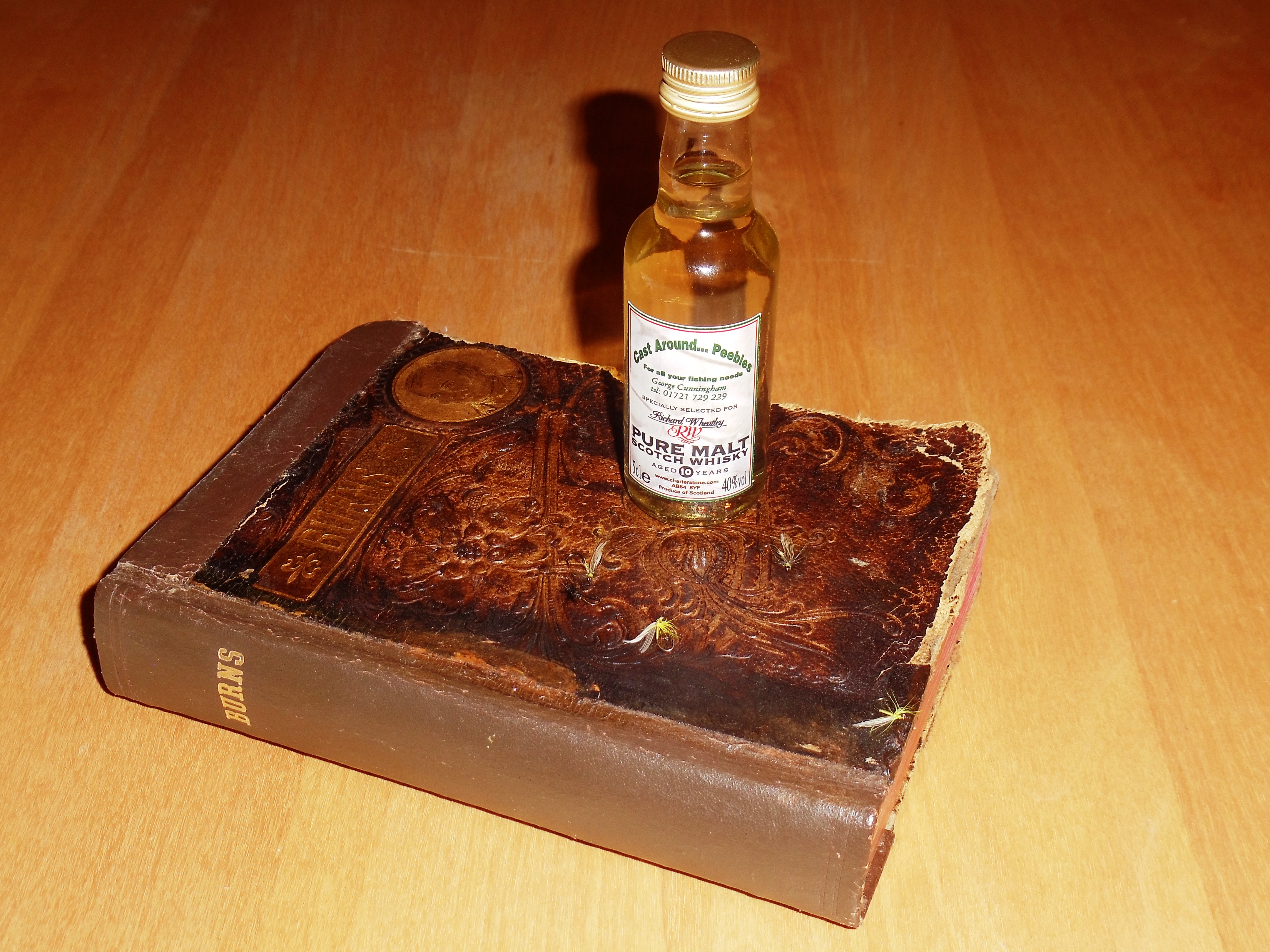
My Grandfather’s Burns book, a bottle of Scotch from a Wheatley fly box I purchased in Peebles, Scotland, and a few Clyde style flies tied by Andy Gunderson.

Once again, it is that time of year when fans of Robert Burns celebrate Scotland’s most famous bard. My love of his writing springs not only from his writing talent, but from his ability to speak as one close to the land, the people who toil upon it, that animals, and even the plants.

In “Nature’s Law,” Burns acknowledges the inspiration that the world-less-cultivated provides him. More directly, though, he honors life. Specifically, he honors life (with no small amount of pride) as it is shared with and manifested in his twins, just born to him and his future wife, Jean Armour.

“Nature’s Law. A Poem Humbly Inscribed to G.H. Esq., ” 1786.

Let other heroes boast their scars,
The marks of sturt and strife:
And other poets sing of wars,
The plagues of human life;
Shame fa’ the fun; wi’ sword and gun
To slap mankind like lumber!
I sing his name, and nobler fame,
Wha multiplies our number.

Great Nature spoke, with air benign,
‘Go on, ye human race!
‘This lower world I you resign;
‘Be fruitful and increase.
‘The liquid fire of strong desire
‘I’ve pour’d it in each bosom;
‘Here, on this hand, does Mankind stand,
‘And there, is Beauty’s blossom.’

The Hero of these artless strains,
A lowly bard was he,
Who sung his rhymes in Coila’s plains,
With meikle mirth an’ glee;
Kind Nature’s care had given his share
Large, of the flaming current;
And, all devout, he never sought
To stem the sacred torrent.

He felt the powerful, high behest
Thrill, vital, thro’ and thro’;
And sought a correspondent breast,
To give obedience due;
Propitious Powers screen’d the young flow’rs,
From mildews of abortion;
And lo! the Bard – a great reward –
Has got a double portion!

Auld cantie Coil may count the day,
As annual it returns,
The third of Libra’s equal sway,
That gave another Burns,
With future rhymes, an’ other times,
To emulate his sire;
To sing auld Coil in nobler style,
With more poetic fire.

Ye Powers of peace, and peaceful song,
Look down with gracious eyes;
And bless auld Coila, large and long,
With multiplying joys.
Lang may she stand to prop the land,
The flow’r of ancient nations;
And Burnses spring, her fame to sing,
To endless generations!

Peter Pan, Fly Fishing, and the Girl Who Won’t Grow Up.

November 21, 2013

It is well known that the character of Peter Pan was first created by J.M. Barrie, in the stories he told to the young Llewelyn Davies boys. In fact, the four boys, with whom Barrie had a special relationship, helped inspire the character. Barrie eventually immortalized Pan (and thus the Davies boys) in his 1904 stage play and 1911 novel, Peter Pan; or, the Boy Who Wouldn’t Grow Up.

After the deaths of the Davies boys’ parents, Barrie became their guardian. Among other things, Davies took the boys salmon fishing, which was a favorite pastime of his. Such trips included the provision of fly fishing instructors and gillies.

IMG-20131103-00329

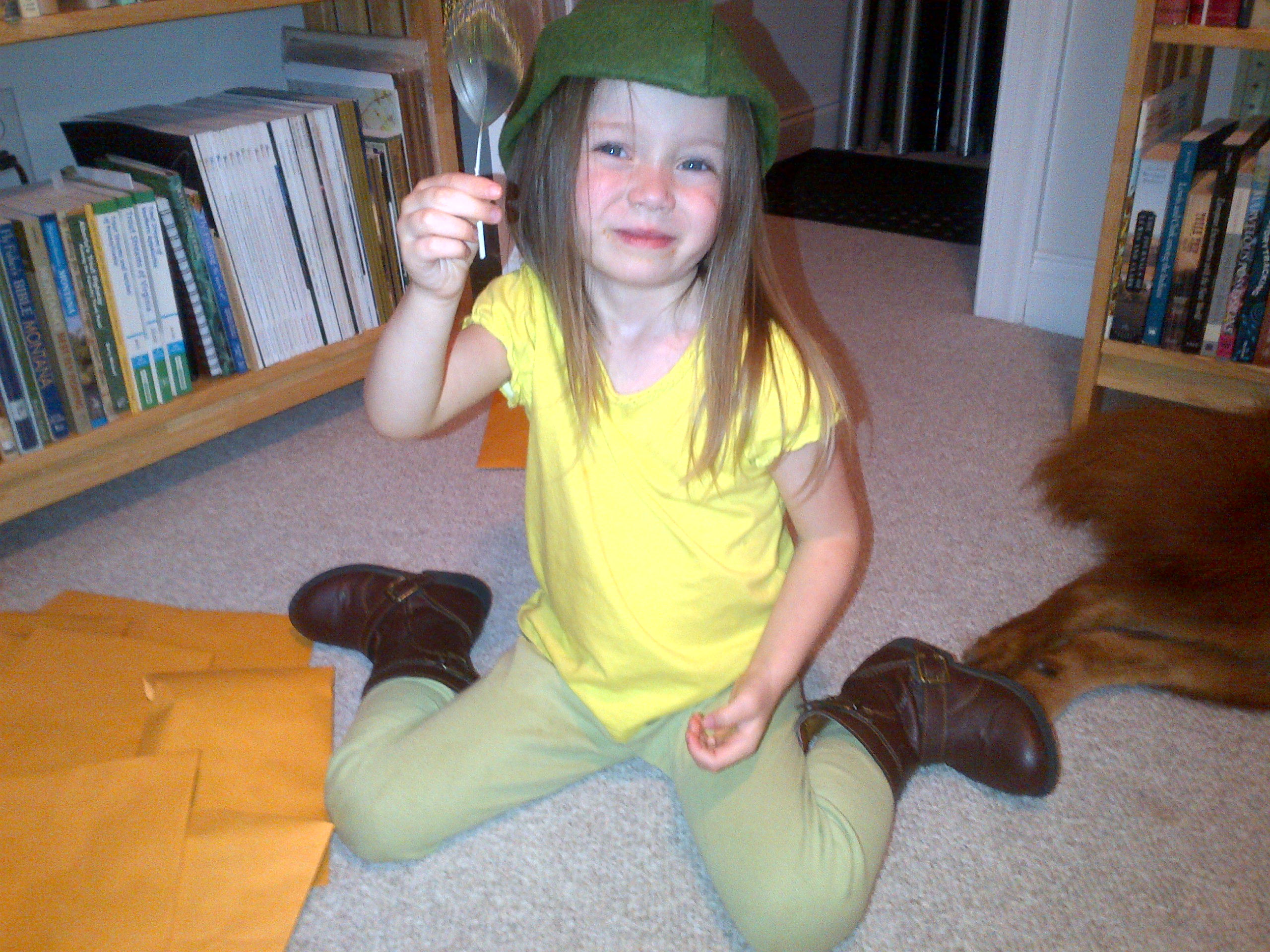
My daughter is a great fan of Peter Pan’s.  She is very familiar with fly fishing, as well. However, at this point, she is much more interested in the sartorial possibilities of fly tying materials than she is in actual fishing flies.  In the picture above (notice the Peter Pan inspired clothes),  she procures some peacock for Captain Hook’s hat. Unsurprisingly, given her interest in Pan, she claims that she does not want to grow up. That’s fine by me, but I hope she grows just enough to handle a rod.

A Fishing Poet

November 11, 2013

A fly fishing friend of mine, who also happens to be a graduate student in my department, recently won a poetry contest sponsored by Loop Tackle.  His award was a new Cross S1 6 weight rod.  This is no small prize for a fly fishing graduate student, living on a tight budget (in fact, it would be no small prize for anyone).   Congratulations to scholar, poet, and fly fisherman Stan Thayne.  You can read his poem below (notice that he worked a bit of advertising in there; smart man, Stan):

Loop Consciousness

At 4 AM something is biting,
tugging at the line
of my brain,
dragging me out of bed,
and netting me
into the car and on down
the road,
releasing me into the Haw
River.

I scan
my flybox,
choose a cork
popper
for bass, then
thread the line through
the guides of my Loop
opti creek, wishing
I were in Montana
or at least a little further
west
on the Davidson
or Watauga
or Oconaluftee
casting for trout.

I’ll take what I can get.

The Haw is muddy this morning,
running high
with that faint smell
of gunsmoke
so unlike western
rivers.
Mist is rising off the water.
I wade
waderless
into the warm cool
water
and begin casting.

I catch several
large bream and toss
them back and tie
on a bigger fly
and move downstream
into smoother water,
casting low
along the surface
to get under
the branches that hang
down along
the bank
and almost touch
the water.

One strikes and
I set the hook
but he goes airborne
immediately tossing
his head furiously
from side to side
and throws
my fly.

That was a big fish.

I’m trembling as
I retrieve my line and
cast again.

Time’s short and
I’m forced
to abandon
the river,
still trembling;

But the river goes with me,
flowing along
the channels of
my consciousness.

Sitting at my desk at work I feel
the spray coming off a cast,
the frigid bite of river morning air,
the feel of wet cork in my hands,
the weight of line rolling out,
the satisfaction of a perfect cast:
loop, roll, settle, and strike:
connecting me to something
that is alive.

My stream of consciousness
is swimming with trout.

The River — a Film by Claudiu Presecan — and The Things that Matter

October 14, 2013

This last summer I had the pleasure of fishing some Transylvanian streams for wild brown trout and grayling.  I have grown to enjoy other parts of the Carpathians (my brother-in-law lives on the edges, in Hungary), but this was my first trip Transylvania. I was invited to fish there by Claudiu Presecan, a gifted painter.  Claudiu and I share the feeling that activities such as fly fishing can create a space in our lives, from which we can better appreciate the enduring, material world around us — the things that exist beyond money, status, and the other most superficial features of “culture.” Claudiu and his family served as my hosts in Romania.  They were joined in this task by Claudiu’s fly fishing friends Paul Sas (of Xander Fly Rods) and Dan Sacui.  I really enjoyed my time talking, eating, drinking, and fly fishing with all of them.  I am genuinely eager to do so again.

As the world seems to shrink and the consequences of our and others’ actions increase in speed, it is becoming harder to avoid discussing controversial social topics. This may be especially the case in parts of Central and Eastern Europe.  Of course, many of these topics need to be dealt with head on.  But some of them are best put aside. When one of these difficult topics would appear on the conversational horizon, during my visit to Romania, I noticed that Claudiu would simply say, “That doesn’t matter.” It was such a simple and decisive way of focusing people’s attention (including my own) upon the topics that do really matter. To Claudiu, his friends, me, and many others, the environment and the connections that it makes possible to fellow outdoor sportspersons, people of other cultures, nonhuman beings, and even our creator are the topics of greatest importance. You can see this understanding in Claudiu’s short film, The River, and you can it reflected in his beautiful paintings as well.