Archive for the ‘Fly Fishing’ Category

Charles E. Goodspeed, Francis Francis, and Christmas

December 26, 2014

For the winter holidays, I repost this essay from some time back.

Kenov's avatarThe Literary Fly Fisher

Copyright 2010, Kenneth H. Lokensgard

NOTE: For a correction of these dates, please see the first reader’s response, written by a former employee of Goodspeed’s Book Shop.

Charles Eliot Goodspeed opened Goodspeed’s Book Shop in 1937.  His Boston store grew to be one of the most respected antiquarian book shops in the United States, and it was in business until 1993.  Goodspeed cared not only about books, but also about fishing. As biographer Walter Muir Whitehill puts it, Goodspeed was “a devout disciple of Izaak Walton.”[1] No doubt, this prompted Goodspeed to compile a massive collection of new and previously published fishing essays.  This collection was published in 1946, as A Treasury of Fishing Stories (New York: A.S. Barnes and Company). According to the book’s “Acknowledgements” section, Goodspeed gathered most of the previously published selections from a collection of fishing works left to Harvard Libraries by Daniel Butler Fearing.

Among the sometimes…

View original post 665 more words

“Human Blood and Woman’s Milk”

December 7, 2014
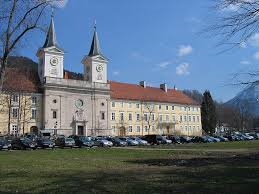
Tegernsee Abbey today. It no longer houses a monastic community.

Tegernsee Abbey today. It no longer houses a monastic community.

Richard Hoffman published a translation of a fragmentary text written around 1500 AD, which has become known as “Tegernseer Angel- und Fishbucklein.” In his book, Fisher’s Craft and Lettered Art: Tracts on Fishing from the End of the Middle Ages (1997), Hoffman identifies the text in English as “Tegernsee Fishing Advice.”  The “advice” is that presumably recorded by a Benedictine monk at the Tegernsee Abbey in Bavaria, in the late 15th century. The advice was probably intended for one of the fishermen licensed by the abbey to provide food for the monks.(117) Interestingly, much of “Tegernsee Fishing Advice” is devoted to fly fishing. This means that fly fishing was not just a pastime of nobility in 15th and 16th century Bavaria; it was also used to acquire food by peasants such as those working for the Abbey. A passage from the translated text, dealing with flies, follows:

Thereafter, as soon as the brooks become small and clear, like in May, [whether it] is the first month or second, then see to it to put ‘stone bait’ on the feathered hook which should be tied with yellow silk and with pinkish-coloured silk around the ‘heart’ [and] with a black one mixed around the ‘heart.’ (141).

However, the monks also provided fishing advice for fishing in still waters that is even more surprising to read:

If you want to catch fish in still waters, in brooks, or in lakes, then take and prepare a bait this way. Take human blood and woman’s milk together in a vessel, and take raw barley and cook it very well and completely and press it in a mortar while still wet until it all becomes like a gruel. After that press it through a cloth, and if it will not go easily through the cloth then add to it a little of the liquid in which it was cooked so that it does go through easily.Take that very thing [that was] pressed through a let it parch and dry up completely, and then make it into a fine powder. Then take that [powder] out and the above-mentioned blood and woman’s milk and stir it [all] together then, and make something like a gruel. Then let that become very hard and dry in the air. Thus it is ready. …. To that thing [will] so rush all the fish which live in that same water, and they will not turn back until after they have come into the trap. (171).

Today, we often think of fly tying as a time-consuming passion. But just you try making a complicated bait from human blood and woman’s milk.

Ready . . . .

November 20, 2014

IMG_438242280

Autumn

November 10, 2014

Fall fishing is a revival after the quieter times of summer. Cooler nights and the melt of early snowfall in the mountains bring falling water temperatures and rains freshen the streams. Shadows are longer, shielding the pools. The fish are more active and there is a touch of urgency about it all, a feeling that it cannot last very long so one had better get out and be doing. After all, there have been falls when the heavy rains came early and suddenly, the streams flooded and everything was over before it had started.

Roderick Haig-Brown, Fisherman’s Fall, 1964.

IMG_1286

IMG_1288

FullSizeRender

Ichabod Crane and the Angler

October 31, 2014

As another Halloween passes, I repost this essay on Nathaniel Hawthorne, author of “The Legend of Sleepy Hallow.”

Kenov's avatarThe Literary Fly Fisher

Painting of Irving by John Wesley Jarvis, 1809 (Wikimedia Commons, public domain) Painting of Irving by John Wesley Jarvis, 1809 (Wikimedia Commons, public domain)

At this time of year, Washington Irving’s well-known “The Legend of Sleepy Hollow” is often brought to mind. This, of course, is the classic tale of schoolmaster Ichabod Crane, his romantic rivalry with Brom Bones to gain the affections of Katrina Van Tassel, and his terrifying encounter with the Headless Horseman. It was originally part of a much larger collection of works by Irving, titled The Sketchbook of Geoffrey Crayon, Gent., published in 1819 and 1820. “The Legend of Sleepy Hollow” has subsequently been published many times as a solitary work.

The person who actually reads “The Legend of Sleepy Hollow” in the Sketchbook, will find that it is preceded by a reminiscence entitled “The Angler.”  Here, Irving shows a very clear familiarity with fly fishing and angling literature.  He first describes his initiatory fly fishing…

View original post 497 more words

“More Perfect”

October 22, 2014

photo 3

Balsa Bug (top), tied by Jack Boehme (approx. 1885-1956); Bunyan Bug, tied by Norman “Paul Bunyan” Means (approx. 1899-1986); “Bunyan Bug” woodcut print by Barry Moser (1940-present), from Norman Maclean’s A River Runs Through It, 1989 Pennyroyal Press edition.

“The River of the Road to Buffaloe”

October 16, 2014

photo nfk

In 1806, Meriwether Lewis, William Clark, and other members of the “Corps of Discovery,” made their return from the West Coast of North America, over the Continental Divide, on their way back to Saint Louis. In approaching the Divide, they relied heavily upon the knowledge and physical guidance of the Nez Perce or Nimiipuu. On July 3, Lewis and Clark divided the Corps, in order to explore different areas. Lewis and his party travelled east along what we now know as the Big Blackfoot River. The Nez Perce guides told the party that the river was the Cokahlarishkit, as Lewis rendered it, or “the River of the Road to Buffaloe” (better transcribed as Qoq’áax ‘í skit and translated as “buffalo road”).

On July 6, 1806, Lewis notes that the party crossed the North Fork of the Big Blackfoot. He describes it as 45 yards wide, deep, rapid, and turbid. He notes the squirrels, goats, deer, curlews, woodpeckers, plovers, robins, doves, hawks, sparrows and duck in the area. He also remarks on the cottonwoods and pines.

He notes, too, that the Corps was wary of meeting parties of the Blackfoot tribes or their allies. The Blackfeet, or Niitsitapiiksi (“Real People”), reside on the eastern side of the Continental Divide. At the time of Lewis and Clark’s expedition, the Blackfeet largely controlled Nez Perce and other Plateau people’s access to the bison of the Plains

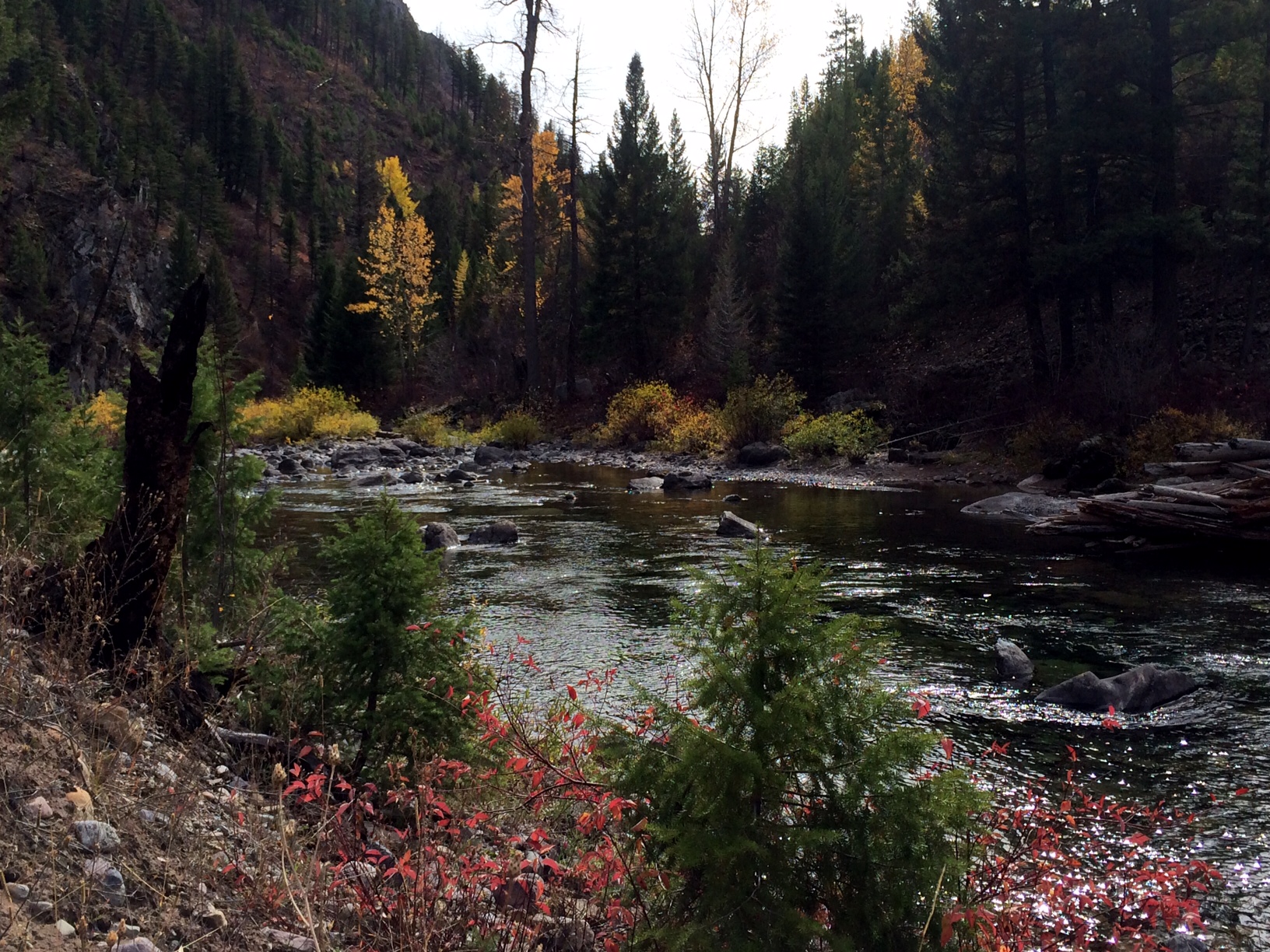
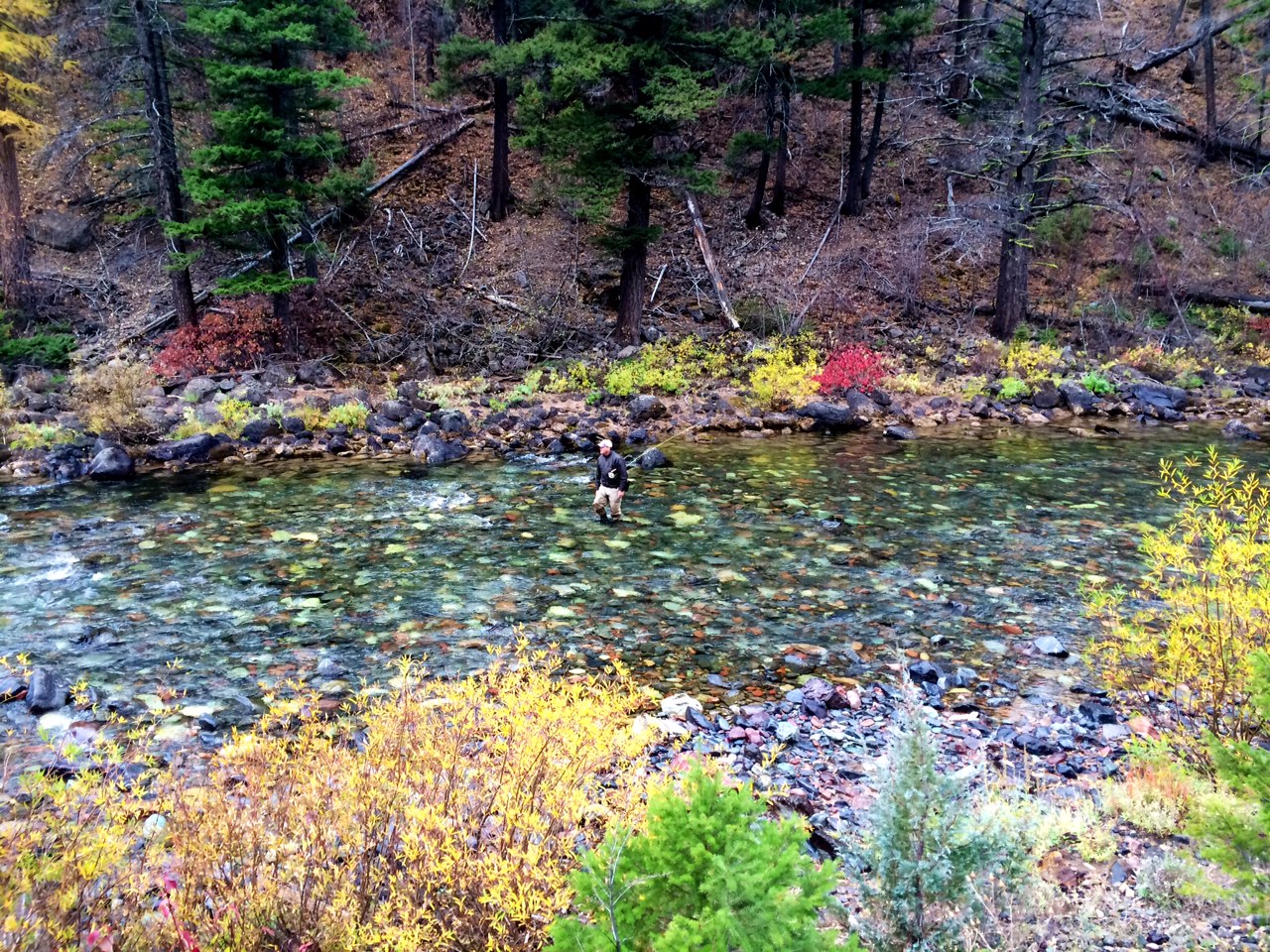
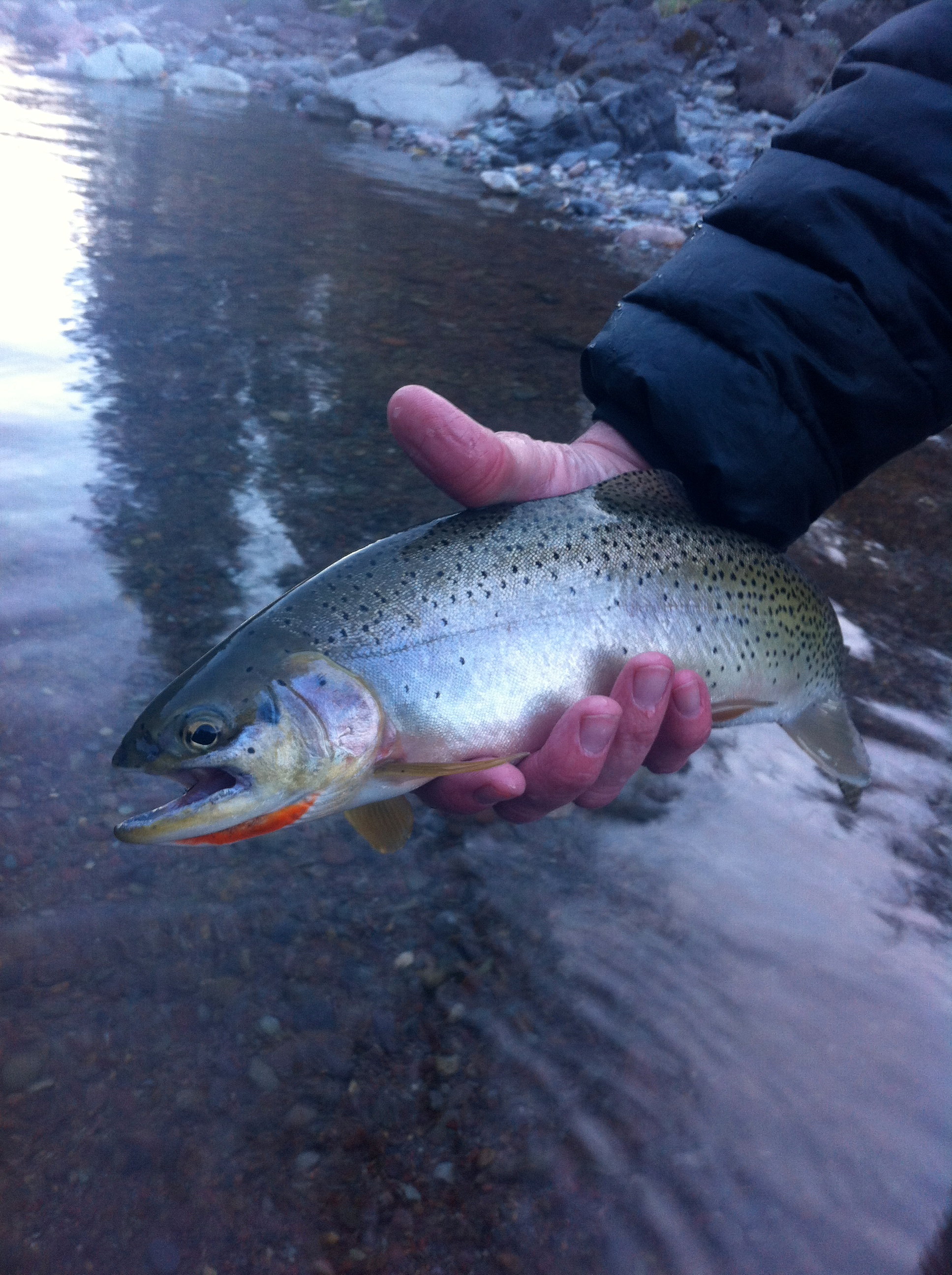
I spend a great deal of time near the North Fork of the Big Blackfoot, as our family cabin is in the area. And, indeed, I drive along the main river, via Highway 200, to visit friends on the Blackfeet Reservation or on the Canadian reserves. The North Fork remains the powerful river described by Lewis over two hundred years ago. And the drainage remains a lively place, populated by all of the flora and fauna recorded by Lewis and many other plants and animals as well (including trout). It is a particularly pretty place during the fall. For this reason, I share a few pictures taken during my latest visit (the trout picture was taken my by friend, Bill Gregory).

photo bill

trout

Opinel “Trout” Knife

October 5, 2014

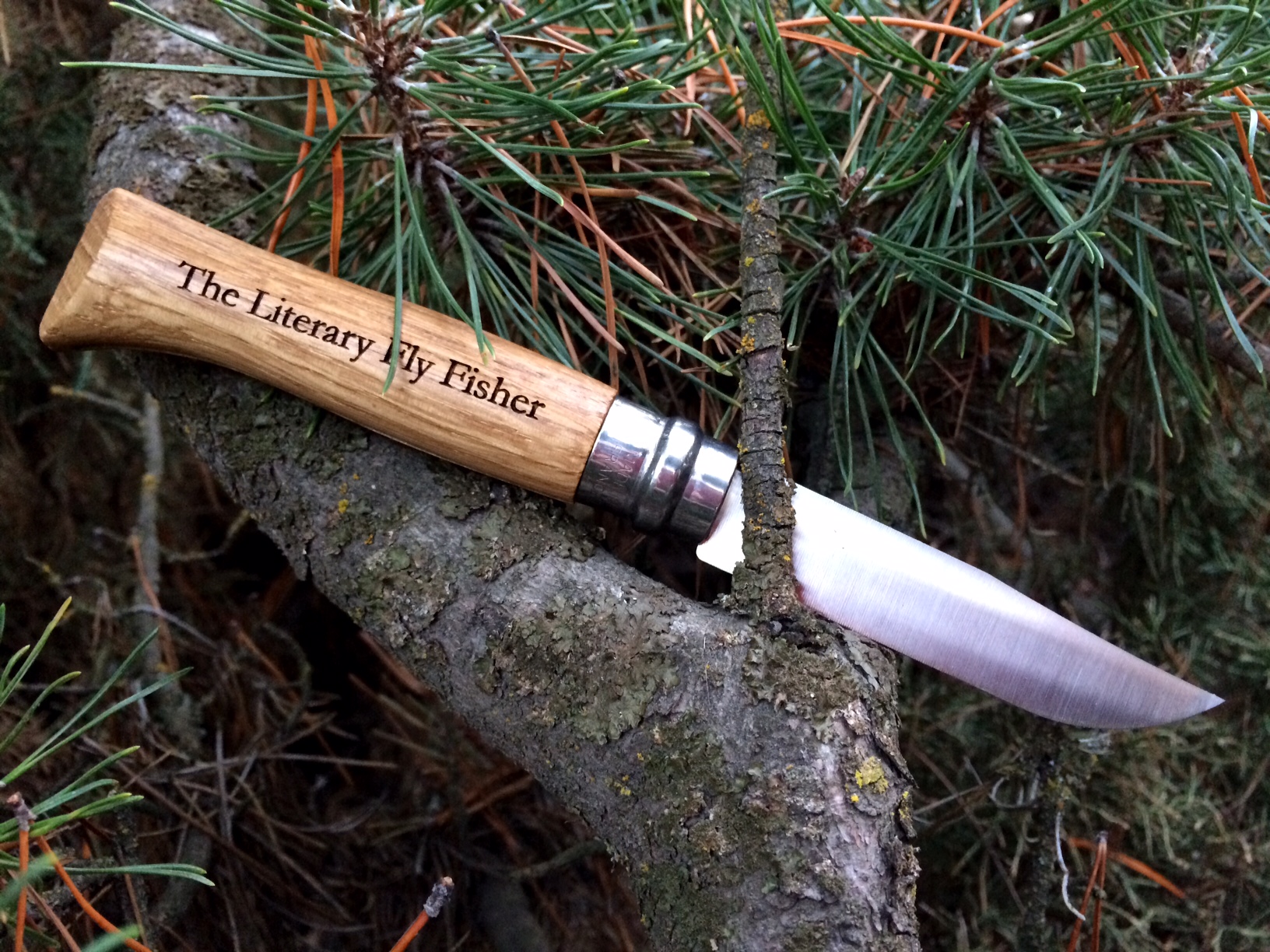
I discovered recently that the venerable French maker of  knives, Opinel, offers a model with trout engraved on an oak handle.  Opinel has made simple, folding knives, in a variety of numbered sizes, for over 100 years.  Despite their continued popularity and the fact that they are still made in France, Opinel knives remain very affordable to the working people for whom they were originally intended.

photo opinel 2

Today, Opinel knives are popular enough among outdoors persons that Patagonia sells them along with its own products.  Patagonia describes the Opinel No. 8 that they offer, online, they describe their Opinel No. 8:

If we made knives, this is the one we’d want to make. The Opinel folding knife, with its clean, simple design and remarkable utility, has been prized by adventurers, artists and chefs for more than 100 years. This modern version of the classic Opinel No8 features a 3-1/4” stainless steel blade and beautiful olive-wood handle. It fits easily in a pocket, but also comes with a leather belt sheath for easier access. Packaged in a wooden, slide-top box.

You can read about the Opinel No. 8, oak-handled “trout” knife, available directly (and much less expensively) from Opinel, at their website. You will notice that they offer custom engraving.  When ordering one, I could not resist making use of this service. It has been a handy companion during my time beyond the paved world.

photo opinel

University Course: “Salmon and People”

September 18, 2014

I am sharing the flyer for a course that a colleague in anthropology is teaching. She is an archaeologist, but she is offering a comprehensive look at the place of salmon in Pacific and Inland Northwest cultures, both Native and non-Native. She has worked closely with Nez Perce representatives to incorporate contemporary Native views. All in all, it’s an impressive course.  In fact, it would be nice to see more classes that focus upon such basic, yet essential topics. Academic theories are important devices through which to understand human perception of the world. But discussions should always start with the tangible things in life.Salmon

Thomas Salter and the Duchess

September 9, 2014

Thomas Frederic Salter was a London hatmaker. He fished as a child with his father and remained a devoted angler as an adult. Apparently, his health prevented him from fishing regularly in his later years. He therefore turned his attention toward writing several books having to do with fishing, each of which went through several editions. The first was The Angler’s Guide, or Complete London Angler in the Thames, Lea, and other Waters twenty miles round London, which was published in 1814.  Interestingly, he dedicated it to “Her Royal Highness the Duchess of York,” whom, he says, “occasionally enjoys the amusement of Angling” (vii). At the time, the duchess was the beloved Princess Frederica Charlotte of Prussia. An independent woman, she lived separately from her husband, apparently preferring the company of her many pets and other animals.

"Frederica Charlotte Ulrica Catherina, Duchess of York and Albany" published by Robert Laurie, published by  James Whittle

In his guide, Salter speaks highly of fly fishing, describing it as “gentlemanly and pleasant,” if also “difficult to learn” (82-83). In all, he dedicates five chapters of the book to the practice. Had I been Salter’s editor, I might have pointed it out that the sport must also be “ladylike” (or something to that effect), since the Duchess, so highly praised in Salter’s, dedication, was an angler.

Salter Trout

Illustration of a trout, from page 95 of Salter’s Guide.

Interestingly, Salter also includes a poem by a “Mr. Cracknell,” entitled “The Female Angler” (103). Two stanzas follow.


From town I walk’d to take the air,

Shun smoke and noise of coaches;

I saw a lovely damsel fair,

Angling for Dace and Roaches.


Close by a brook, with line and hook,

Which curiously was baited,

Attentively the maid did look,

While for a bite she waited.


Looking back as readers, and not editors, we should commend Salter for acknowledging so clearly that field sports are not only or best practiced by men. While many authors of Salter’s time and before paid homage to the legendary Juliana Berners, O.S.B., supposed author of the 15th century Treatyse of fysshynge wyth an Angle , few of them seemed to consider that there may have been many other figures like her. Admittedly, there seems to be a hint of romance in the poem Slater includes in his book; there is an implication that the “female angler” shares in the simple purity of nature or the rural area free from “smoke and noise.”

Yet, Salter tells us that “The Female Angler” was inspired by a very real friend of Cracknell’s. Also, as its subtitle indicates, Salter’s book focuses upon fishing in urban and suburban London (in later editions, the subtitle changes).  Thus, he does not see to see the divide between nature and culture as being so bold as many others did and do. This makes him a rare figure in his time — one worth reading. While the Guide is mostly a technical manual and guidebook to certain fishing locations, there is, as I have indicated here, some material that truly stands out.

I leave you with a stanza from another poem, “The Angler’s Morning Walk,” apparently written by Salter himself (x).


From sweet repose I early rose

To fish, and take the air;

I look’d around, saw good abound,

Then why should Man despair.