Archive for the ‘Fly Fishing’ Category

Thomas Salter and the Duchess

September 9, 2014

Thomas Frederic Salter was a London hatmaker. He fished as a child with his father and remained a devoted angler as an adult. Apparently, his health prevented him from fishing regularly in his later years. He therefore turned his attention toward writing several books having to do with fishing, each of which went through several editions. The first was The Angler’s Guide, or Complete London Angler in the Thames, Lea, and other Waters twenty miles round London, which was published in 1814.  Interestingly, he dedicated it to “Her Royal Highness the Duchess of York,” whom, he says, “occasionally enjoys the amusement of Angling” (vii). At the time, the duchess was the beloved Princess Frederica Charlotte of Prussia. An independent woman, she lived separately from her husband, apparently preferring the company of her many pets and other animals.
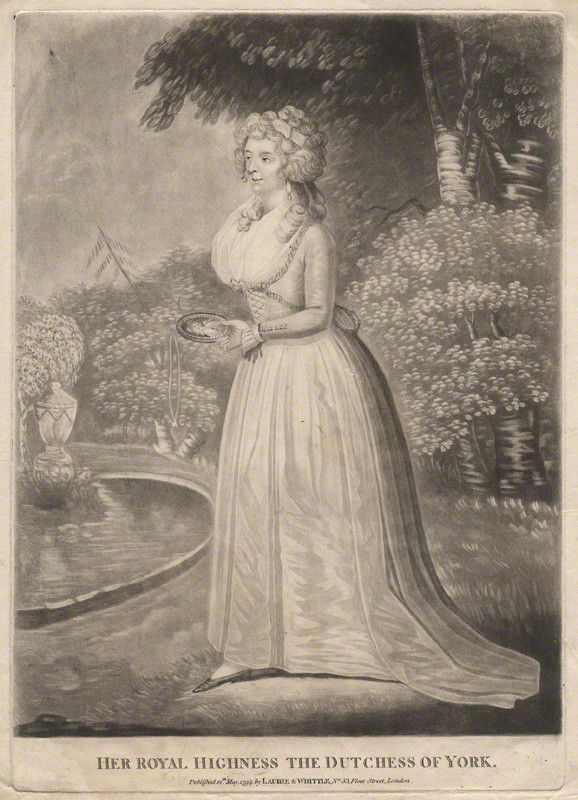
"Frederica Charlotte Ulrica Catherina, Duchess of York and Albany" published by Robert Laurie, published by  James Whittle

In his guide, Salter speaks highly of fly fishing, describing it as “gentlemanly and pleasant,” if also “difficult to learn” (82-83). In all, he dedicates five chapters of the book to the practice. Had I been Salter’s editor, I might have pointed it out that the sport must also be “ladylike” (or something to that effect), since the Duchess, so highly praised in Salter’s, dedication, was an angler.
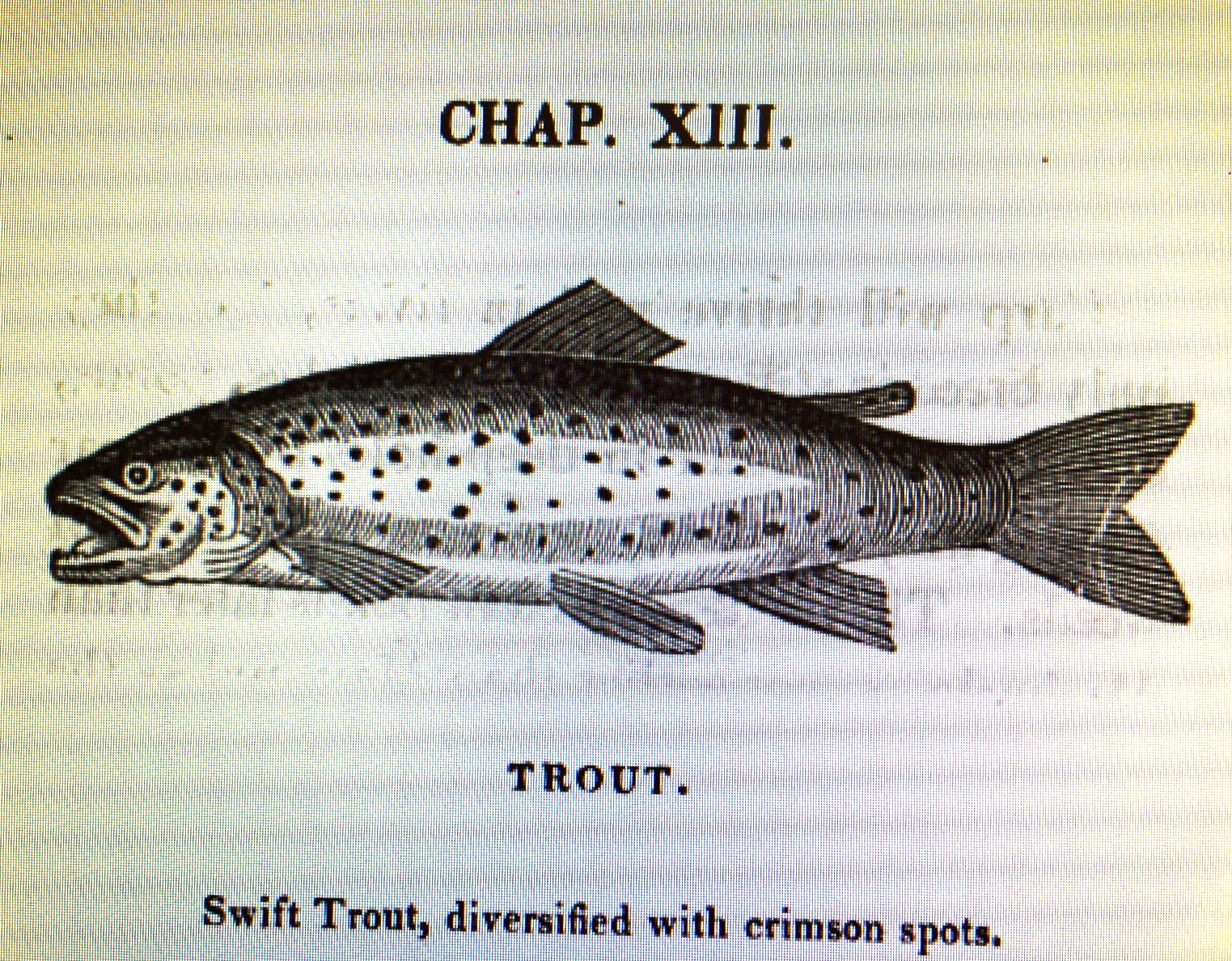
Salter Trout

Illustration of a trout, from page 95 of Salter’s Guide.

Interestingly, Salter also includes a poem by a “Mr. Cracknell,” entitled “The Female Angler” (103). Two stanzas follow.


From town I walk’d to take the air,

Shun smoke and noise of coaches;

I saw a lovely damsel fair,

Angling for Dace and Roaches.


Close by a brook, with line and hook,

Which curiously was baited,

Attentively the maid did look,

While for a bite she waited.


Looking back as readers, and not editors, we should commend Salter for acknowledging so clearly that field sports are not only or best practiced by men. While many authors of Salter’s time and before paid homage to the legendary Juliana Berners, O.S.B., supposed author of the 15th century Treatyse of fysshynge wyth an Angle , few of them seemed to consider that there may have been many other figures like her. Admittedly, there seems to be a hint of romance in the poem Slater includes in his book; there is an implication that the “female angler” shares in the simple purity of nature or the rural area free from “smoke and noise.”

Yet, Salter tells us that “The Female Angler” was inspired by a very real friend of Cracknell’s. Also, as its subtitle indicates, Salter’s book focuses upon fishing in urban and suburban London (in later editions, the subtitle changes).  Thus, he does not see to see the divide between nature and culture as being so bold as many others did and do. This makes him a rare figure in his time — one worth reading. While the Guide is mostly a technical manual and guidebook to certain fishing locations, there is, as I have indicated here, some material that truly stands out.

I leave you with a stanza from another poem, “The Angler’s Morning Walk,” apparently written by Salter himself (x).


From sweet repose I early rose

To fish, and take the air;

I look’d around, saw good abound,

Then why should Man despair.


Dream and Fable

September 3, 2014

“Standing on the shore, I once more cast my line into the stream, and found the dream to be real and the fable true.”

Henry David Thoreau, The Maine Woods, 1864.

photo 3


photo 2


Angling Library Locator

August 20, 2014

This map was created by Brandon Simmons at the Trout School blog. The few libraries identified here that I have actually seen were well worth the visit.

Brandon Simmons's avatarTrout School

For those of you as obsessed with Angling Libraries as I am, I have begun to compile a geographical reference- a treasure map, if you will. This is a Public Google Map which provides a pin for each institution I have found to house an Angling Book Collection.

Please let me know if I have omitted any sites you may be aware of. I have been fairly loose with my criteria (I would rather be inclusive to allow for a larger footprint).

I have visited only a handful of these places yet cherish the time spent within their majestic stacks. I welcome your input and any stories of your pilgrimages you care to share.

View original post

A Little Piece of Home

August 9, 2014

New

My sister painted me a little 3 inch by 3 inch picture for my birthday. It is based upon a photograph I took recently, from the seat of a canoe. In the image, the viewer looks north toward the Scapegoat Wilderness in Montana, from the lake where my sisters and I share a cabin. The picture is a wonderful gift, though my photograph of it does not capture its nuances. Of course, there is a fly rod in the image.

Accidental Waters

June 30, 2014

As in marriage, so in fishing; one’s choice is made by accident. One opens the door of a room; and there, for better or for worse, the lady sits. One sees a river from a train, a car, one halts to stretch one’s legs and is lost.

John Inglis Hall, Fishing a Highland Stream; a Love Affair with a River (Putnam and Co, 1960).


In Fishing a Highland Stream, John Inglis Hall writes of his love affair with the River Truim, a tributary of Scotland’s famous River Spey. If you have traveled between Perth and Inverness, you have probably seen this river. However, when Hall first began to fish the Truim in the 1940’s, its course was less widely known by the public.

Photo 4

My own home waters remain more remote. But like Hall, I first came to them accidentally. My family chose to build a cabin on the banks of what is now my favorite trout lake and just over the ridge from my favorite river. Naturally, I grew familiar with these waters over time, and I have come to love them as much as Hall loved the River Truim.

I visited these waters last weekend, and I look forward to doing so again in a few days. Included here are a few pictures, which will explain my love.

Photo 2


Photo 3


photo 1


Photo 5


Rod & Dog

May 13, 2014


IMG-20140504-00562

IMG-20140504-00567


The Lochsa, Again.

April 21, 2014

And Alan, whose muscles are not yet really strong enough to handle a fly rod, perched on a rock with the landing net. Little boy in summer, I thought, watching the ripples of water all about him and the dense screen of leaves on the trees behind him. But he was more than that, a creature of choice, putting a deliberate trust in me to hook a fish and make work for the net that he still finds the most exciting part of going fishing.

Roderick Haig-Brown, Measure of the Year: Reflections on Home, Family, and a Life Fully Lived (1950).

Fishing

I drove with my daughter to Missoula the other day, so that we could spend some time with her grandfather on Easter weekend. I asked her if she would like to fish a bit on the return trip, and she said she would.  Instead of returning over Lookout Pass, then, we went over Lolo Pass and drove along the Lochsa River.  As I’ve indicated before, the Lochsa has a lot of significance to me.  Perhaps it will for my daughter some day, as well.

After finding a spot on the river that was accessible to a four-year-old, we fished.  I had not thought to bring her own, short rod. The 8.5 foot one I had with me was a bit much for her.  So, we tied a fly and leader to a long branch, still green and flexible.  She carefully cast the fly into the water, again and again, for a good while before getting anxious to leave.  Not surprisingly, she didn’t catch a fish.  I was happy to see how enthusiastic she was, though.  While on the river, she was a “creature of choice,” to borrow the words with which Roderick Haig-Brown describes his son in the epigraph above.  My daughter and I have summer just ahead of us, and she’ll have many more opportunities to catch a fish with her father during the coming months..

Recommended Reading

April 7, 2014

Fly Fish Journal


When I was looking through The Flyfish Journal that arrived in the mail last week, I came across a pleasant surprise. As I neared the end of the magazine, thinking how I really needed to be in bed, I came across a piece written by a friend, Mike Sepelak. The next day, I realized there were two more pieces by him in the same issue.

Until recently, Mike and I were nearly neighbors (by semi-rural/small town standards, at least). We have fly fished together quite a bit, in saltwater, warmwater, and coldwater. All along, I have followed his writing. You can, too, by looking at his website, Mike’s Gone Fishin’ … Again. There, you will find some great essays. I know Mike has put a lot of work into them, but I also know that choice words come easier to him than they do to many.

It’s very gratifying to see Mike’s writing in print. I have urged him to put together a collection of essays for publication as a book someday, and I continue to hope he does so. Read an essay such as “Shattered,” and  you will understand why. Few people can write something so emotional, yet so well crafted at the same time.

Meanwhile, pick up Volume Five, Issue Three of The Flyfish Journal. It’s a great publication, and it’s all the better with Mike’s work in it.


The Lochsa

March 18, 2014
IMG-20140316-00481

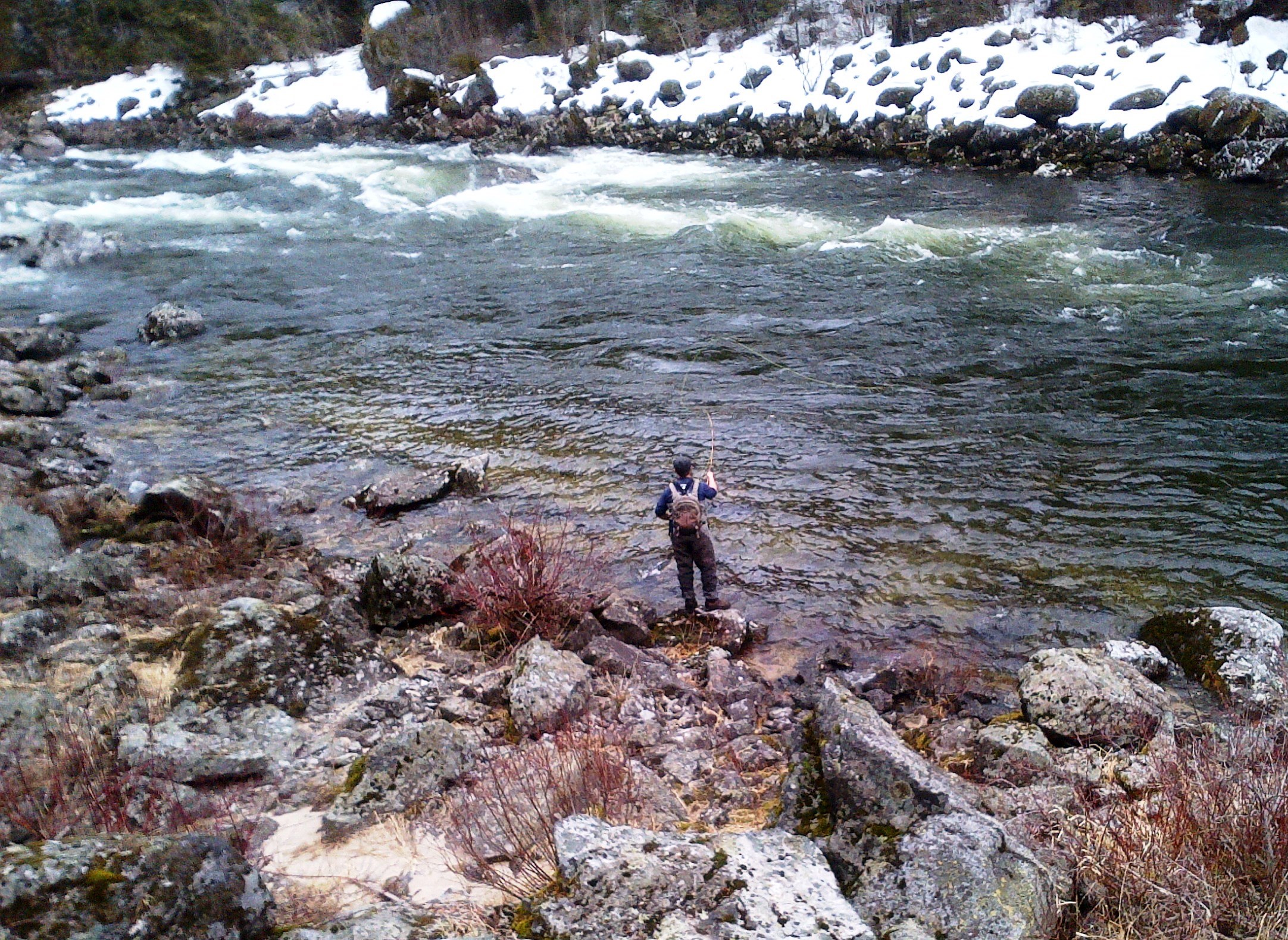
Friend AJ casting a four-weight bamboo rod on the Lochsa.

I cannot claim to know the Lochsa River, of north central Idaho, well. It has had a place in my life, and in the lives of my family and friends, for many years, though.  I fished it this last weekend with a new friend.  Now that I live in Idaho, I look forward to visiting many times and giving it the intimate attention I should have, long ago.

It was years ago that I was last on the Lochsa.  My wife and I had not yet moved East, and we were traveling from my sister’s house in Boise to visit my family in Missoula.  I remember the drive well because it was Christmas Even, and it was snowing hard.  For those who have not been there, narrow Highway 12 borders the river for many miles before climbing over Lolo Pass and down into Montana’s Bitterroot Valley.  I wanted to put chains on the car — a late 80’s Subaru wagon — but I was afraid to stop.  In the blizzard, we could not see the side of the road, nor could we see approaching traffic. Fearing that we might be knocked into the river if we stopped, we kept inching along.

Wariness while driving along the Lochsa in wintertime is warranted.  One of my brother-in-laws once slipped partially off the highway, with his wife and two sons in the car.  As my sister described it to me, they were left teetering on the edge of the road, very close to falling in the river.  I think the incident affected my brother-in-law greatly, and understandably so.  I had another friend whose car actually did slide all the way into the water.  Miraculously, he and his family were alright.

I have more positive memories involving the Lochsa too.  During my college years and shortly after, several friends and I would often snowshoe in that river drainage, visiting some of the hot springs in the area. At the time, I often thought of my troubled, but beautiful uncle.  He spent a summer manning a fire lookout tower near the Lochsa, in the 1950’s.  My uncle has passed away since I made those visits to the area on snowshoes, but I found myself thinking of him this last weekend, as well.  As in the past, I wondered if the summer he spent on that lookout tower was a happy one — if it was free from some of the problems that made his life so much more difficult  than it should have been.

IMG-20140316-00478

Looking downstream.

I am like my uncle was in many ways. My life is a happier one, though.  This is especially the case, now that I live, once again, close to family and friends in Idaho and Montana … and closer to rivers such as the Lochsa, as well.

Getting Settled

January 20, 2014

Having relocated to the area where the Palouse and Rocky Mountains meet in Idaho, my mind has been as filled with fish and fly fishing as ever. But even with my thoughts wandering toward the rivers, I have been unpacking boxes and getting acquainted with a new university. This week, as time allows, I’ll get to know the angling collections housed among Washington State University’s Rare Books and Special Collections. And soon enough, I’ll reacquaint myself with Idaho’s fish. Eventually, I’ll even write a few posts about it.

DSC02793

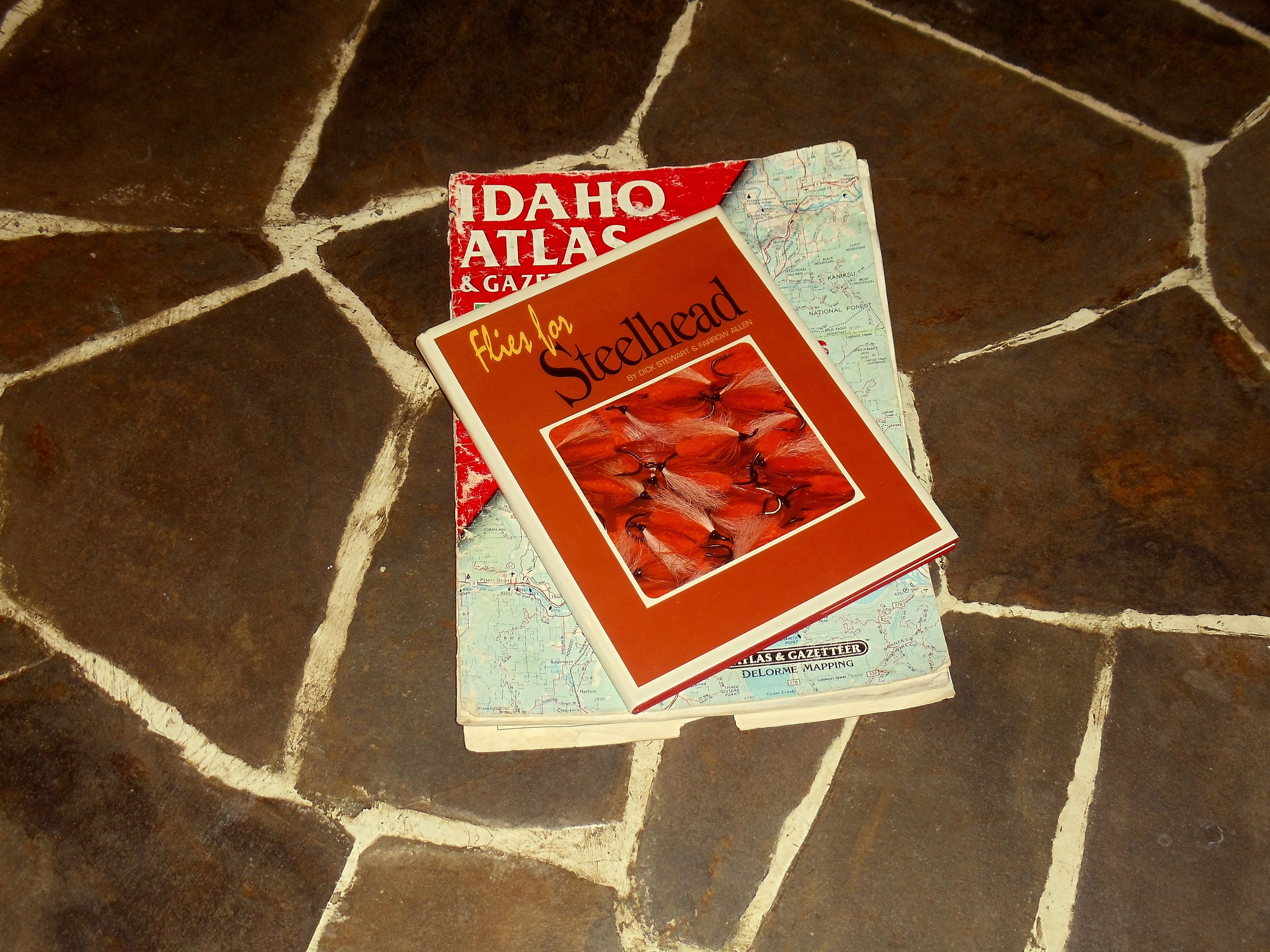
The flagstones in our mid-century modern house were reportedly taken from the Clearwater River.