Author Archive

The Film, A River Runs Through It, Twenty Years Later

March 7, 2012

Midcurrent Fly Fishing News alerted me to a great article in the Bozeman Daily Chronicle.  Written by Carly Flandro, the article is about the 1992 film adaptation of Norman Maclean’s “A River Runs Through Itand its impact.  A copy of Maclean’s 1976 book, A River Runs Through It and Other Stories, always had a presence on our shelves in Helena and at our family cabin near the Big Blackfoot River.  The book, and particularly the title story, had special meaning to me, because I was the son of a Presbyterian Minister, and he was the one who introduced me to fly fishing (see my previous post).

I remember well, when the movie came out.  Many people, as the Chronicle article points out, bemoaned the attention it brought to fly fishing and to Montana.  Personally, I think the movie was a good thing for the sport and for the state.  I was more upset by two articles published around the same time,  in major outdoor magazines, about fishing my home water in the Big Blackfoot drainage.  Admittedly, though, it may have been the movie that prompted such articles.  Fortunately, the fishing pressure on my home water has leveled out or even declined a bit.  The main Blackfoot River, however, is a busy one indeed.  Still, as the article mentions, along with the desire to fish the Big Blackfoot came the successful effort to restore it.

If you are a fan of the movie, A River Runs Through It, be sure to read the Chronicle article: Reflecting on the film “A River Runs Through It” and how it changed Montana – The Bozeman Daily Chronicle: News.  And if you haven’t read Maclean’s book, be sure do so.

Age, Fly fishing, and Legacies: Meriwether Lewis and the Rest of Us

March 4, 2012

I have been corresponding with a very old friend recently.  This friend’s father — a humble man — is a long-time fly fisherman.  As he ages, my friend tells me, he looks for evidence that he has been successful, appreciated, and so on.   From the little I know, my friend’s father is an accomplished fly fisherman with numerous fly patterns and even an unusually high-profile publication to his credit.  Moreover, he is a medical doctor, and he has undoubtedly helped many people in that capacity.  Still, I think most of us can understand his feelings.  Therefore, as I learn more about this man and his role in the history of fly fishing in the American West, I resolve that he will receive evidence of my own admiration.

The correspondence with my friend put me in mind of a journal entry written by Captain Meriwether Lewis on August 18th, 1805, during his US government sponsored exploration of the American Northwest with William Clark and others.  Lewis and Clark’s trip, arranged by President Thomas Jefferson, is remembered as the “Voyage of Discovery.”

No doubt, most readers are familiar with Lewis and Clark.  Fly fishers may know that members of the expedition catalogued many fish that were previously unknown to Euro-Americans.  The scientific name of the Westslope Cutthroat Trout, Oncorhynchus clarki lewisi, reminds us of this. 

The fact that the “Voyage of Discovery” is remembered by so many means that Lewis and the others accomplished a degree of fame.  Mind you, I am no particular fan of Lewis and Clark.  They “discovered” nothing that was not already known to the indigenous inhabitants of the lands they crossed.  Moreover, they set back Euro-American relations with some of those inhabitants significantly, through their prejudicial and even deadly behavior toward Native Americans (the reader should know that Blackfoot oral tradition relates a very different account of the fatal encounter between Clark and the Blackfeet than the one Clark, himself, relates).

My cultural concerns aside, the physical feats that Lewis and the others accomplished in crossing and recrossing a significant portion of the continent are astounding.  And yet, there is Lewis’ journal entry, which I mentioned earlier.  I quote it here (precisely), from The Journals of Lewis and Clark, edited by Bernard DeVoto (1997).

This day I completed my thirty first year, and conceived that I had in all human probability now existed about half the period which I am to remain in the Sublunary world.  I reflected that I had as yet done but little, very little, indeed, to further the hapiness of the human race or to advance the information of the succeeding generation.  I viewed with regret the many hours I have spent in indolence, and now sourly feel the want of that information which those hours would have given me had they been judiciously expended.  but since they are past and cannot be recalled, I dash from me the gloomy thought, and resolved in future, to redouble my exertions and at least indeavor to promote those two primary ojbects of human existence, by giving them the aid of that portion of talents which nature and fortune have bestoed on me; or in future, to live for mankind, as I have heretofore lived for myself. (1997, 206)

Clark’s unusual moment of humility and self-reflection is startling, given the task in which he was currently engaged.  Admittedly, I don’t think he did much to increase mankind’s happiness — certainly not that of Native Americans.  Yet, he did “advance the information” possessed by his fellow Euro-Americans about the Northwest and, to a very small extent, about the indigenous peoples there.

If, then, someone like Clark can doubt the value of his past actions, even at such a young age, it is only natural that others of us are concerned about our contributions to the world, or lack thereof, and about the perceptions others have of us.  One way to relieve such concerns, when felt by those we admire — to further their happiness, as Clark put it — is to inform them of our appreciation and respect. I hope that many people besides myself do this for my friend’s fly fishing father.

Note: Interested readers can learn more about Lewis and Clark and the fish they encountered during their expedition, in the 21 page pamphlet Fish, Fishing, and Lewis & Clark: The True Story of the Greatest Fishing Trip Ever, published in 2009 by the Federation of Fly Fishers. I am certain it can be obtained by contacting the FFF or the Montana Fish, Wildlife, and Parks Department.  I’ll bracket my issues with the pamphlet’s title.

Updated Sale Listings

February 29, 2012

New items, including Fishpond gear, added to sale listings.   More items will be posted shortly: Orvis graphite trout rods, T&T and Loomis graphite saltwater rods, English boron trout rod, Orvis/Eddie Bauer glass rod, early Loop  “Model 3w” (now sold as the Danielsson “Original 3w”) large arbor reel, English-made Orvis “Madison” reel, Scientific Anglers System 2L “67L” disc reel, vintage Orvis rod bags, and more.  Click link on right of page, or follow link above.

Joseph Seccombe, Ethics, and Nature in 1739

February 21, 2012

In 1739, Anglican minister and avid sport fisherman Joseph Seccombe delivered a sermon on the religious justification of recreation, particularly fishing, at Amoskeag Falls, in New Hampshire. Published later, in 1743, the sermon would become the first document published in the American colonies dealing with these subjects. The sermon is now known by the title, Business and diversion inoffensive to God, and necessary for the comfort and support of human society. A discourse utter’d in part at Ammauskeeg-Falls, in fishing season. 1739.

Following is an excerpt from the sermon:

But here, in Fishing, we are so far from delighting to see our Fellow-Creature die, that we hardly think whether they live—— We have no more of a murderous Tho’t in taking them, than in cutting up a Mess of Herbage. We are taking something, which God, the Creator and Proprietor of all, has given us to use for Food, as freely as the green Herb. Gen. ix. 2, 3.

He allows the eating them, therefore the mere catching them is no Barbarity. Besides God seems to have carv’d out the Globe on purpose for a universal Supply: In Seas, near Shores, are Banks and Beds made for them; ——to furnish the Lands adjacent——and Lands which lye remote, are more divided into Lakes and Ponds, Brooks, and Rivers; and he has implanted in several Sorts of Fish, a strong Instinct [or inclination] to swim up these Rivers a bast Distance from the Sea.  And is it not remarkable, that Rivers most incumbered with Falls, are ever more full of Fish than others. Why are they directed here? Why retarded by these difficult Passages? But to supply the Inlands? Does forming and disposing of these Things argue nothing? (16-17).

Seccombe was undoubtedly familiar with fellow Anglican writer, Issac Walton, who wrote of the presence of the Christian God in nature several decades earlier and whose book, The Compleat Angler, or, The Contemplative Man’s Recreation (1653) remained in print.  Still, Seccombe is relatively unique, as a writer in North America, in describing the wilds as possessing God-given value.  It appears that he even wrote letters, filled with observations of “nature,” to superior members of the Anglican Communion.

On the other hand, Seccombe clearly places little intrinsic value upon those beings that inhabit the wilds about him.  Here, he is not so unique.  It took well over one hundred more years for American anglers to realize, as a whole, that their activities were impacting fish populations negatively.  And it took them well over one hundred years beyond that for them to engage in concerted conservation efforts.  No doubt, Seccombe would have been engaged in such efforts, himself, had he realized the impact his fishing would have upon the salmon and trout that he hunted.  He is to be admired, however, for advocating that his listeners and readers appreciate the natural world around them, and to do so with religious seriousness.  That, at least, was a first, very early step toward conservation.

Update:

February 21, 2012

Update: My sincere apologies.  New inventory is delayed one week (’til Feb. 27).  Granger Favorite, glass rods, Fishpond, Orvis, and more. Please inquire.  Also, I have items in hand that have  not been listed.  Let me know if you’re looking for something.  I’ve been “sick as a dog” this week, and not up to the required travel.

Families, Video, and Fly Fishing Stories

February 18, 2012

Todd Moen and Brian O’Keefe’s Catch Magazine: The Official Journal of Fly Fishing Photography and Film is a visually stunning and exceptionally well presented online magazine (I’m not sure what makes Catch “official,” but it’s still a fantastic magazine).  Through Catch, Moen has shared a two-part  “documentary style” film, as he describes it, focuses upon a mother, father, and daughter, who run a fly fishing lodge in northern British Columbia.  The film also deals with their many years fishing together as a family.  The subject matter is wonderful and the videography is amazing. 

Certainly, in the 1600’s, Isaac Walton never imagined that one day fishing stories would be told through moving pictures.  I have no doubt, however, that he would have approved of this development.  Moen’s film captures much of the beauty in nature, about which Walton wrote.  You can see Parts 1 and 2 of Moen’s Steelhead Dreams, below:

Part 1:

http://vimeo.com/17973045

Part 2:

http://vimeo.com/22680248

Hardy’s Diamond Jubilee Reel, further notes

February 15, 2012

Last weekend, I had the pleasure of handling Hardy’s Diamond Jubilee Perfect, about which I wrote in my previous post, at the Raleigh Fly Fishing Show.  It is truly a dandy, even if it is priced well beyond my own means.  The 1912 checkwork is very well made.  I was particularly impressed by the delicacy of the brass “worm” that puts pressure on the spring (sorry, I forgot to take my camera).  The reel is, in fact, still available, though most potential customers will have to go through dealers.

It was nice to chat with Jim Murphy and John Shaner of Hardy, USA at the show, and it was great of them to both come down to Raleigh.  They mentioned some very interesting products that may be coming down the line at Hardy.  I hope to talk more with them about these things this weekend in Lancaster, Pennsylvania.

By the way, there was much to interest the person who is passionate about classic and antique fly fishing tackle at the Raleigh Show.  Reelmaker Ted Godfrey was there, as was Bob Selb of “The Classic Fly Fisherman.”  There were also some wonderful tiers of traditional salmon and trout flies.

Hardy’s Diamond Jubilee Perfect Fly Reel

February 8, 2012


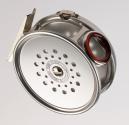
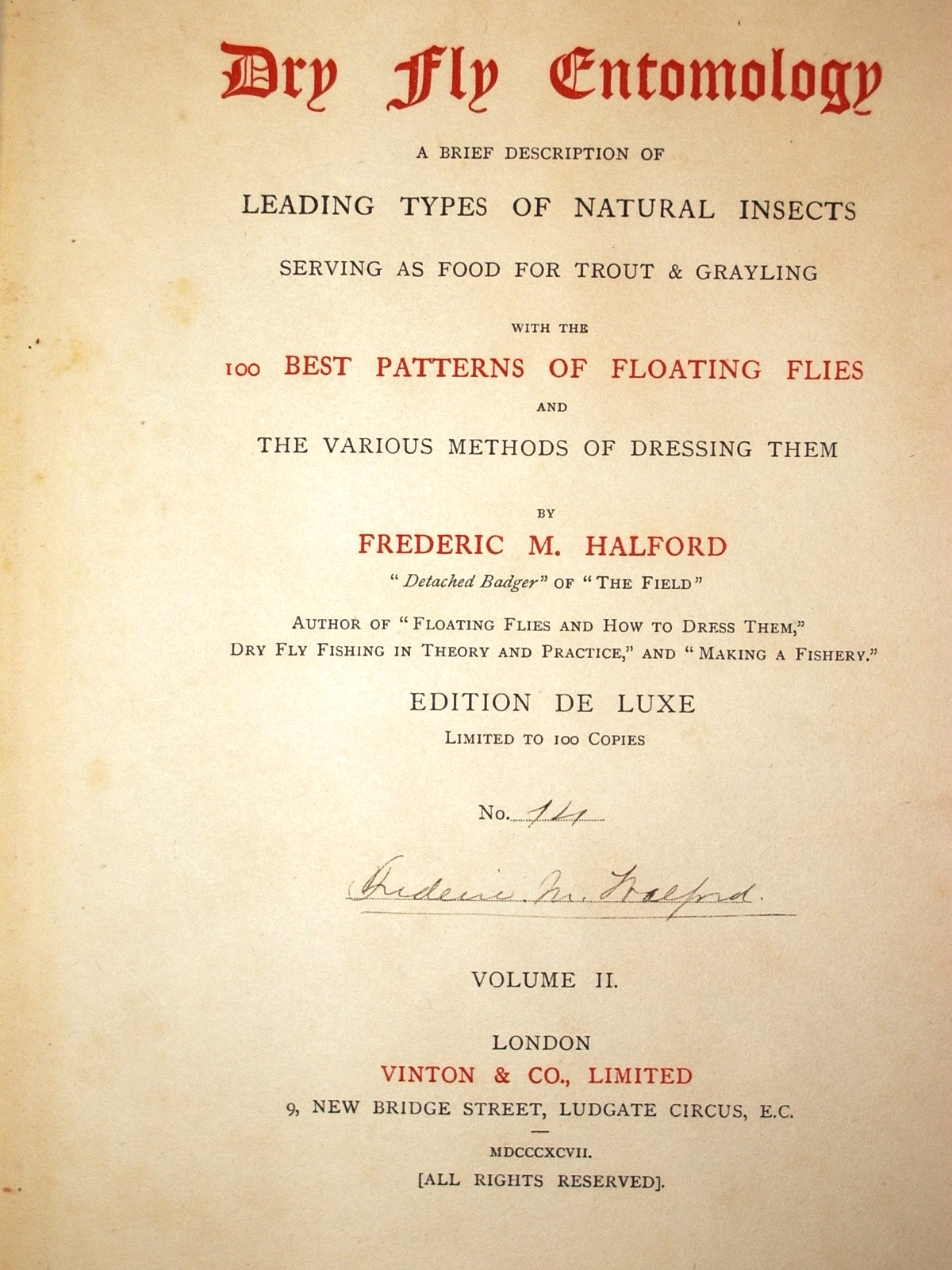
Hardy’s “Perfect” is a legendary fly reel.  Brass versions were being marketed by 1890 (Jess Miller, The Dunkeld Collection, 6), and several versions are still being produced today in Hardy’s Alnwick, England factory.  The plate-wind reel with internal ball bearings has given birth to several other Hardy reels, and it has inspired the production of reels from many other manufacturers as well.  It is one of the reels approved of by Frederick M. Halford (b 1844, d 1914), the famous “dry-fly purist,”  who was notoriously rigid in his recommendations of fishing tackle and technique.  In his preface to 1919’s The Dry Fly Man’s Handbook, he offers descriptions of the reel provided by Mr. J.J. Hardy (then managing director of Hardy Brothers, Ltd.), in “whose judgement and bona-fides” he has “full confidence.” (1).  Halford quotes J.J. Hardy as saying, “Those who have once used Hardy’s ‘Perfect’ reels with ball-bearings, regulating check and line guards, which can be dismounted in a minute without the use of any tools, would hardy be satisfied to go back to the older form, or indeed any reel which requires a tool chest and some knowledge of mechanics, before it can be dismounted” (26).  Apparently, J.J. Hardy was right, since the Perfect remains in production.

The first edition of Halford’s Dry Fly Entomology.
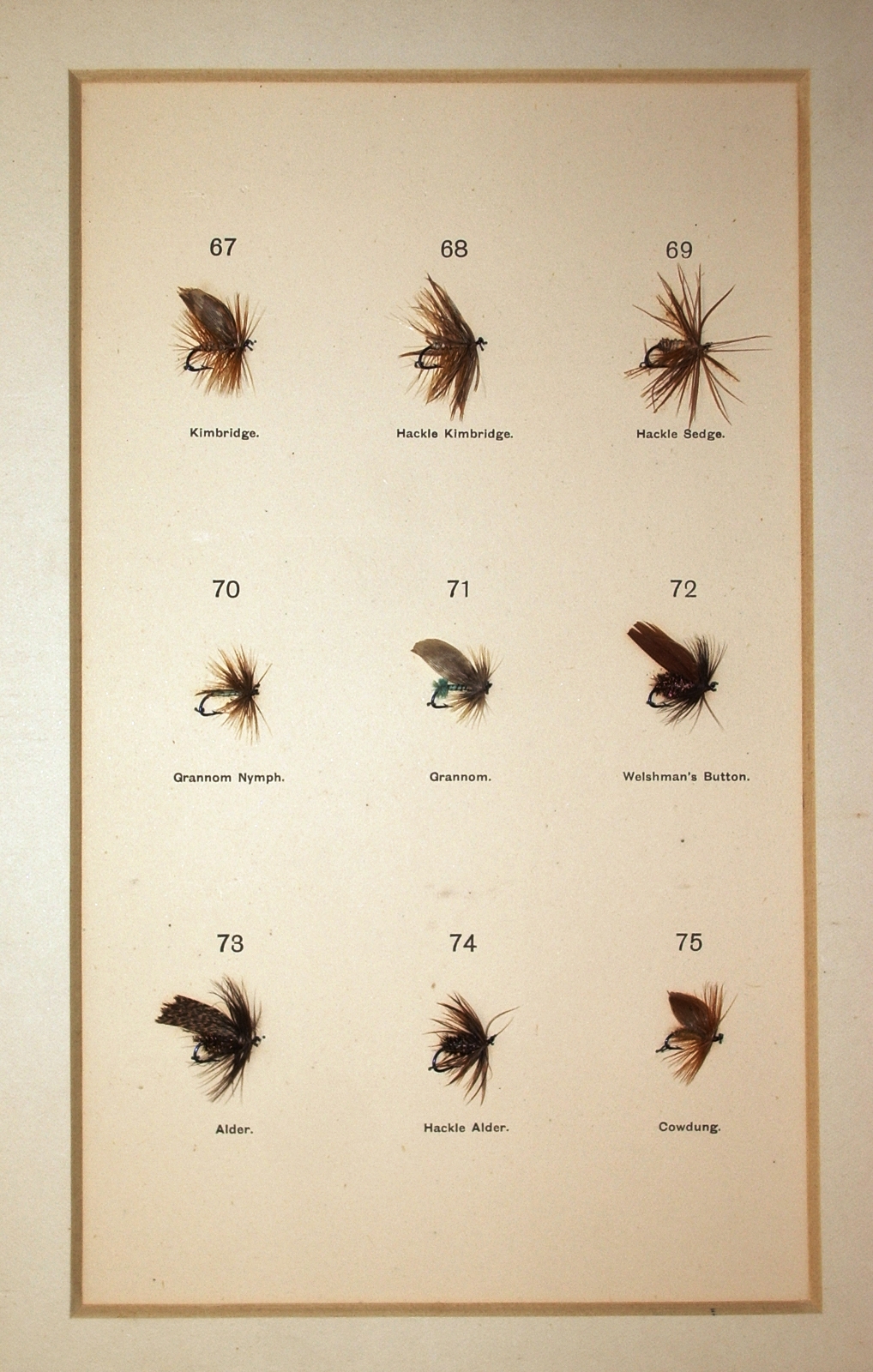
A plate of actual flies, included in the Dry Fly Entomology
The latest version of the Perfect to be released by Hardy is the Diamond Jubilee Reel, made to celebrate Queen Elizabeth II’s 60th year on the throne.  On Hardy’s website, the reel is described as, “One of a Limited Edition of 250 reels commemorating the Queen’s Diamond Jubilee, the 140th anniversary of Hardy Bros., and marking 100 years since the introduction of the ‘1912 pattern check’.”  Hardy USA President Jim Murphy tells me the reel will retail for $2,400.00.  All 250 reels, however, have already been claimed.
 
In the above pictures, notice the strapped tensioner and famous rod-in-hand logo.  According to Hardy’s 2011 Fly Fishing Catalogue, the latter is being reintroduced to the made-in-England “Hardy Bros” range (formerly the “Heritage” range).  You can read more about the Diamond Jubilee Reel here, on Hardy’s website. 
 

Me, in front of a display at Hardy's Alnwick, England headquarters.

Best Book Subtitle Ever

January 30, 2012

While compiling a research bibliography of early works on fly fishing, I came across this book: The Whole Art of Fishing: Being a Collection and Improvement of All that has been Written upon this Subject. London: Edmund Crull, 1714.

Surely, this book has the best subtitle ever conceived.  Perhaps my next book will be something like The Academic Study of Religion: Being a Collection and Improvement of All that has been Written upon this Subject. Or maybe Fly Fishing: Being a Collection and Improvement of All that has been Written upon this Subject.  Or even Life: Being a Collection and Improvement of All that has been Written upon this Subject. We’ll see.

Burns’ Night

January 25, 2012
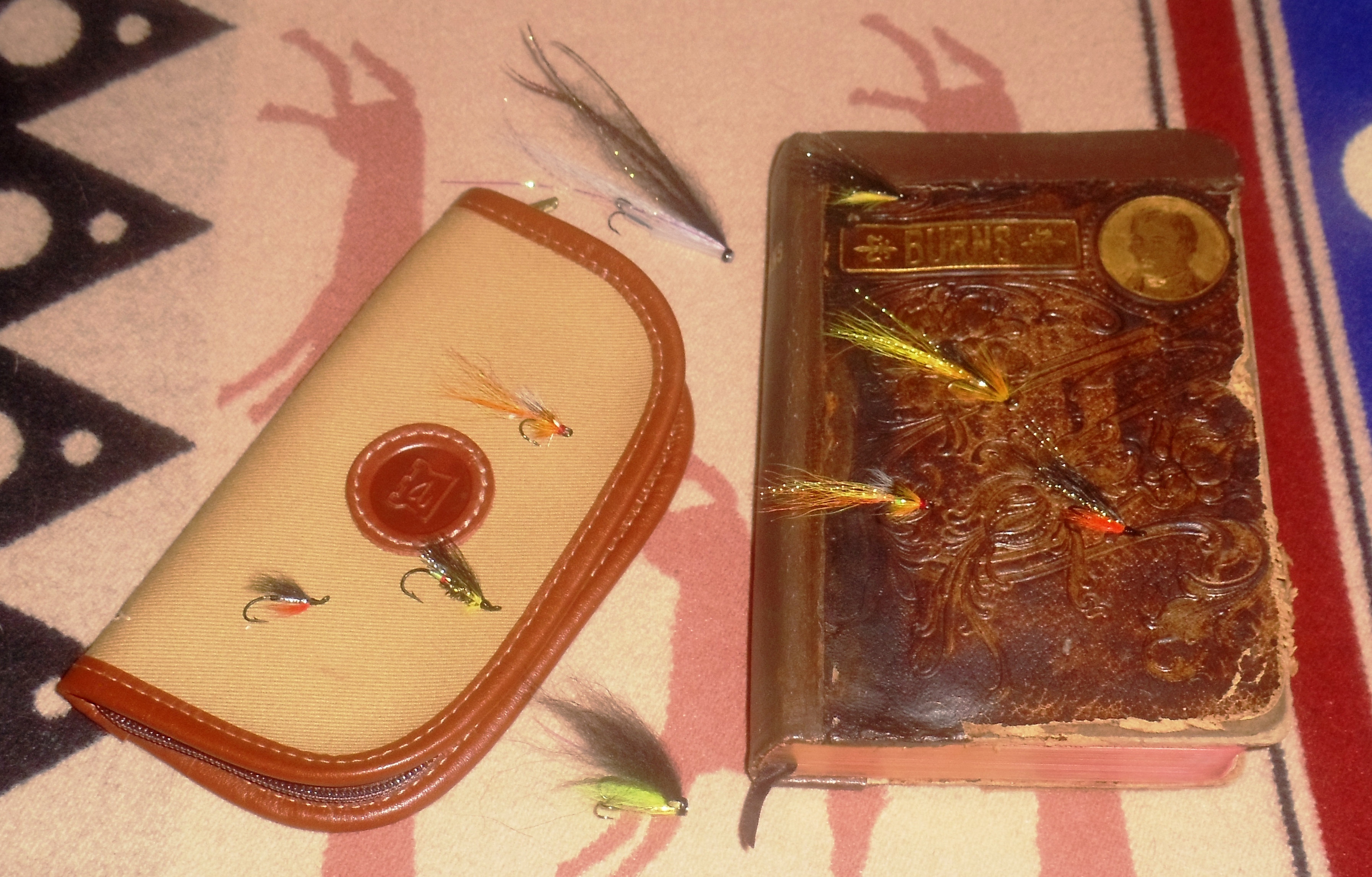
My grandfather’s copy of The Poetical Works of Robert Burns, passed to me by my grandmother, and some salmon flies from Scotland.

Tonight, and every January 25,  is “Burns’ Night”–the holiday honoring the great Scottish poet Robert Burns (1759-1796).  Burns heralded the Romantic Age, when artists, writers, philosophers, and others would focus upon the “natural” world, not as an object of study, as it was for so many intellectuals during the Enlightenment, but rather as something to admire, to feel, and to celebrate.  Burns was also a poet for the common person, writing about the daily life of laborers and often doing so in the Scots language.  He was one of a very few poets in his time to write in a vernacular language and also gain wide-spread success.

Despite his love for nature, expressed in such well-known poems as “To a Mouse,” and despite the fact that he spent much of his life close to some of Scotland’s finer trout and salmon streams, Burns does not seem to have been a fisherman.  As far as I know, he mentioned trout in only one piece of work, a song titled “To Mr. Cunningham” (or “Song inscribed to Alexander Cunningham,” or “Now Spring has Clad the Grove[s] in Green).

As I did last year, I post that piece here, for your enjoyment.

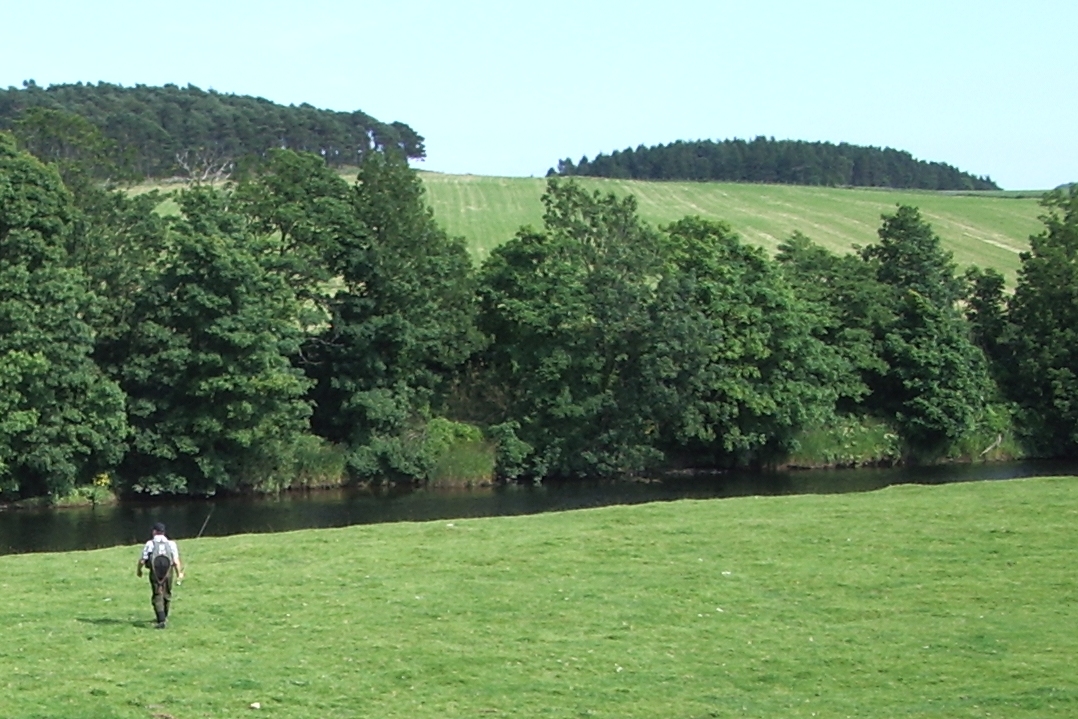
Making my way to a trout stream in Scotland.

“To Alexander Cunningham”

Now spring has clad the groves in green,
And strew’d the lea wi’ flowers;
The furrow’d, waving corn is seen
Rejoice in fostering showers;
While ilka thing in nature join
Their sorrows to forego,
O why thus all alone are mine
The weary steps o’ woe!

The trout within yon wimpling burn
Glides swift, a silver dart,
And safe beneath the shady thorn,
Defies the angler’s art:
My life was ance that careless stream,
That wanton trout was I;
But Love, wi’ unrelenting beam,
Has scorch’d my fountain dry.

That little flow’ret’s peaceful lot,
In yonder cliff that grows;
Which, save the linnet’s flight, I wot,
Nae ruder visit knows,
Was mine; till Love has o’er me past,
And blighted a my bloom,
And now, beneath the withering blast,
My youth and joy consume.

The waken’d lav’rock warbling springs,
And climbs the early sky,
Winnowing blithe his dewy wings
In morning’s rosy eye;
As little reck’d I sorrow’s power,
Until the flowery snare
O’witching Love, in luckless hour,
Made me the thrall o care.

O had my fate been Greenland snows,
Or Afric’s burning zone,
Wi ‘man and nature leagu’d my foes,
So Peggy ne’er I’d known!
The wretch whase doom is, “Hope nae mair!”
What tongue his woes can tell!
Within whase bosom, save despair,
Nae kinder spirits dwell.