The art of fly fishing for trout never was, nor will it ever be, a simple affair. The true greatness of the happy sport is due to two features: the fascination of the problems presented and the glory of the environment in which the adherent operates. … The most beautiful places on earth, be they rural or rustic, are the edges where land and waters meet.[1]
Charles K. Fox, This Wonderful World of Trout
Last weekend, I had the privilege of joining the Fly Fishers’ Club of Harrisburg, thanks to the invitation of a close friend, who was already a member. Until recently, I lived in South Central Pennsylvania, and there were long periods when I fished the Harrisburg area limestone streams and other local waters on a daily basis. Having long enjoyed and learned from the writings of those who help refine modern fly fishing methods on these streams, and having gotten to know some of the area old timers in that fishing community, joining this club at their annual dinner was a great thrill. I plan to attend as often as possible in the future, even though doing so will involve some travel.
The Fly Fishers’ Club of Harrisburg is largely regarded at the second oldest fly fishing club in the United States, predated only by Anglers Club of New York. It was founded in 1947 by legendary anglers and fly fishing writers Charlie Fox and Vince Marinaro. Fox went on to write such books as the immensely entertaining This Wonderful World of Trout (1963), and Marinaro eventually wrote the highly influential The Modern Dry Fly Code (1950), among other titles.
Sam Slaymaker recounted the club’s founding in the 1978 spring edition of Fly Fisherman magazine (reprinted in Limestone Legends: The Papers and Recollections of the Fly Fishers’ Club of Harrisburg, 1947-1997). He wrote:
Charlie suggested forming their own fly fishermen’s group. Vince liked the idea and suggested calling it the Fly Fisher’s Club of Harrisburg. While Vince had the Fly Fishers’ Club of London in mind when he suggested the name, the two groups came to have little else in common. The founders of this new angler’s club were anxious to admit anyone interested in fly-fishing. They wanted, in Charlie’s words, “to talk fly-fishing in all its aspects.”[2]
Initially, the Fly Fishers’ Club of Harrisburg held regular luncheons with invited speakers. In 1948, they began to hold an annual dinner. Today, the luncheons are no longer held, and the dinner is the primary social event for the club. Speakers at the dinner have included Edward Hewitt, Arnold Gingrich, Lee Wulff, Ernie Schwiebert, and many other famed fly fishers and authors.
I grew up in Montana. Certainly, my home state is one of the first that comes to mind when one is thinking of fly fishing. But the history of the sport there is only becoming well-known now. Therefore, when I was younger, the fly fishing books I grabbed from the book shelf at our Montana cabin were generally not written by fellow Montanans. They were written by people like Arnold Gingrich, the founding editor of Esquire magazine, who praised Charlie Fox and other Pennsylvania fly fishers. Of course, these books made a great impression on me. Little did I guess that I would one day join the club founded by Fox.
In Limestone Legends, Norm Shires notes that “It has been said that the Fly Fishers’ Club of Harrisburg is more tradition than organization.”[3] As a person who is deeply fascinated with the traditions associated with fly fishing, this suits me just fine. I thank my friend John Bechtel for sponsoring my membership.
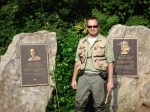


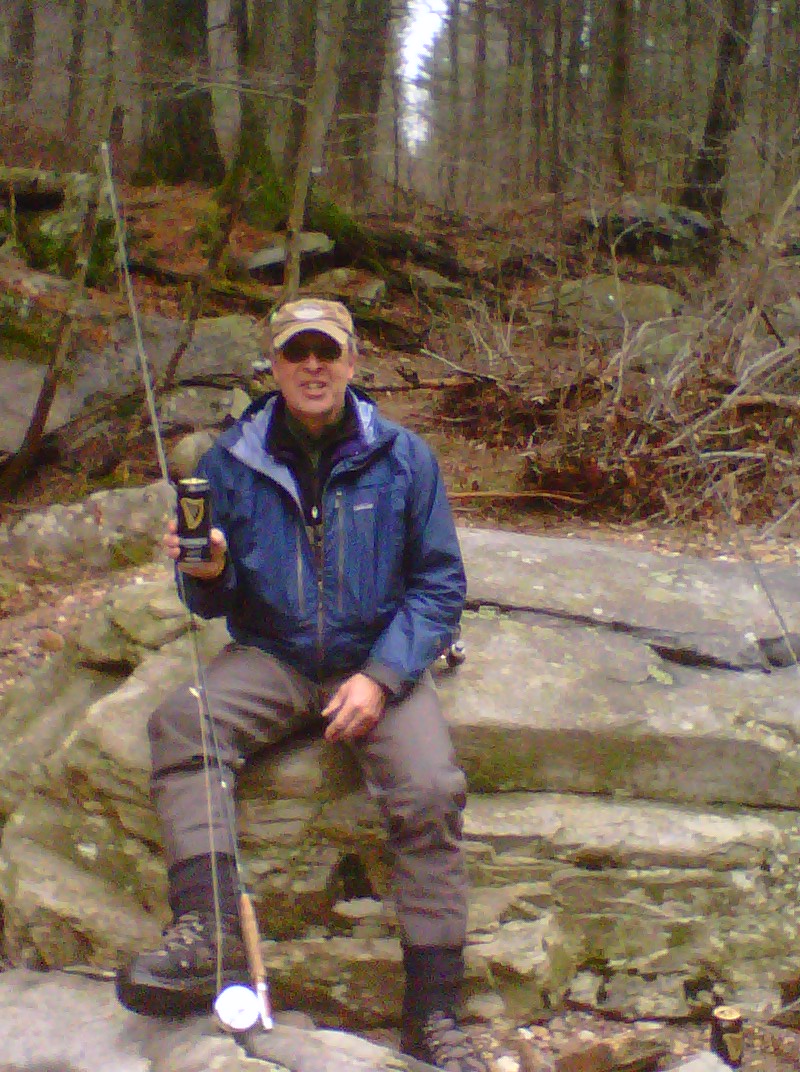
Above left: Memorials to Charlie Fox and Vince Marinaro. Middle: Fishing a favorite South Central PA stream. Right: John Bechtel.
[1] Charles K. Fox, This Wonderful World of Trout, Revised Edition (Rockville: Freshet Press, 1971), 190.
[2] S.R. Slaymaker II, “The Fly Fishers’ Club of Harrisburg,” in Limestone Legends: The Papers and Recollections of the Fly Fishers’ Club of Harrisburg, 1947-1997 (Mechanicsburg: Stackpole Books, 1997), 4-5.
[3] Norm Shires, “A Postscript,” in Limestone Legends, 22.



 The Literary Fly Fisher