Archive for the ‘Fly Fishing’ Category

Steve Earle, Fly Rods, and Moonshine

January 19, 2013

It is difficult to pack a fly rod around some of the more remote portions of Southern Appalachia and  not occasionally find yourself humming fellow fly fisher Steve Earle’s “Copperhead Road.”  The illicit “licker” making culture, about which Earle sings, is still alive in such places (heck, there even seems to be an old still in the forest behind our house).  For instance, a couple of years back, my friends and I were investigating some backcountry streams.  One morning, a couple of us popped into a tiny store, built of logs, to buy some junk food for breakfast.  After a short wait, a middle-aged fellow hobbled to the rickety counter and rang up our purchases.  While doing so, he engaged in a rather poetic pitch for his moonshine.  “You boys ever taste pure goodness?  You boys know what it’s like to swallow a ray of sunshine?”  I had to head back to town, but my friend was camping another night and decided to check out the clerk’s special product.  The man’s hand reached under the counter and brought out a mason jar full of crystal clear liquid.  My friend took the jar back to our camp, and I took the clerk’s phone number back to town.

Here is an excellent scholarly essay by Jason Sumich, on contemporary North Carolina moonshine production:  “It’s all Legal Until you get Caught: Moonshining in the Southern Appalachian Mountains.”

And here is a great version of “Copperhead Road,” by Steve Earle:

New Year’s 2013

January 7, 2013

The days surrounding New Years were great fun.  My wife, daughter, dog, and I shared a little cabin in the mountains.  My daughter loved playing in the snow, my dog and I enjoyed fishing, and my wife loved the warmth of the cabin and her family.  Of course, my wife and I jumped into the New Year at midnight and then read Robert Burns’ “Auld Lang Syne.”  Already, it is a fine memory, and many years from now, we will fondly remember this holiday, “a long time ago.”

Sure, for those of us who pay attention to such things, the year turned a few weeks back at the solstice.  Still, I enjoy the January 1st holiday and it serves as a fine reminder that the time we can spend with our loved ones and on the stream are, indeed, getting longer (or at least more sunlit).

IMG-20121231-00691

IMG-20121231-00689

IMG-20130101-00702

IMG-20121231-00697

IMG-20130101-00704

IMG-20121231-00700

And there’s a hand, my trusty fiere,

And gie’s a hand o’ thine,

And we’ll tak a right gude-willie waught

For auld lang syne.

From “Auld Lang Syne” (“A Long Time Ago), a traditional Scots song, put to paper (and, most likely, largely composed) by Robert Burns in 1793.

Jumping into the New Year

December 29, 2012

DSC02297

Years ago, during my first visit to my wife’s hometown of Budapest, Hungary, we celebrated New Year’s Eve at the home of a somewhat shady businessman and family friend.  Just before the clock struck 12:00 AM, he had us all stand on the couches and clutch as much money as we could find.  At midnight, we jumped off the couches and into the New Year.  The idea was that the coming months would be filled with wealth.

My wife and I now do this every year, and it has become a tradition in the rest of her family too.  Of course, one can jump into the New Year with things that signify non-monetary wealth too.  As for the shady New Years Party host, who introduced us to this little ritual all those years ago … well, let’s just say that he’d best start jumping into the New Year with a key, since he is usually locked up.

Often times, I have been lucky enough to go fishing on New Years Day (and on the Winter Solstice too, which is a much more proper start date for each new year).  I’ll be doing that again on January 1, next week; I’ll be making yet another visit to my newly discovered, enchanted brookie stream. The tackle is packed, and I’m ready to roll.  Happily, I am heading to the mountains with my wife, daughter, and dog, too.  Therefore, I’ll be jumping into the New Year doing the thing that I love and also enjoying the company of those precious to me.

Photo by Mike Sepelak

Photo of me on the enchanted stream, by Mike Sepelak

My own tradition, by the way, has been to always read Robert Burns’ classic version of “Auld Lang Syne” on New Years Eve.  I have already packed the 1920 copy of Burns Poems and Carlyle Essay, edited by George Marsh, that I have been sure to have in my back pocket every December 31, since 1992.

DSC02317

Eden Phillpotts, Pretense, and Fly Fishing in the 1800’s and Today

August 19, 2012
First Edition of Folly and Fresh Air, 1891

First Edition of Folly and Fresh Air, 1891

I received an email today from a very old and reputable outdoor company, with a subject line that read, “complete your look with the right accessories.”  Of course, I found this line a bit ridiculous.  I fully realize, though, that many fly fishers are more concerned about appearances than they are the practice of fishing and the other activities that go with it.

Things seem a bit different than they were, say, fifty years ago, here in the States.  Back then, most fly fishers probably would have been casting a glass rod with an automatic reel or Medalist attached.  At least, that was certainly the case in the West.  It’s also true that there were simply fewer fancy fishing clothes in which the fisherperson of the time may have donned her or himself.  That’s not to say there weren’t plenty of other gadgets marketed to fly fishers.

Still, there is a segment of the fly fishing population that has always been concerned more with appearances than fishing.  And I would be less-than-honest, if I did not admit that my own eyes are often caught be a particularly nice piece of gear, wearable or otherwise.  My tastes are a bit eccentric, however (look at the books I read!)  and not so much affected to impress any one other than a community of fellow sartorial weirdos in my head.

Regardless, one of the most amusing examples a fly fisher obsessed with appearances is a fictional one.  This is a young man, who is the central character in Eden Phillpotts’ (b. 1862, d. 1960) Folly and Fresh Air.  The book, narrated in the first-person, was published by the prolific and very successful English author in 1891.  The young man in question is rather prone to exaggeration.  He attempts to impress his family and colleagues by claiming fly fishing prowess.  Before long, he has accidentally talked himself into taking a fishing trip to Devon with his brother, who actually does know how to fish.  In Devon, the two brothers make friends with locals, find romance, and even catch a few trout.

The funniest part of the book comes toward the beginning, when the central character visits a tackle shop to gear up.  Actually knowing nothing about fishing, but trying to pretend that he does, he makes a buffoon of himself.  Following are a few passages from this hilarious scene:

Finding an admirable establishment, I entered it and asked to see some fly rods.  I said—

” I happen to want a new one.”

Note the ‘new.’  This, if properly understood, must have led the man to suppose that I owned hundreds of faithful, well tried, old rods, and now, just for the mad freak of the thing, thought about adding another to my collection.  But it was not understood properly.  The person in the shop appeared to be upset about some private concern, and answered, shortly—

“We never sell any but new ones.”

Then he dived out of sight behind his counter, and brought up a fishing-rod.  He put it together without a word and handed it to me.  I took it from him, weighed it and frowned.  Then I shut one eye and looked down the handle, as though I purposed shooting something with it.  Meanwhile the man regarded  me in stony silence.  I began to yearn for a word of encouragement from him.  Even censure would have been more bearable than the look he cast at me.  I felt as if I was doing wrong, grew nervous, and flourished the thing to show technical familiarity with it.  This action fetched down a gas globe, which should have made conversation.  I took the liberty of pointing out that anybody showing technical familiarity with a trout rod here, must destroy that glass globe every time the man renewed it.  Still his taciturnity was such that I grew foolhardy, and advised him to modify the whole scheme of his shop.  This stung him into retort.  He said any alteration would depend up the extent of my custom.  If I could limit my visits, and mention the date of them beforehand, he thought he should risk leaving things as they were.  For which intentionally rude remark I snubbed him. (19-20).

Things go on like this for some length, until the shopkeeper realizes he has a sucker on his hands.  Eventually, the young man leaves the establishment with “all the best things in the shop” (21).

No doubt, if Phillpotts’ fictional character were an actual person and alive today, he would have been mightily excited to receive the email that was sent to me this morning.  And, perhaps, after acquiring the latest zipper-crotched waders, expedition quality wading  jacket, retro trucker cap or fedora, and so on, he would have actually gone fishing, as the character in the book does, and fallen in love with the pastime.  No doubt, there are worse things than well-dressed fly fishers — well-dressed bankers, politicians, and used-car salespersons, for instance.  Then again, a lot of those well-dressed fly fishers probably are bankers.

Frederick Halford in the 1890’s

August 15, 2012

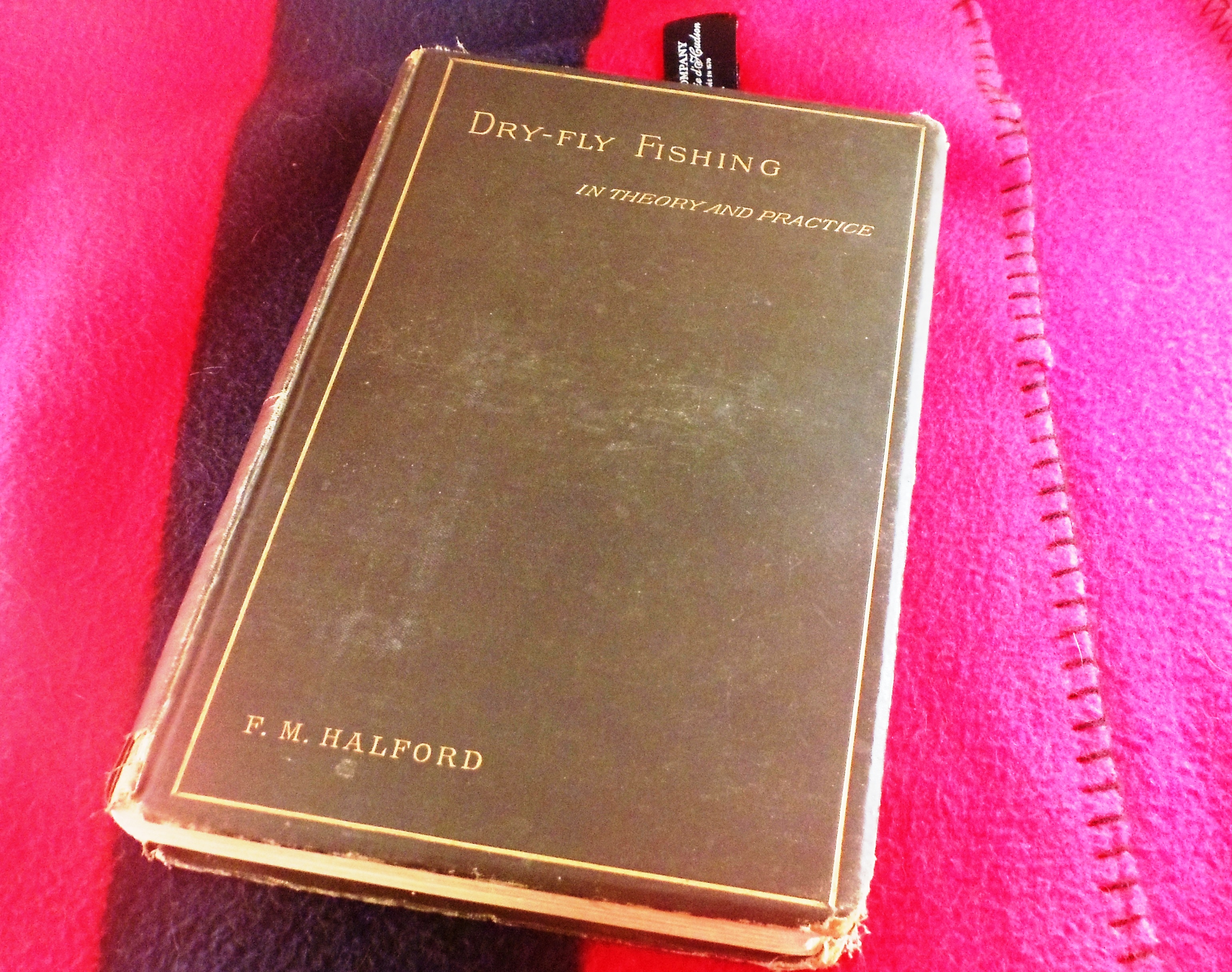
I write this post mostly to share my excitement over a recent acquisition.  I was able to pick up a frist edition of Frederick M. Halford’s Dry-Fly Fishing, in Theory and Practice, published in 1889 by Samson Low, Marston, Searle, and Rivington, Ltd. in London.  Most fly fishers know Halford as an advocate of dry fly fishing, particularly when it comes to fishing the essentially manicured chalk streams of England.

Fly fishers often imagine Halford as a stodgy, old businessman and grand supporter of the Empire.  In fact, he was Jewish, and he retired very early in life–during his forties–to become what we might now call a “trout bum.”  Despite is purist reputation, however, he was actually also bit of a “grayling bum:”

Many first-class fishermen say that they do not care for grayling fishing, possibly because they have never really tried it, or equally possibly because they are not quite right–I will not say straightforward–but disingenuous and candid in the opinion they are giving.  Then they quote Cotton, who wrote that extraordinary sentence about the grayling being the deadhearted fish that swims.  Cotton certainly never killed a three-pound grayling on a Test shallow; if he had, with his power of discrimination and strong desire for truth, he could not have written that sentence.  Some fishermen have even been heard to say that they wished the last pike in the Test might be choked in the act of swallowing the last grayling.  This, however smart it may sound, is childish and selfish, as many fishermen consider that grayling fishing is quite as good in its way as the trout, and with these I wish to be numbered. (Halford, Dry Fly Fishing, 251-252).

As regards Halford’s favor for dry fly fishing and the promotion of a sort of orthodox fly fishing style on chalk streams, he is probably misremembered as being overly opposed to “fishing on the bottom:” 

In treating of the advantages of the dry-fly over wet-fly fishing, I am most desirous of avoiding any expression which should tend to depreciate in any way the skill exhibited by the experienced and intelligent followers of the wet-fly.  They require not only most undoubted judgement of the character of water frequented at various times of the day and season by feeding fish, not only a very full knowledge of the different species and genera of insects forming the food of the fish, not only a full perception of the advantages of fishing up-stream under one set of conditions and of fishing down-stream under others; but, in addition to all this, great skill in placing their flies accurately in the desired position, and allowing them to drift down in a natural matter and without any drag or check over the precise spot they wish to fish.  There is far too much presumption of superior scientific knowledge and skill on the part of the modern school of dry-fly fishermen, and I should be the last to wish to write a line tending to encourage this erroneous assumption of superiority, or to depreciate in any way the patience and perseverance, coupled with  intuitive perception of the habits of the fish, requisite for a really first-rate performer of the wet fly (Halford, Dry Fly Fishing, 3).

I think Halford is written off by most American fly fishers today.  This was not always the case, though.  Among those who are best known for advancing “technical” fishing in the US, he was quite popular.  Of course, the foremost of these figures are Vince Marinaro and Charlie Fox, who fished the Pennyslvania “Limestoner” equivalents of the English chalk streams.

Prolific journalist, writer, and fly fisher, Alfred Miller (AKA “Sparse Grey Hackle”) wrote, “These Pennsylvania boys laugh at the idea that the pattern doesn’t matter if you handle it correctly and insist tha it is necessary to imitate exactly the hatch on the water, use fine gut, and fish delicately and far off to achieve consistent success.  They read Halford and believe what he says.  Their average knowledge of stream entomology would put the average Angler’s Club [of New York or London] member to shame, and they keep emergence tables, either mental or written, as a matter of course.  And they put their fish back  (Alfred Miller, Limestone Legends: The Fly Fishers’ Club of Harrisburg, 1997, 95).

So, while Halford’s stodgy reputation seems to be undeserved, it is certainly the case that his emphasis upon entomology and “matching-the-hatch” was influential.  No doubt, this is largely because the crystal clear, food-rich chalk streams of the UK and limestone creeks of the US are immensely difficult to fish.  The western US fisher who claims that Idaho’s Silver Creek or the Henry’s Fork are the most difficult waters to fish in the world, then, might do well to remember that other skilled fly fishers have been dealing with similar challenges for a very,very long time.  Who knows?  That same western US fly fisher may actually pick up a tip or two from Halford, who was not so rigid in his techniques as he is now remembered.  This fly fisher might also consider the fact, too, that Halford and Marinaro often crawled to their streams, in order to avoid spooking fish.  While I’m sure it has happened plenty of times, I have yet to see someone do this on the Henry’s Fork.

Schionatulander, King Arthur, and Fly Fishing in Germany, circa 1220 CE

July 31, 2012

Illumination from 15th c. copy of Parzival

Scholars, both professional and independent, have long argued that the first literary reference to fly fishing in European literature, outside of the ancient world, appears in a fragmentary, 13th century text.  The text was composed by German author Wolfram von Eschenbach, who also composed a very popular version of the Arthurian romance Parzival.  Titurel, the fragmentary text in which Wolfram refers to fly fishing, is also a part of the Arthurian body of literature.  Indeed, tales of King Arthur, his knights, and related figures were immensely popular outside of the Celtic areas of England, with which they are most often associated.  The tales became known in France because the people of Bretagne were closely related to the Celts of Wales and Cornwall, with whom the narratives of Arthur likely originated.  The Arthurian stories then became known in Germany, simply because French writers were so influential throughout the continent.

The story of Parzival is well known, even today.  Many of the characters and events of Wolfram’s other text, Titurel, remain relatively obscure.  One of the characters is Schionatulander, a young squire.  The text describes him enjoying the distraction of the forest with his lover, Sigune, who is the granddaughter of King Titurel.  Schionatulander and Sigune embark upon this retreat just before being led to tragedy by a hound with an unusual collar and leash.

Here are several lines from the text, translated by Cyril Edwards:

Schionatulander, with feathered bait, was catching perch and grayling, while she was reading–and catching also, such loss of joy that he was very seldom merry thereafter.[1]

. . . .

Schionatulander was catching large and small fish with his rod, standing there on his bare, white legs to enjoy the coolness in the clear-swift brook.[2]

Admittedly, these references to fly fishing are very minor.  On the other hand, they are presented in a way that indicates fishing was well-known as an acceptable pastime for high-born, future knights in the presence of noble women.  Indeed, it is the passing quality of these references that makes them so interesting.  Many, many texts about King Arthur and related characters were written in this era and later.  Many of these, probably most, did not survive.  It is easy to imagine that fly fishing appeared in one of these lost texts.  Perhaps somewhere, sometime, there was even a reference to King Arthur fly fishing for salmon in Wales.  In fact, if he was a fly fisher, we might better understand why his wife’s eyes wandered toward another man: Arthur was always off fishing.  Now, lest anyone take this latter suggestion seriously, let me emphasize that I am joking.  Still, I would be surprised if fly fishing did not appear in any of the other stories at some point.


[1] Wolfram von Eschenbach, Parzival and Titurel: A New Translation by Cyril Edwards, translated by Cyril Edwards (Oxford: Oxford University Press, 2006), 366.

[2] Ibid.

Perfection

July 20, 2012

The little lake in the Big Blackfoot River drainage, where our cabin is.

My wife, daughter, and I were in the West earlier this summer.  We visit there often, as it is home for me.  The highlight of these trips is the time we spend at our family cabin, which is located on the shore of a small lake in Montana’s Big Blackfoot River drainage.  Recently, one of my sisters and I were discussing the fact that the cabin has always been our one “constant” in life.  This, in addition to the beauty of the place, makes it immensely important to us.

I’m back in the East, now, trying to wrap up some writing and prepare for some fall teaching.  My wife left for an extended work trip shortly after we returned from Montana.  I just picked her up at the airport, last night.  My little daughter was terribly excited to see her mom, and she insisted on sleeping with us.  As I lay in bed, I could hear my sleeping wife breathing, and I could feel our girl nestled between us.  Meanwhile, my dog was audibly licking his paws on the floor.  All of this reminded me of our time at the cabin.

I thought, specifically, of another night.  It was late, but I was awake as usual.  Getting up for a drink of water, I looked upon my wife on the bed, with the dog at her feet.  Our daughter was in a tiny mummy bag on the floor–she loves that sleeping bag.  The moonlight lit interior of the cabin and also called my attention to the scene beyond the windows.  Outside, I could see the stars, the moon and its reflection upon the lake, and the outline of the surrounding mountains.  I thought to myself that, at that very moment, life was perfect.

The cabin.

Perfection is something I address in some of my college classes.  The students and I discuss, with the help of both academic and nonacademic sources, how perfection is a fleeting thing in our world.  The sources suggest we should cherish it whenever and wherever we find it because, soon enough, we’ll have to return to our daily lives, which are marked by our social and economic statuses, our need to pay the bills, maintain our health, and so on.  Anthropological and philosophical sources argue that our daily lives are so different—so imperfect—because all of these things prevent us from feeling the sense of connection that we do during the moments of perfection.

Indeed, religious mystics and scholars of mysticism tell us that it is connection or intimacy with our loved ones, nature, or even our creator that characterize perfection.  One such scholar, Margaret Smith, writes that, in mysticism, “consciousness is deepened to a sense of the Beyond as a unity . . . .”[1]  Smith first made this claim in the 1930s, and there much critical scholarship on mysticism has been published since.  But I won’t drag you through all of that.  After all, I’m trying to enjoy the last few weeks I have outside of a college classroom, before returning to the lectern after an extended break.

Regardless, scholars and mystics alike suggest we can we can live our lives in ways that will allow us to achieve moments of perfection as often as possible.  In fact, we should lead our lives in such ways, for it is the moments of perfection that make life most worthwhile.  No doubt, this is why I am drawn to fly fishing, to the wild places where trout live, and to our cabin in the Big Blackfoot River drainage.  At these places, I am most likely to find perfection.

Fly fishing on the lake, just outside our front door.

Norman Maclean might be the most famous fly fisher of the Big Blackfoot River.  In his novella, A River Runs through It, he describes the fleeting moments of perfection in a way that few people ever have.  He suggests, too, that fly fishers may be especially prone to experiencing them:

Poets talk about “spots of time,” but it is really the fisherman who experiences eternity compressed into a moment.  No one can tell what a spot of time is until suddenly the whole world is a fish and the fish is gone.[2]

A “Bunyan Bug” fly, fished by Maclean in his novella.

That sense of connection, intimacy, or “compression” is explicit in the moment he describes.  Elsewhere in his novella, he compares this sense of connection to electricity (read the entire passage).  At this point in the story, he is sitting with his father, watching his brother Paul fish.  In the larger context of the book, it is not only the connection felt with the larger world of fish and other beings that is important here, it is also the connection felt between the family members:

Everything seemed electrically charged but electrically unconnected.  Electrical sparks appeared here and there on the river.  A fish jumped so far downstream that it seemed outside the man’s electrical field, but when the fish had jumped, the man had leaned back on the rod and it was then that the fish toppled back into the water not guided in its reentry by itself.  The connections between the convulsions and the sparks became clearer by repetition.  When the man leaned back on the wand and the fish reentered the water not altogether under its own power, the wand recharged with convulsions, the man’s hand waved frantically at another departure, and much farther below a fish jumped again.  Because of the connections, it became the same fish.[3]  

 I think we all feel these moments of perfection and connection, on occasion.  If you have trouble finding them yourself, however, you might visit a wild place.  You might even bring a loved one and a fly rod, too.  At the very least, you might take time to reflect, in the quite of the night, upon the connection you feel to the most important people in your life.

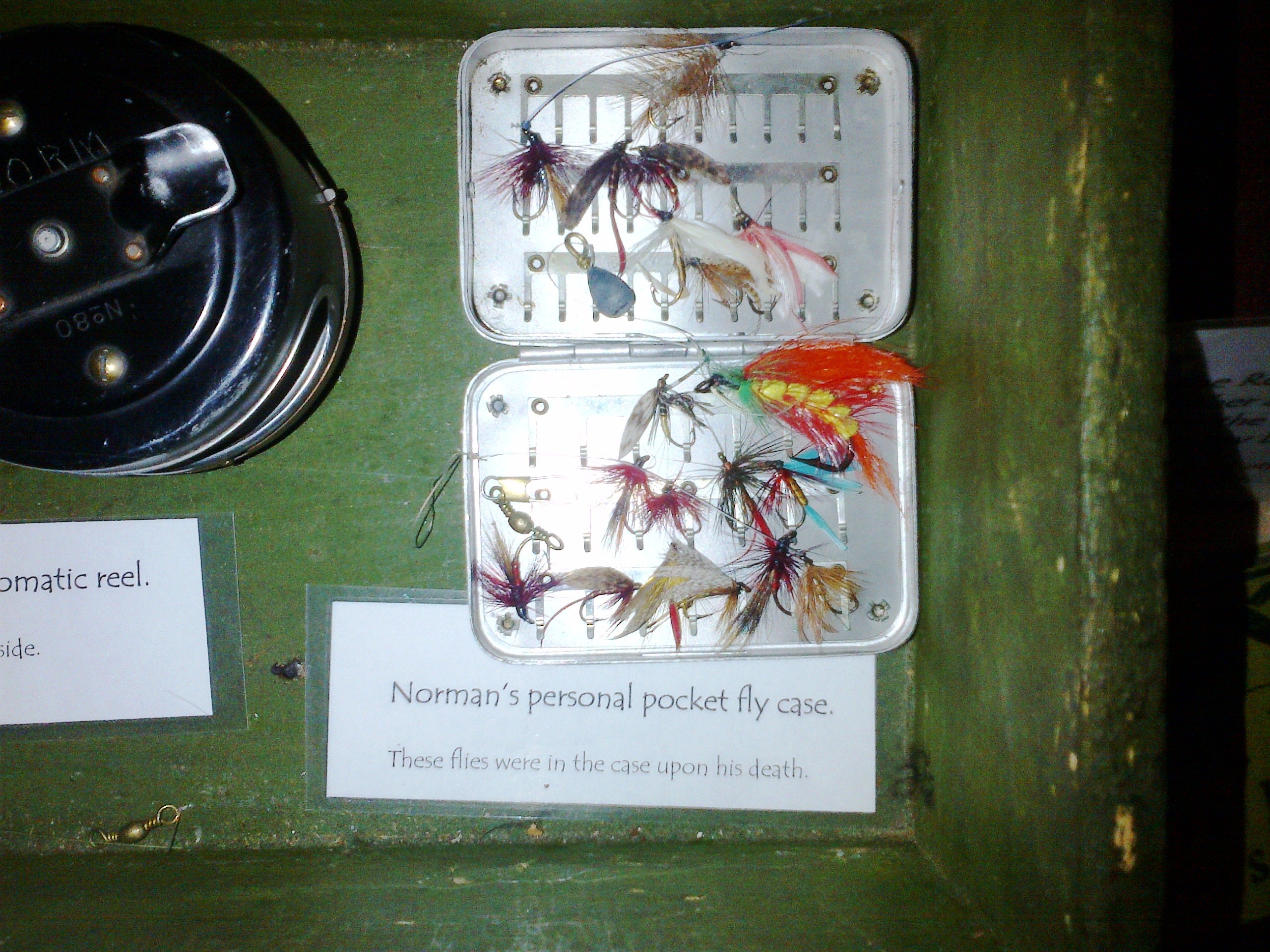
Flies owned by Norman Maclean, at the Seeley Lake Historical Center and Museum


[1] Margaret Smith, The Way of the Mystics: the Early Christian Mystics and the Rise of the Sufis ( New York, NY: Oxford University Press, 1978), 2.

[2] Norman Maclean, A River Runs through It, and Other Stories, Twenty-fifth Anniversary Edition (Chicago, IL: The University of Chicago Press, 2001), 45.

[3] Ibid., 98.

Rock Creek, Montana, and Me

July 1, 2012

While I grew up primarily in Helena, Montana and at our cabin near Ovando (as well as at cabins shared with the extended family in Glacier National Park), Missoula, Montana and its environs have figured prominently in my life for a long time.  While I was a kid, we had friends and relatives there.  Later in life, I earned my bachelor’s degree at The University of Montana in Missoula, and I hung out there for a while afterwards before going to graduate school.  By then, my sister and her family, as well as my father (both of whom also went to U of M) had moved there.

Today, with the majority of my family in Missoula, it feels more like “home” than most other places, with the exception of our cabin.  For many years, I have fished the waters around Missoula.  In college, friends and I would often visit nearby Rock Creek.  These days, too, I often head there when I don’t have time to make the longer journey to the cabin and the waters surrounding it.

Rock Creek was a relatively quiet place, when I was in college.  Certainly, it had many fly fishing fans, but the numbers of people who fished there are nothing like the numbers one sees today.   Also, development of the private land along the rivers has increased at a frightening rate.  Still, I enjoy fishing there, though I usually only visit during the week and at times of the year, when I know it is not likely to be so crowded as to make fishing there a bad experience.

Rock Creek Road

I visited Rock Creek just a short time ago.  Driving up and down the long dirt road that borders the creek gave me plenty of time to think about past fishing trips there.  For instance, I thought of the time that a college friend and I drove up in his truck.  Just as we hit the dirt section of the road, a sherif pulled us over for speeding.   My friend probably wasn’t in any condition to be driving at all, and that condition was only going to get worse (thanks, in part, to the twelve-pack at my feet).  And yet, my friend, a North Carolinian with a molasses-like drawl, managed to talk the sherif out of giving him a ticket.  Before the sherif returned to his truck, he said, “I’ll get my quota elsewhere.”  I remember fishing with another friend, with whom I was quite close.  We had known each other for years, and his father had once been appointed as my public defender (that’s a whole other story).  We were fishing one of the lower stretches of the creek, and my slightly inebriated friend was casting from a half-submerged log.  When a fish struck his fly, he vigorously set the hook and threw himself backwards of the log.  The trout got away, of course.  

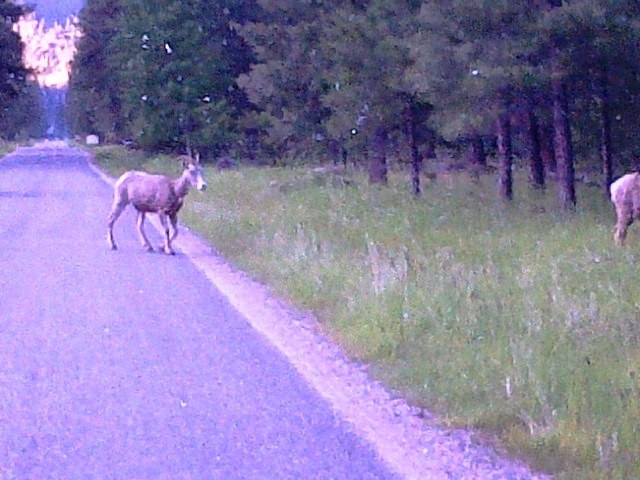
Bighorn Sheep (ewes).

On this last trip to the creek, I had nothing in me besides a cup of coffee.  My personal habits have changed tremendously in recent years.  Hopefully my old friends’  habits have changed too, though I have lost touch with them and really don’t know.  I’m not even sure if they still fly fish, sober or otherwise.

The “Salmon Fly” — Pteronarcys carlifornica

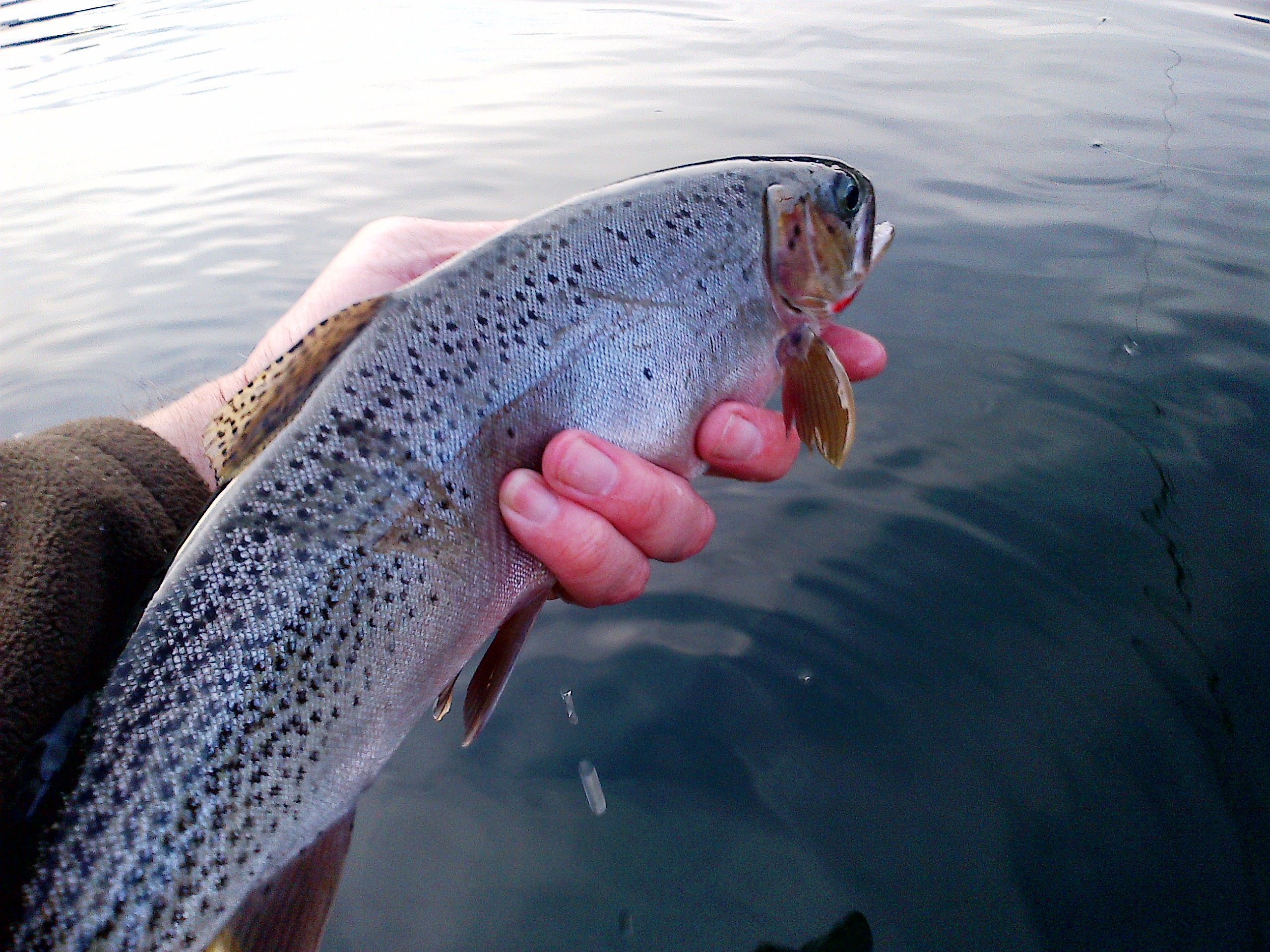
Rock Creek is still a wonderful place, despite the greater numbers of people now there.  I took a few pictures on my recent visit.  Because I’m usually more concerned with fishing than with photography, these are poor images taken on my smart phone.  Their grainy quality aside, I think the pictures show why Rock Creek remains special.  They include an image of two of the Bighorn Sheep (ewes) one often sees on the road, an image of one of the Giant Stone Flies or “Salmon Flies” that attracts so many people to the creek, and an image of one of the beautiful (if not-so-large) brown trout that fishermen seek with their salmon fly and other imitations. 

I hope that, with all the human visitors this place receives, Rock Creek remains a wonderful place for a long time to come.  Kudos to The Kingfisher fly shop in Missoula, whose owner’s have made the conscious decision to decrease their guided trips to Rock Creek and other area waters.  We’ll see if other outfitters follow suit (it would be especially nice if the one who had his client fish in my hole during this last trip would lay off the float trips). 

Rock Creek Brown

 Post script: My apologies for the long period between posts.  I was travelling for the past month.


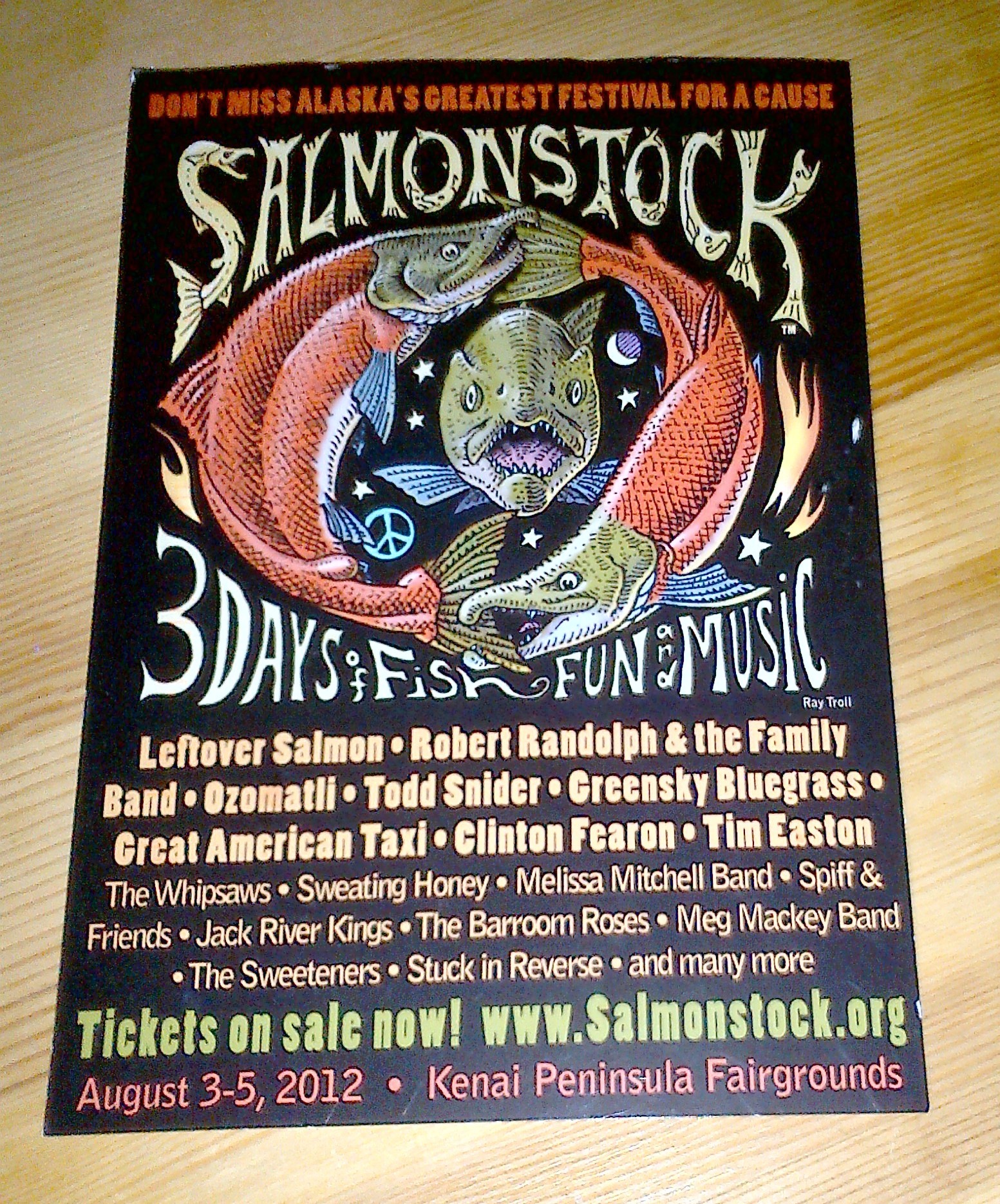
Salmonstock: 3 Days of Fish, Fun, and Music

May 19, 2012

This event could be a lot of fun.  Held August 3-5, 2012, in Ninilchik, AK, Salmonstock is advertised as “a celebration of Wild Alaska Salmon and the people who depend upon them.”  Attendees can enjoy three days of fly fishing on the Kenai Peninsula and some great music (trust me), all while benefiting an important cause.  For more information, visit www.Salmonstock.org.

The Film, A River Runs Through It, Twenty Years Later

March 7, 2012

Midcurrent Fly Fishing News alerted me to a great article in the Bozeman Daily Chronicle.  Written by Carly Flandro, the article is about the 1992 film adaptation of Norman Maclean’s “A River Runs Through Itand its impact.  A copy of Maclean’s 1976 book, A River Runs Through It and Other Stories, always had a presence on our shelves in Helena and at our family cabin near the Big Blackfoot River.  The book, and particularly the title story, had special meaning to me, because I was the son of a Presbyterian Minister, and he was the one who introduced me to fly fishing (see my previous post).

I remember well, when the movie came out.  Many people, as the Chronicle article points out, bemoaned the attention it brought to fly fishing and to Montana.  Personally, I think the movie was a good thing for the sport and for the state.  I was more upset by two articles published around the same time,  in major outdoor magazines, about fishing my home water in the Big Blackfoot drainage.  Admittedly, though, it may have been the movie that prompted such articles.  Fortunately, the fishing pressure on my home water has leveled out or even declined a bit.  The main Blackfoot River, however, is a busy one indeed.  Still, as the article mentions, along with the desire to fish the Big Blackfoot came the successful effort to restore it.

If you are a fan of the movie, A River Runs Through It, be sure to read the Chronicle article: Reflecting on the film “A River Runs Through It” and how it changed Montana – The Bozeman Daily Chronicle: News.  And if you haven’t read Maclean’s book, be sure do so.