Archive for the ‘Fly Fishing Literature’ Category

Frederick Halford in the 1890’s

August 15, 2012

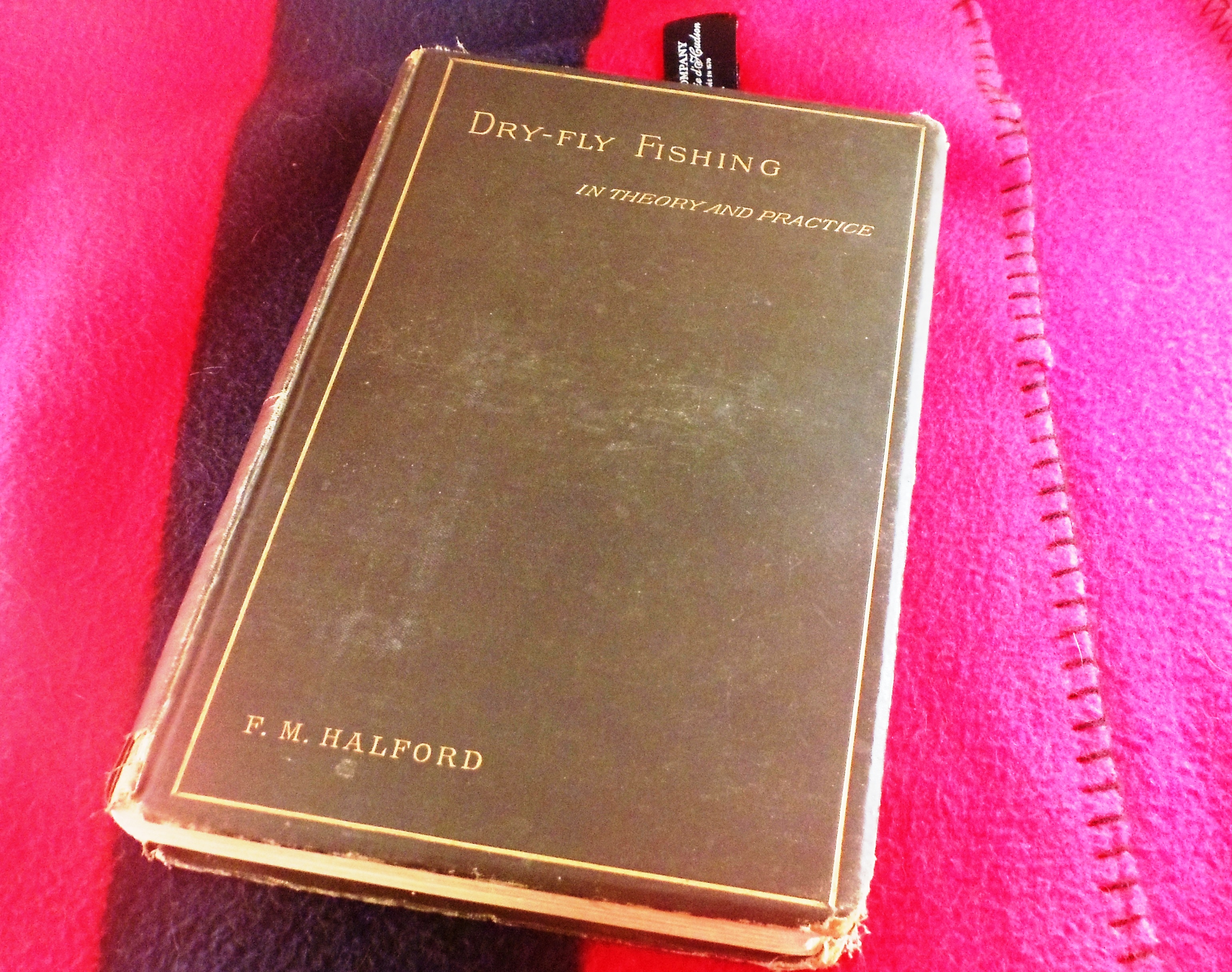
I write this post mostly to share my excitement over a recent acquisition.  I was able to pick up a frist edition of Frederick M. Halford’s Dry-Fly Fishing, in Theory and Practice, published in 1889 by Samson Low, Marston, Searle, and Rivington, Ltd. in London.  Most fly fishers know Halford as an advocate of dry fly fishing, particularly when it comes to fishing the essentially manicured chalk streams of England.

Fly fishers often imagine Halford as a stodgy, old businessman and grand supporter of the Empire.  In fact, he was Jewish, and he retired very early in life–during his forties–to become what we might now call a “trout bum.”  Despite is purist reputation, however, he was actually also bit of a “grayling bum:”

Many first-class fishermen say that they do not care for grayling fishing, possibly because they have never really tried it, or equally possibly because they are not quite right–I will not say straightforward–but disingenuous and candid in the opinion they are giving.  Then they quote Cotton, who wrote that extraordinary sentence about the grayling being the deadhearted fish that swims.  Cotton certainly never killed a three-pound grayling on a Test shallow; if he had, with his power of discrimination and strong desire for truth, he could not have written that sentence.  Some fishermen have even been heard to say that they wished the last pike in the Test might be choked in the act of swallowing the last grayling.  This, however smart it may sound, is childish and selfish, as many fishermen consider that grayling fishing is quite as good in its way as the trout, and with these I wish to be numbered. (Halford, Dry Fly Fishing, 251-252).

As regards Halford’s favor for dry fly fishing and the promotion of a sort of orthodox fly fishing style on chalk streams, he is probably misremembered as being overly opposed to “fishing on the bottom:” 

In treating of the advantages of the dry-fly over wet-fly fishing, I am most desirous of avoiding any expression which should tend to depreciate in any way the skill exhibited by the experienced and intelligent followers of the wet-fly.  They require not only most undoubted judgement of the character of water frequented at various times of the day and season by feeding fish, not only a very full knowledge of the different species and genera of insects forming the food of the fish, not only a full perception of the advantages of fishing up-stream under one set of conditions and of fishing down-stream under others; but, in addition to all this, great skill in placing their flies accurately in the desired position, and allowing them to drift down in a natural matter and without any drag or check over the precise spot they wish to fish.  There is far too much presumption of superior scientific knowledge and skill on the part of the modern school of dry-fly fishermen, and I should be the last to wish to write a line tending to encourage this erroneous assumption of superiority, or to depreciate in any way the patience and perseverance, coupled with  intuitive perception of the habits of the fish, requisite for a really first-rate performer of the wet fly (Halford, Dry Fly Fishing, 3).

I think Halford is written off by most American fly fishers today.  This was not always the case, though.  Among those who are best known for advancing “technical” fishing in the US, he was quite popular.  Of course, the foremost of these figures are Vince Marinaro and Charlie Fox, who fished the Pennyslvania “Limestoner” equivalents of the English chalk streams.

Prolific journalist, writer, and fly fisher, Alfred Miller (AKA “Sparse Grey Hackle”) wrote, “These Pennsylvania boys laugh at the idea that the pattern doesn’t matter if you handle it correctly and insist tha it is necessary to imitate exactly the hatch on the water, use fine gut, and fish delicately and far off to achieve consistent success.  They read Halford and believe what he says.  Their average knowledge of stream entomology would put the average Angler’s Club [of New York or London] member to shame, and they keep emergence tables, either mental or written, as a matter of course.  And they put their fish back  (Alfred Miller, Limestone Legends: The Fly Fishers’ Club of Harrisburg, 1997, 95).

So, while Halford’s stodgy reputation seems to be undeserved, it is certainly the case that his emphasis upon entomology and “matching-the-hatch” was influential.  No doubt, this is largely because the crystal clear, food-rich chalk streams of the UK and limestone creeks of the US are immensely difficult to fish.  The western US fisher who claims that Idaho’s Silver Creek or the Henry’s Fork are the most difficult waters to fish in the world, then, might do well to remember that other skilled fly fishers have been dealing with similar challenges for a very,very long time.  Who knows?  That same western US fly fisher may actually pick up a tip or two from Halford, who was not so rigid in his techniques as he is now remembered.  This fly fisher might also consider the fact, too, that Halford and Marinaro often crawled to their streams, in order to avoid spooking fish.  While I’m sure it has happened plenty of times, I have yet to see someone do this on the Henry’s Fork.

Perfection

July 20, 2012

The little lake in the Big Blackfoot River drainage, where our cabin is.

My wife, daughter, and I were in the West earlier this summer.  We visit there often, as it is home for me.  The highlight of these trips is the time we spend at our family cabin, which is located on the shore of a small lake in Montana’s Big Blackfoot River drainage.  Recently, one of my sisters and I were discussing the fact that the cabin has always been our one “constant” in life.  This, in addition to the beauty of the place, makes it immensely important to us.

I’m back in the East, now, trying to wrap up some writing and prepare for some fall teaching.  My wife left for an extended work trip shortly after we returned from Montana.  I just picked her up at the airport, last night.  My little daughter was terribly excited to see her mom, and she insisted on sleeping with us.  As I lay in bed, I could hear my sleeping wife breathing, and I could feel our girl nestled between us.  Meanwhile, my dog was audibly licking his paws on the floor.  All of this reminded me of our time at the cabin.

I thought, specifically, of another night.  It was late, but I was awake as usual.  Getting up for a drink of water, I looked upon my wife on the bed, with the dog at her feet.  Our daughter was in a tiny mummy bag on the floor–she loves that sleeping bag.  The moonlight lit interior of the cabin and also called my attention to the scene beyond the windows.  Outside, I could see the stars, the moon and its reflection upon the lake, and the outline of the surrounding mountains.  I thought to myself that, at that very moment, life was perfect.

The cabin.

Perfection is something I address in some of my college classes.  The students and I discuss, with the help of both academic and nonacademic sources, how perfection is a fleeting thing in our world.  The sources suggest we should cherish it whenever and wherever we find it because, soon enough, we’ll have to return to our daily lives, which are marked by our social and economic statuses, our need to pay the bills, maintain our health, and so on.  Anthropological and philosophical sources argue that our daily lives are so different—so imperfect—because all of these things prevent us from feeling the sense of connection that we do during the moments of perfection.

Indeed, religious mystics and scholars of mysticism tell us that it is connection or intimacy with our loved ones, nature, or even our creator that characterize perfection.  One such scholar, Margaret Smith, writes that, in mysticism, “consciousness is deepened to a sense of the Beyond as a unity . . . .”[1]  Smith first made this claim in the 1930s, and there much critical scholarship on mysticism has been published since.  But I won’t drag you through all of that.  After all, I’m trying to enjoy the last few weeks I have outside of a college classroom, before returning to the lectern after an extended break.

Regardless, scholars and mystics alike suggest we can we can live our lives in ways that will allow us to achieve moments of perfection as often as possible.  In fact, we should lead our lives in such ways, for it is the moments of perfection that make life most worthwhile.  No doubt, this is why I am drawn to fly fishing, to the wild places where trout live, and to our cabin in the Big Blackfoot River drainage.  At these places, I am most likely to find perfection.

Fly fishing on the lake, just outside our front door.

Norman Maclean might be the most famous fly fisher of the Big Blackfoot River.  In his novella, A River Runs through It, he describes the fleeting moments of perfection in a way that few people ever have.  He suggests, too, that fly fishers may be especially prone to experiencing them:

Poets talk about “spots of time,” but it is really the fisherman who experiences eternity compressed into a moment.  No one can tell what a spot of time is until suddenly the whole world is a fish and the fish is gone.[2]

A “Bunyan Bug” fly, fished by Maclean in his novella.

That sense of connection, intimacy, or “compression” is explicit in the moment he describes.  Elsewhere in his novella, he compares this sense of connection to electricity (read the entire passage).  At this point in the story, he is sitting with his father, watching his brother Paul fish.  In the larger context of the book, it is not only the connection felt with the larger world of fish and other beings that is important here, it is also the connection felt between the family members:

Everything seemed electrically charged but electrically unconnected.  Electrical sparks appeared here and there on the river.  A fish jumped so far downstream that it seemed outside the man’s electrical field, but when the fish had jumped, the man had leaned back on the rod and it was then that the fish toppled back into the water not guided in its reentry by itself.  The connections between the convulsions and the sparks became clearer by repetition.  When the man leaned back on the wand and the fish reentered the water not altogether under its own power, the wand recharged with convulsions, the man’s hand waved frantically at another departure, and much farther below a fish jumped again.  Because of the connections, it became the same fish.[3]  

 I think we all feel these moments of perfection and connection, on occasion.  If you have trouble finding them yourself, however, you might visit a wild place.  You might even bring a loved one and a fly rod, too.  At the very least, you might take time to reflect, in the quite of the night, upon the connection you feel to the most important people in your life.

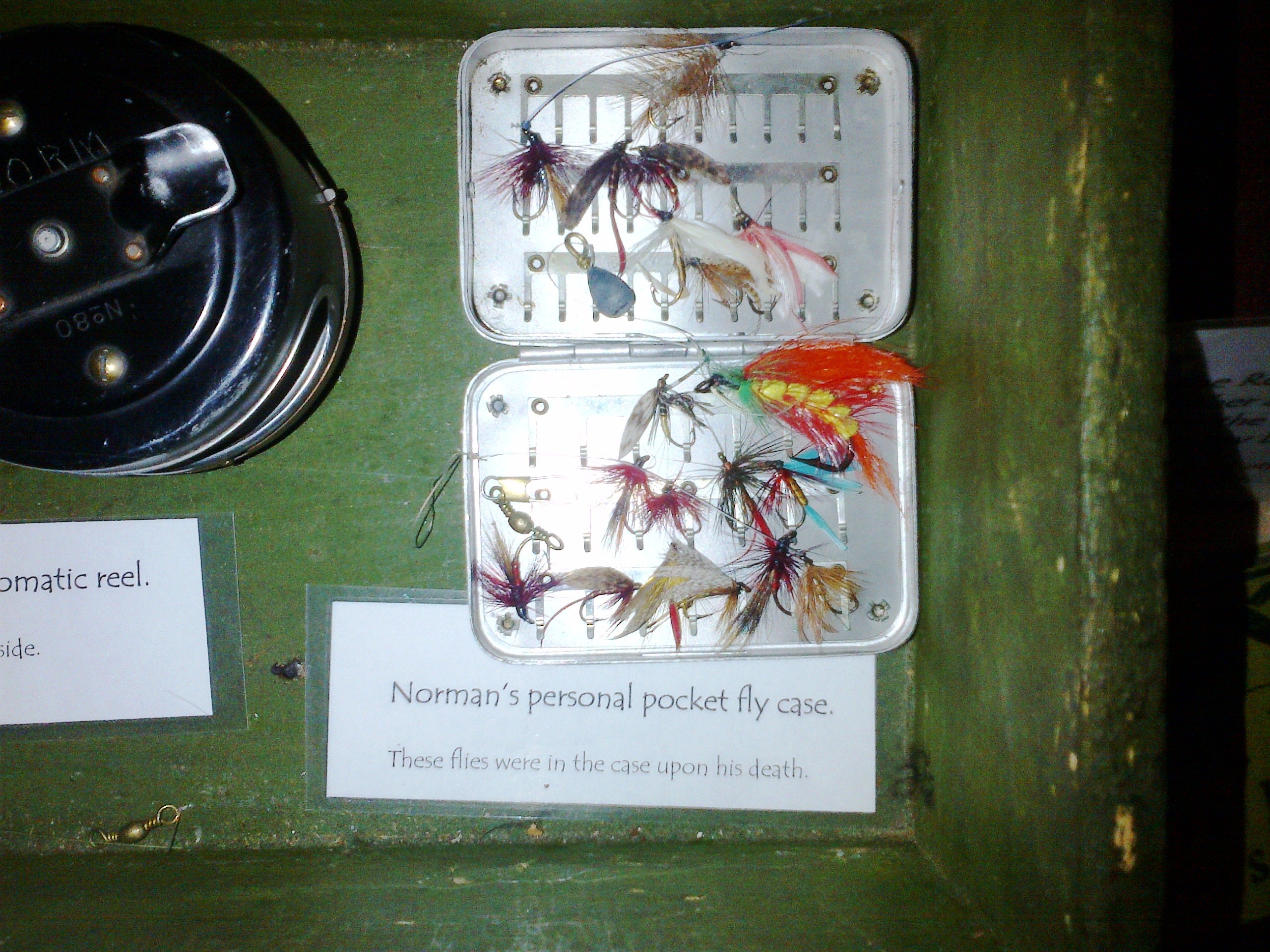
Flies owned by Norman Maclean, at the Seeley Lake Historical Center and Museum


[1] Margaret Smith, The Way of the Mystics: the Early Christian Mystics and the Rise of the Sufis ( New York, NY: Oxford University Press, 1978), 2.

[2] Norman Maclean, A River Runs through It, and Other Stories, Twenty-fifth Anniversary Edition (Chicago, IL: The University of Chicago Press, 2001), 45.

[3] Ibid., 98.

Norman Maclean and Rejection

April 16, 2012

I have to share this wonderful letter from Norman Maclean to Charles Elliot, of publishers Alfred A. Knopf, Inc.  Elliot wrote Maclean, after the massive success of A River Runs through It and Other Stories (University of Chicago Press, 1976), trying to solicit Maclean’s next manuscript.  Maclean’s scathing but humorous response to Elliot is influenced by the fact that  Alfred E. Knopf rejected the earlier book.

Maclean’s response: Letters of Note: The end of the world of books.

The letter was posted by Shaun Usher at his website, Letters of Note:  Correspondence deserving of a Wider Audience.  Thanks to Erin Block, of Mysteries Internal for pointing it out.

Fly Fishing Literature, as enjoyed by Parents and Child

March 24, 2012


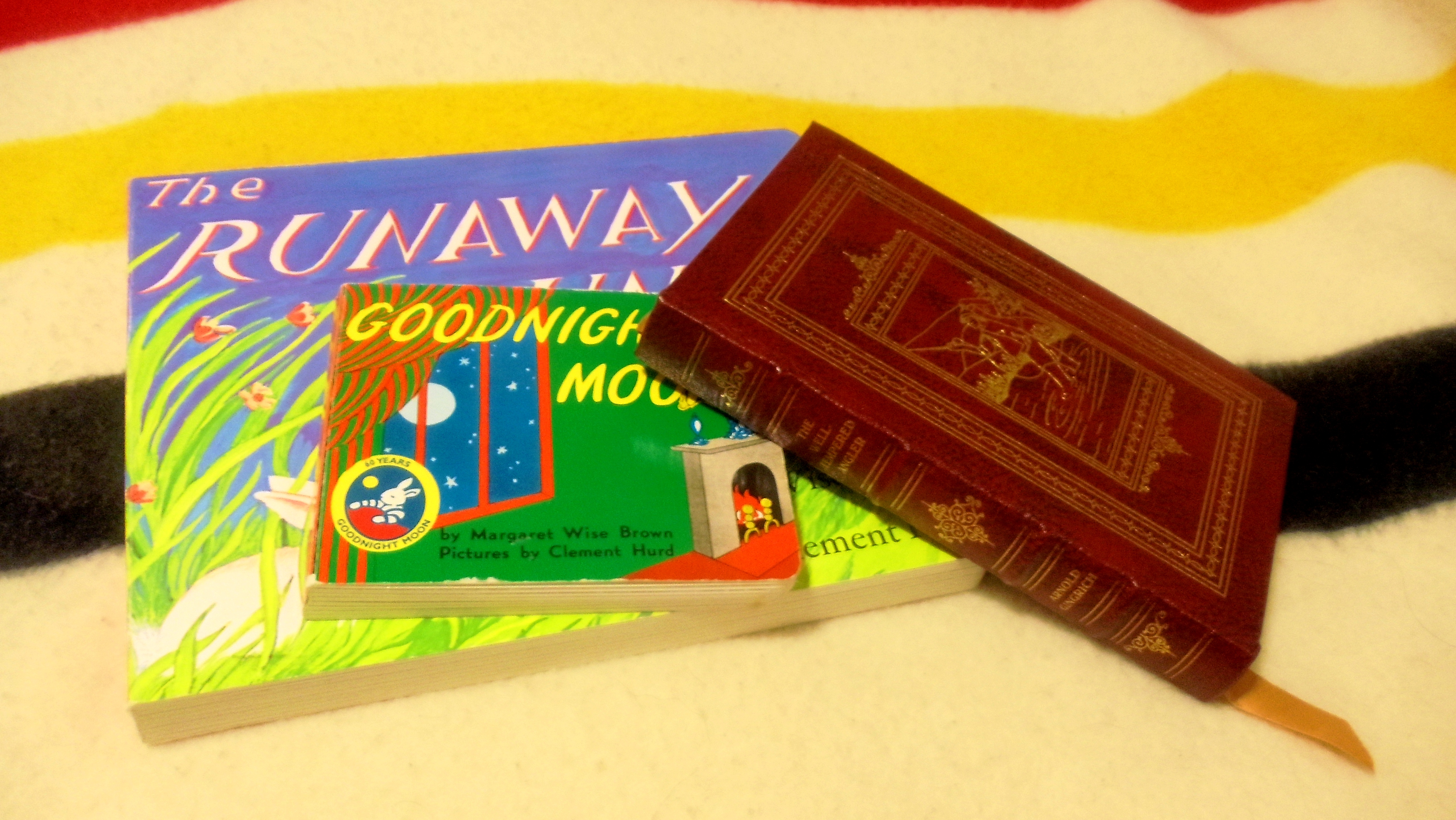
The Runaway Bunny, Goodnight Moon, and The Easton edition of The Well-Tempered Angler.

Each night, my wife and I enjoy reading books, telling stories, and singing songs to our daughter before she goes to sleep.  Later on, we often read to each other, too.

Our daughter tends to favor “big” books.  That is, books that will take a long time to read and allow her to stay up just a little bit longer.  Fortunately, she has a pretty great selection of books.  One of her “big” books is The Runaway Bunny, authored by Margaret Wise Brown and illustrated by Clement Hurd and first published in 1940 (and continually in print since).  Wise Brown and Hurd also collaborated on a later, better known book, Goodnight Moon (1947).   In this second book, there are some interesting pictorial allusions to The Runaway Bunny.

I am always happy when our daughter wants us to read The Runaway Bunny.  It is a touching story about a “little bunny,” who wants to run away from his mother.  His mother insists that she will follow him everywhere, always bringing him back to her.  “Little bunny finally says to his mother, “Shucks, …  I might just as well stay where I am and be your little bunny.”  It is a sweet story, and it certainly has greater depth than the average story written for children today.

What interests me most about The Runaway Bunny, however, is that little bunny, in the course of the short narrative, decides that he will “become a fish in a trout stream” and swim away from his mother (which, perhaps, displays some influence from Celtic mythology).  To this, his mother responds, “I will become a fisherman and I will fish for you.”  Below, you can see the illustration of little bunny swimming with the trout.  Following this page and the next, there is a full-color picture of his mother fly fishing for him with a carrot “fly.”  Great stuff.

After my daughter falls asleep, and after my wife and I go to bed and finish reading to each other, I often pull out another book.  Often, it is a fly fishing book.  As much as I love Runaway Bunny, though, I always turn toward something more adult.  Not infrequently, I reread Arnold Gingrich’s The Well-Tempered Angler (1965).  Gingrich was the founding editor of Esquire.  In his magazine’s pages, Gingrich published pieces by authors who would eventually be considered among America’s greatest.  Ernest Hemingway is just one example.  I point this out simply to indicate that  Gingrich understood great writing, and he was a pretty darn good writer himself.  I might add, too, that his book, The Fishing in Print: A Guided Tour through Five Centuries of Angling Literature (1974), is by far the most extensive, annotated bibliography of fishing literature ever published.

If you have a young child, be sure to share The Runaway Bunny with her or him.  And, if you love fishing literature yourself, Gingrich’s The Well-Tempered Angler is a must read.  He wrote amusing, compelling essays about fly fishing long before the likes of John Gierach put pen to paper (or finger to key).  Finally, if you happen to be a parent and a fly fisher, well, you might consider both books.

The Film, A River Runs Through It, Twenty Years Later

March 7, 2012

Midcurrent Fly Fishing News alerted me to a great article in the Bozeman Daily Chronicle.  Written by Carly Flandro, the article is about the 1992 film adaptation of Norman Maclean’s “A River Runs Through Itand its impact.  A copy of Maclean’s 1976 book, A River Runs Through It and Other Stories, always had a presence on our shelves in Helena and at our family cabin near the Big Blackfoot River.  The book, and particularly the title story, had special meaning to me, because I was the son of a Presbyterian Minister, and he was the one who introduced me to fly fishing (see my previous post).

I remember well, when the movie came out.  Many people, as the Chronicle article points out, bemoaned the attention it brought to fly fishing and to Montana.  Personally, I think the movie was a good thing for the sport and for the state.  I was more upset by two articles published around the same time,  in major outdoor magazines, about fishing my home water in the Big Blackfoot drainage.  Admittedly, though, it may have been the movie that prompted such articles.  Fortunately, the fishing pressure on my home water has leveled out or even declined a bit.  The main Blackfoot River, however, is a busy one indeed.  Still, as the article mentions, along with the desire to fish the Big Blackfoot came the successful effort to restore it.

If you are a fan of the movie, A River Runs Through It, be sure to read the Chronicle article: Reflecting on the film “A River Runs Through It” and how it changed Montana – The Bozeman Daily Chronicle: News.  And if you haven’t read Maclean’s book, be sure do so.

Joseph Seccombe, Ethics, and Nature in 1739

February 21, 2012

In 1739, Anglican minister and avid sport fisherman Joseph Seccombe delivered a sermon on the religious justification of recreation, particularly fishing, at Amoskeag Falls, in New Hampshire. Published later, in 1743, the sermon would become the first document published in the American colonies dealing with these subjects. The sermon is now known by the title, Business and diversion inoffensive to God, and necessary for the comfort and support of human society. A discourse utter’d in part at Ammauskeeg-Falls, in fishing season. 1739.

Following is an excerpt from the sermon:

But here, in Fishing, we are so far from delighting to see our Fellow-Creature die, that we hardly think whether they live—— We have no more of a murderous Tho’t in taking them, than in cutting up a Mess of Herbage. We are taking something, which God, the Creator and Proprietor of all, has given us to use for Food, as freely as the green Herb. Gen. ix. 2, 3.

He allows the eating them, therefore the mere catching them is no Barbarity. Besides God seems to have carv’d out the Globe on purpose for a universal Supply: In Seas, near Shores, are Banks and Beds made for them; ——to furnish the Lands adjacent——and Lands which lye remote, are more divided into Lakes and Ponds, Brooks, and Rivers; and he has implanted in several Sorts of Fish, a strong Instinct [or inclination] to swim up these Rivers a bast Distance from the Sea.  And is it not remarkable, that Rivers most incumbered with Falls, are ever more full of Fish than others. Why are they directed here? Why retarded by these difficult Passages? But to supply the Inlands? Does forming and disposing of these Things argue nothing? (16-17).

Seccombe was undoubtedly familiar with fellow Anglican writer, Issac Walton, who wrote of the presence of the Christian God in nature several decades earlier and whose book, The Compleat Angler, or, The Contemplative Man’s Recreation (1653) remained in print.  Still, Seccombe is relatively unique, as a writer in North America, in describing the wilds as possessing God-given value.  It appears that he even wrote letters, filled with observations of “nature,” to superior members of the Anglican Communion.

On the other hand, Seccombe clearly places little intrinsic value upon those beings that inhabit the wilds about him.  Here, he is not so unique.  It took well over one hundred more years for American anglers to realize, as a whole, that their activities were impacting fish populations negatively.  And it took them well over one hundred years beyond that for them to engage in concerted conservation efforts.  No doubt, Seccombe would have been engaged in such efforts, himself, had he realized the impact his fishing would have upon the salmon and trout that he hunted.  He is to be admired, however, for advocating that his listeners and readers appreciate the natural world around them, and to do so with religious seriousness.  That, at least, was a first, very early step toward conservation.

Burns’ Night

January 25, 2012
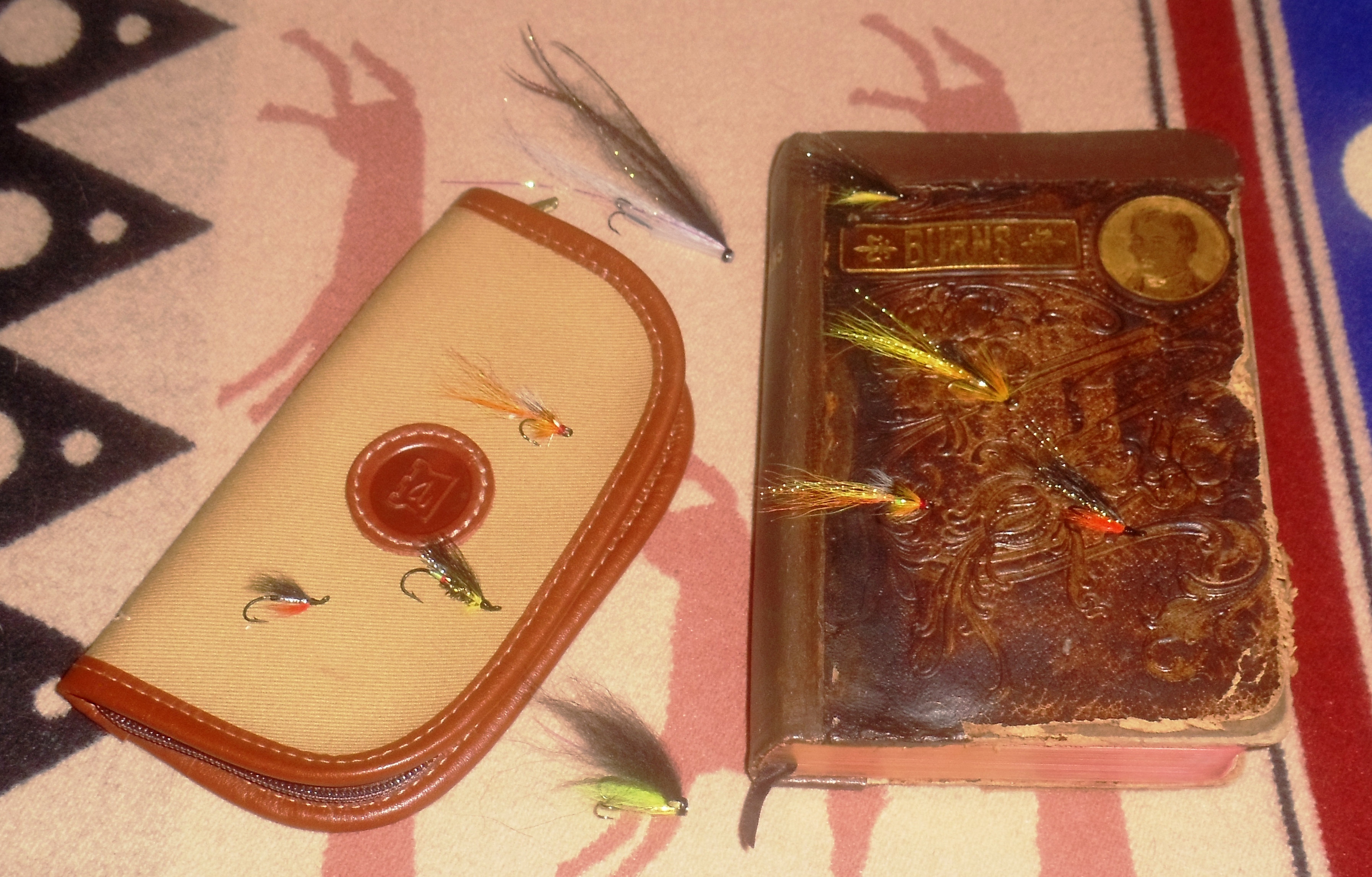
My grandfather’s copy of The Poetical Works of Robert Burns, passed to me by my grandmother, and some salmon flies from Scotland.

Tonight, and every January 25,  is “Burns’ Night”–the holiday honoring the great Scottish poet Robert Burns (1759-1796).  Burns heralded the Romantic Age, when artists, writers, philosophers, and others would focus upon the “natural” world, not as an object of study, as it was for so many intellectuals during the Enlightenment, but rather as something to admire, to feel, and to celebrate.  Burns was also a poet for the common person, writing about the daily life of laborers and often doing so in the Scots language.  He was one of a very few poets in his time to write in a vernacular language and also gain wide-spread success.

Despite his love for nature, expressed in such well-known poems as “To a Mouse,” and despite the fact that he spent much of his life close to some of Scotland’s finer trout and salmon streams, Burns does not seem to have been a fisherman.  As far as I know, he mentioned trout in only one piece of work, a song titled “To Mr. Cunningham” (or “Song inscribed to Alexander Cunningham,” or “Now Spring has Clad the Grove[s] in Green).

As I did last year, I post that piece here, for your enjoyment.

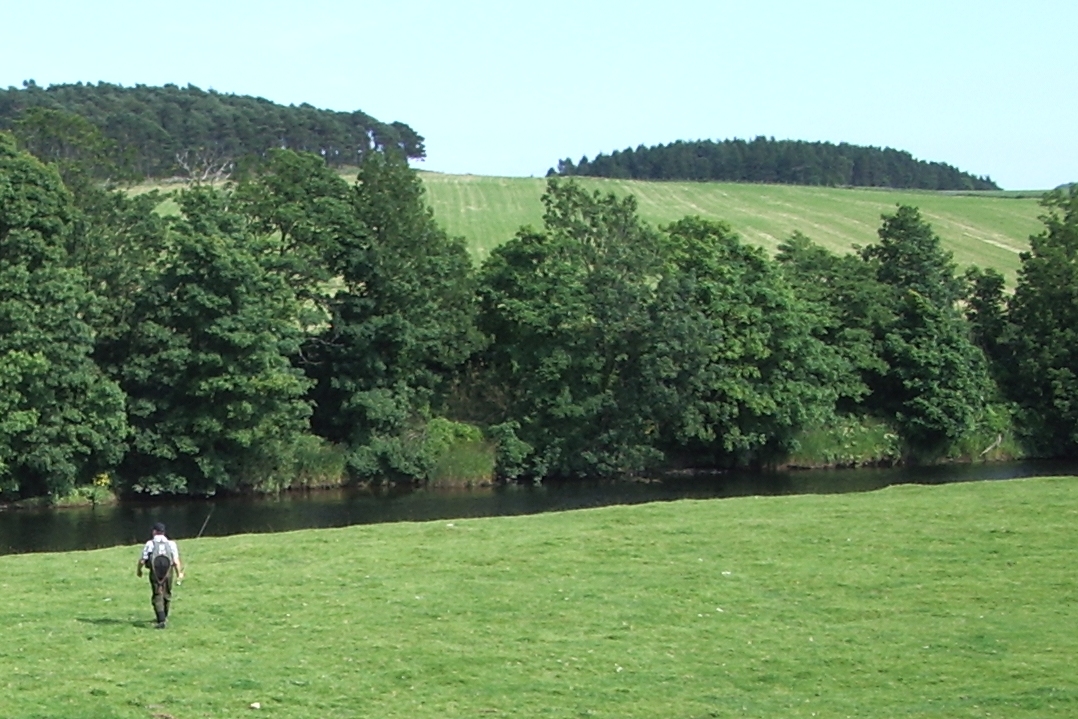
Making my way to a trout stream in Scotland.

“To Alexander Cunningham”

Now spring has clad the groves in green,
And strew’d the lea wi’ flowers;
The furrow’d, waving corn is seen
Rejoice in fostering showers;
While ilka thing in nature join
Their sorrows to forego,
O why thus all alone are mine
The weary steps o’ woe!

The trout within yon wimpling burn
Glides swift, a silver dart,
And safe beneath the shady thorn,
Defies the angler’s art:
My life was ance that careless stream,
That wanton trout was I;
But Love, wi’ unrelenting beam,
Has scorch’d my fountain dry.

That little flow’ret’s peaceful lot,
In yonder cliff that grows;
Which, save the linnet’s flight, I wot,
Nae ruder visit knows,
Was mine; till Love has o’er me past,
And blighted a my bloom,
And now, beneath the withering blast,
My youth and joy consume.

The waken’d lav’rock warbling springs,
And climbs the early sky,
Winnowing blithe his dewy wings
In morning’s rosy eye;
As little reck’d I sorrow’s power,
Until the flowery snare
O’witching Love, in luckless hour,
Made me the thrall o care.

O had my fate been Greenland snows,
Or Afric’s burning zone,
Wi ‘man and nature leagu’d my foes,
So Peggy ne’er I’d known!
The wretch whase doom is, “Hope nae mair!”
What tongue his woes can tell!
Within whase bosom, save despair,
Nae kinder spirits dwell.

Picture the Leviathan (3 Photos) | PDN Photo of the Day

December 30, 2011

Follow this link to an update on James Prosek’s latest project, with accompanying photos.

Picture the Leviathan (3 Photos) | PDN Photo of the Day.

Fly fishing, Fathers, and Children

August 3, 2011
Copyright 2011, Kenneth H. Lokensgard
One of the most beloved works in the centuries-old body of fly fishing literature is Norman Maclean’s novella, “A River Runs through It.” It was published as part of A River Runs through It and Other Stories, by the University of Chicago Press in 1976. The well-known opening passage has always resonated with me.

In our family, there was no clear line between religion and flyfishing. We lived at the junction of great trout rivers in western Montana, and our father was a Presbyterian minister and a fly fisherman who tied his own flies and taught others. He told us about Christ’s disciples being fishermen, and we were left to assume, as my brother and I did, that all first-class fishermen on the Sea of Galilee were fly fishermen and that John, the favorite, was a dry-fly fisherman.

I earned a doctoral degree in Religious Studies. And because my scholarly work has involved the religious practices and beliefs of indigenous peoples — practices and beliefs that rarely correspond to those found in Christianity — I have a broad understanding of “religion.” To me, religion is that which, to paraphrase scholar and mentor Charles Long, provides “ultimate orientation.” In other words, religion is that which helps us understand where we come from, where we stand in relation to others, and where we are going. Thus, it provides both identity and meaning. It makes sense for me, then, that Maclean said that religion and fly fishing were essentially one for him and his family members. In fact, not only does it makes sense to me, it also expresses my own feelings about the relationship between religion and fly fishing. Neither I, nor, I think, Maclean would suggest that fly fishing can replace “traditional” religions such as Christianity, Buddhism, Islam, or the practices and beliefs of the indigenous peoples with whom I work. Rather, it simply functions in much the same way that established religions do; it helps many of us find “ultimate orientation.”

Maclean’s book resonates with me for another reason, unrelated to his religious views. Like him and his brother, my two sisters and I are the children of a Presbyterian minister. Moreover, my “home waters” are in the same area in which Maclean learned to fish. That area is The Big Blackfoot River drainage in western Montana.

Just as Norman Maclean did, my father grew up fly fishing with his own brother and father. Unfortunately, his dad was a hard man, who did not make fishing (or much of anything else), enjoyable to his sons. Still, fly fishing was one of the few ways through which my father and his brother could connect to their dad at all.

Our family cabin, on a lake in the Big Blackfoot River drainage.

As an adult, my father always kept fly tackle at our family cabin. And even if he largely left the practice of fly fishing behind, he encouraged it in me. I remember flinging the occasional “Royal Coachman” onto the waters of the lake, near which our cabin stands. And once I grew more interested in fly fishing, he taught me all the requisite knots and passed along the other pieces of fishing knowledge he retained.

My father and I, before fishing.

My uncle left fly fishing behind as well. Sadly, he had an even more difficult relationship with my grandfather than my dad did. There is little doubt in my mind that this difficult, often violent, relationship contributed to my uncle’s debilitating mental illness. When he retired from his life as a professor, though, he did try his hand again at tying flies. And shortly before his death, he gave to me a size 12 “Black Gnat.” It had been his favorite fly, as a child.

My story only resembles Maclean’s in a broad sense — both of our fathers were Presbyterian ministers living in the same area of Montana, and both of us find fly fishing meaningful in the deepest of senses. When it comes to day-to-day family life, however, there is probably a greater resemblance between my father’s and uncle’s lives and those of the Maclean brothers. Unlike my grandfather, the Reverend Maclean treated his sons well and shared his love with them. On the other hand, like Norman Maclean, my father lived a life during which he was always concerned about his brother, until my uncle died from cancer.

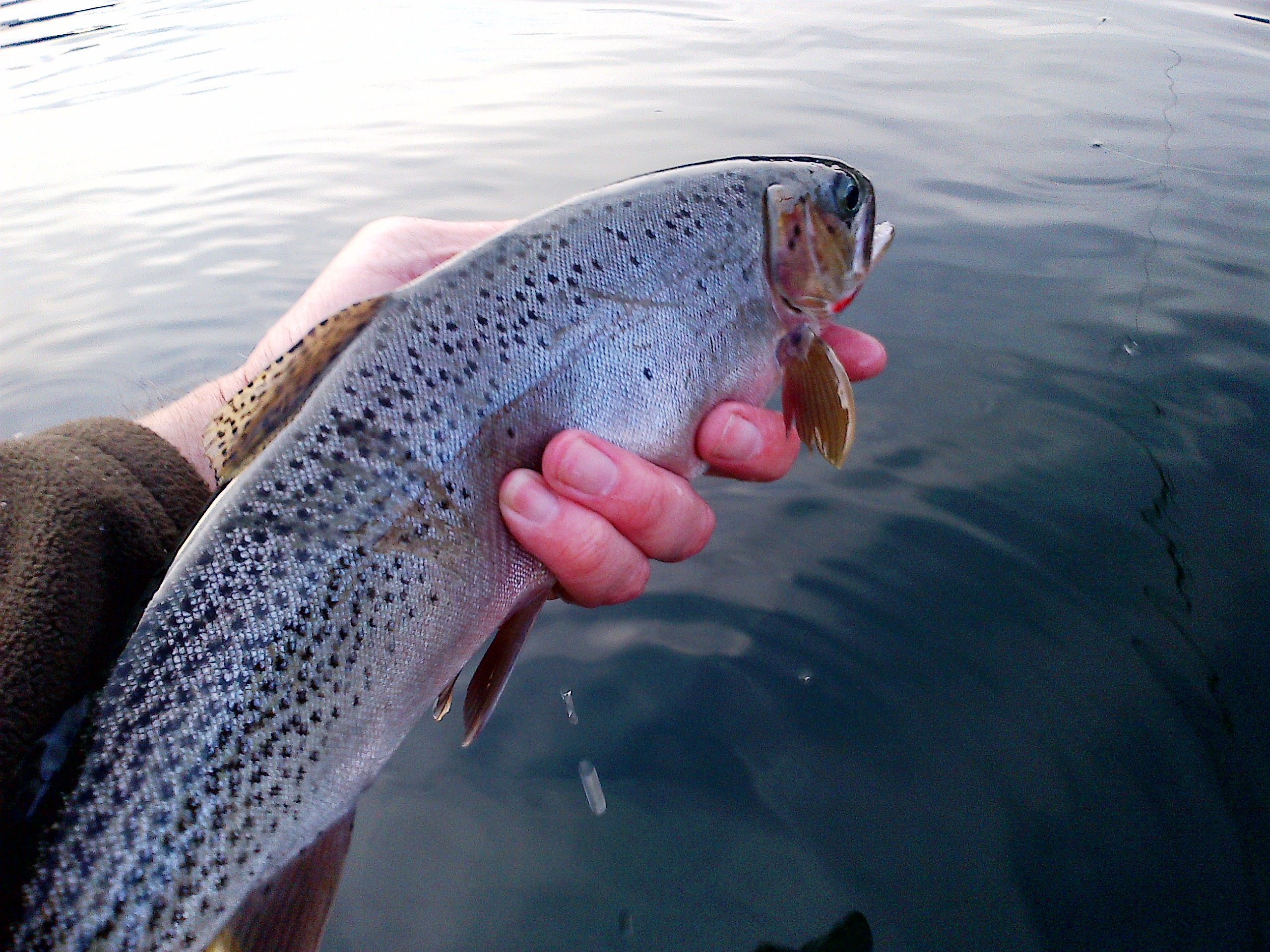
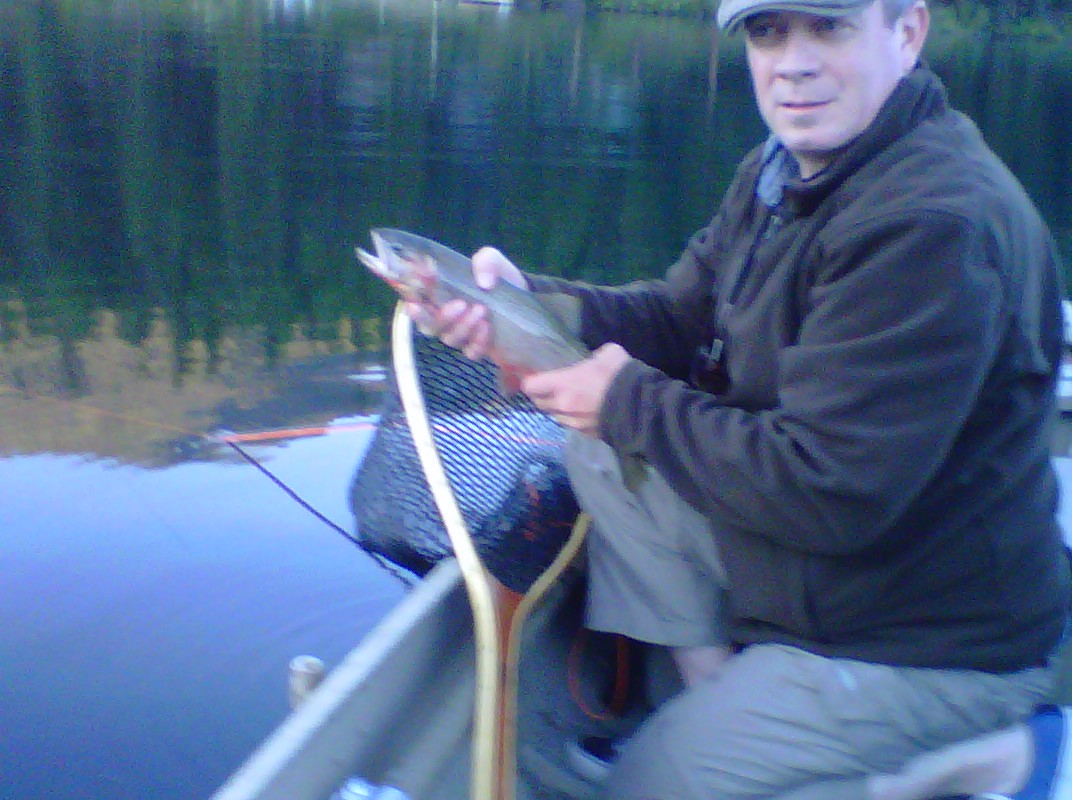
A trout I caught, while fly fishing with my father.

Like the Reverend Maclean, and unlike my grandfather, my dad has always been loving and supportive, despite carrying some demons with him. We have occasionally fly fished with each other through the years. Until fishing together this summer, however, I think we let close to ten years pass since our last outing. It was important to me, then, that when one of my sisters called from Missoula a few days ago (as it happens, she attends the Rev. Maclean’s old church there) and said my dad might finally be ready to fish again, that I meet him at the cabin with my gear. My sister was right, as she most often is when it comes to family matters. My father and I had a great time on the lake. Clearly, it brought back a few unpleasant childhood memories for my dad. But it just as clearly meant a lot to him to get out on the water once again with his own son.

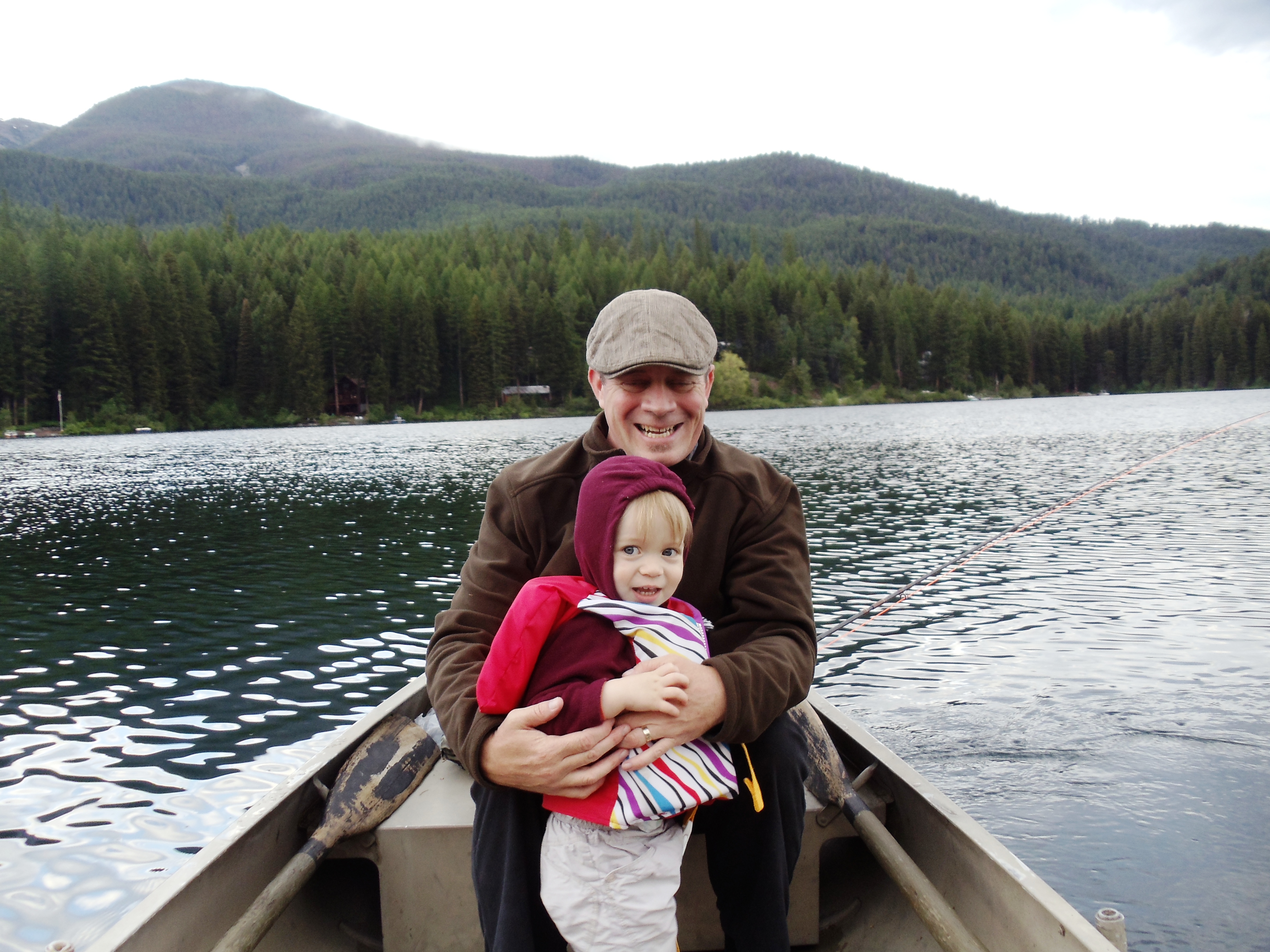
My daughter, during her first fly fishing excursion onto the lake.

I recently became a father myself. I have a beautiful little girl. While she is not yet two years old, she, her mom, and I were able to fish a bit on the lake earlier this summer. She saw her dad catch a fish with a fly for the first time, and she loved it the experience. Fishing may never be religious for her, as it was for Maclean and as it is for me. Nonetheless, I trust it will always be a means through which she can connect with her father. I also trust, however, that she will be able to connect with me during every other imaginable activity too. In spite of their love for each other, this was not the case in the Maclean family, and it was certainly not the case for my father, uncle, and grandfather. Thankfully, life is all about change, and my daughter is the very embodiment of change and possibility.

My daughter helping to release the trout her

Hungary, Flyfishing History, and Travel

June 10, 2011

My wife, daughter, and I just returned from visiting my wife’s family in Magyarország or Hungary.  As indicated in my previous post, I had the opportunity to do some fly fishing.  Levente Kovács-Sinkó graciously put me into both asp and trout.

I enjoyed visiting with Levente, not only because he is a flyfisher, but also because he is a fan of classic flyfishing tackle and literature.  For people like Levente and me, knowing more about how something was practiced and understood in the past, multiplies our appreciation of it in the present.  This is not to say that, in this case, collecting old reels and fishing books necessarily makes us better fly fishers; it does make the sport all the more enjoyable to us, however.

Traveling to new fly fishing destinations is something that provides me, personally, with a greater enjoyment of fly fishing as well.  I love to hear about the fishing history and traditions in the places I visit, to pick up a few locally tied flies, and of course to catch some indigenous fish.  Mind you, I love my home waters with a burning passion, and I’d be happy to fish nothing else my entire life.  Yet, I’m glad I often get the chance to visit waters and communities of fly fishers that are new to me.  I have found both in Hungary, which I have visited numerous times now.  Happily, my next trip takes me back to my home waters in Montana – waters that I have been away from for too long.

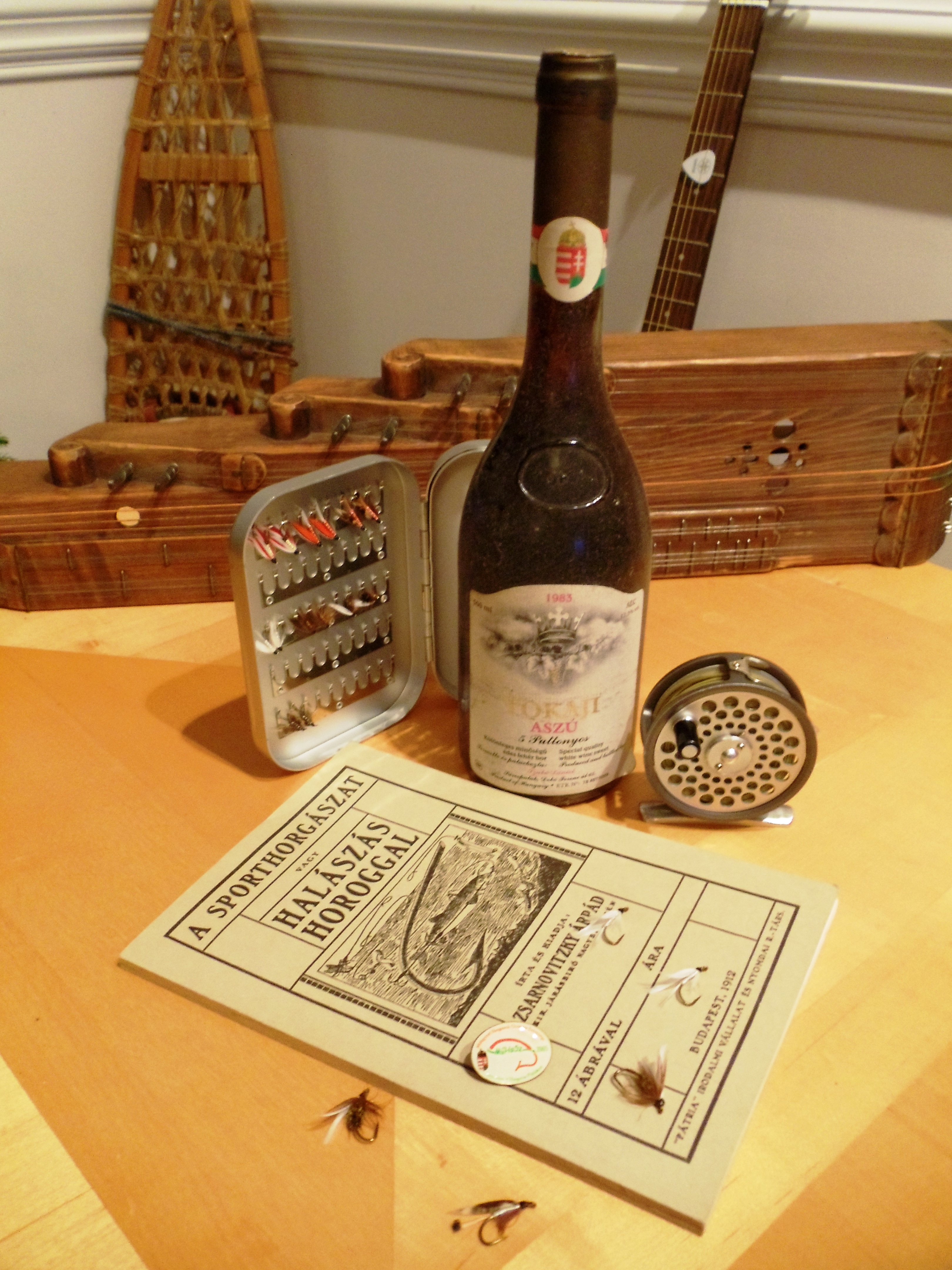
Pictured below is a 1912 Hungarian book on fishing, reprinted by Levente, Kálmán Nagy, and Miklós Zsombori in 2002.  It was authored by Árpád Zsarnovitzky, and its title is Sportfishing, or Fishing with a Hook.  Also pictured are some beautiful wet flies, all tied without a vice, by Levente; an Association of Hungarian Fly Fishers pin; an old bottle of delicious Tokaji dessert wine from Hungary, which my wife and I have long been saving for a special occasion; and a Hardy Flyweight reel, perfectly suited to trout fishing in Hungary.