Author Archive

Steve Earle, Fly Rods, and Moonshine

January 19, 2013

It is difficult to pack a fly rod around some of the more remote portions of Southern Appalachia and  not occasionally find yourself humming fellow fly fisher Steve Earle’s “Copperhead Road.”  The illicit “licker” making culture, about which Earle sings, is still alive in such places (heck, there even seems to be an old still in the forest behind our house).  For instance, a couple of years back, my friends and I were investigating some backcountry streams.  One morning, a couple of us popped into a tiny store, built of logs, to buy some junk food for breakfast.  After a short wait, a middle-aged fellow hobbled to the rickety counter and rang up our purchases.  While doing so, he engaged in a rather poetic pitch for his moonshine.  “You boys ever taste pure goodness?  You boys know what it’s like to swallow a ray of sunshine?”  I had to head back to town, but my friend was camping another night and decided to check out the clerk’s special product.  The man’s hand reached under the counter and brought out a mason jar full of crystal clear liquid.  My friend took the jar back to our camp, and I took the clerk’s phone number back to town.

Here is an excellent scholarly essay by Jason Sumich, on contemporary North Carolina moonshine production:  “It’s all Legal Until you get Caught: Moonshining in the Southern Appalachian Mountains.”

And here is a great version of “Copperhead Road,” by Steve Earle:

“Religion, Sport, and Water” Syllabus

January 10, 2013

Finally, I am posting the syllabus for my seminar on fly fishing literature:

“Religion, Sport, and Water: Contemplation and Conservation

in over 500 years of Fishing Literature”


RELI 438, Religion, Nature, and Environment, Spring 2013

E-mail: lokensga@email.unc.edu (use only if you cannot contact instructor in person)


DESCRIPTION AND GOALS OF COURSE 

This course is an introduction to the literary history, religious significance, and cultural impact of fishing.  Students will read historically and culturally important texts ranging from those written in Ancient Rome, Medieval Europe, and in contemporary North America.  All of these texts emphasize a relationship between religious experience, fishing, and the environment.  We will explore this relationship, considering the cultural settings of each text while also learning about the overlapping aesthetic, ritual, and ecological dimensions ascribed to fishing—particularly fly fishing—by some of the most notable writers and intellectuals in European and Euro-American history.  For comparisons’ sake, we will briefly examine religion and fishing in cultures outside of the European and North American literary worlds, as well.  In addition to fishing literature, students will read relevant theoretical texts on religious experience, conservation, ecology, and “nature.”

As a whole, this course will serve as a focused study of the role that water, the environment in general, and religious practice play in the European, North American, and other cultural contexts.  Thus, the course will introduce students to literature and ways of thinking that can be applied to any implicitly or explicitly religious phenomena that are practiced in so-called “natural” places.  Moreover, the course will introduce students to the often religious significance that conservation and other ecologically informed practices play in the lives of many contemporary people.

As an upper-level seminar, this course is both reading and writing intensive.  Most of the readings, however, were originally written for a popular audience.  Also, the writing assignments will allow the student to incorporate his or her own, carefully examined reactions to these readings in his or her papers and essays.  Therefore, this class is intended to be entertaining and engaging.  Yet, it is designed for the student who is willing to consider religion within its broadest contours, who can devote concerted time to readings, and who is willing to engage in regular and thoughtful writing.  If you are not such a student, then, this course is not designed for you.


ASSIGNED READINGS and OTHER RESOURCES

Required Books:

Swearer, Donald. Ecology and the Environment: Perspectives from the Humanities (Cambridge: Harvard University Press, 2009).

Herd, Andrew. The Fly (Ellesmere,UK: Medlar Press, 2003).

Browning, Mark, Haunted by Waters: Fly Fishing in North American Literature (Athens: Ohio University Press, 1998).

Walton, Izaak and Charles Cotton, The Compleat Angler, Oxford World’s Classics. (New York: Oxford University Press, USA: World’s Classics, 2009).

Luce, A.A., Fishing and Thinking (Shrewsbury, UK: Swan Hill Press, 2002).

Maclean, Norman, A River Runs Through It and Other Stories, Twenty-fifth Anniversary Edition (Chicago: University of Chicago Press, 2001).

Duncan, David James, The River Why, Twentieth-Anniversary Edition (Sierra Club Books, 2002).

Other readings are listed in the tentative schedule and will be accessible online.

Films and Guest Lectures will also serve as important resources.  The films are listed in the tentative schedule, below. Informal guest lectures will be delivered by bamboo rod maker Munsey Wheby, fly tier Brad Kern (http://justwonderingflies.webs.com), professor and author Craig Nova (http://www.craignova.com), artist Michael Simon (http://www.michaelsimonanglingart.com), and others, at dates to be announced.  Each guest will address the aesthetic and spiritual dimensions of fly fishing, from his or her perspective as an artist or craftsperson.

Please note this course is designed to help students develop their critical reading and writing skills  Specific methods of critical reading and writing will be discussed in class at opportune times.  You are also strongly encouraged to make use of the instructor’s office hours and, if necessary, of the campus writing center (http://writingcenter.unc.edu).


REQUIREMENTS AND GRADING

Four three-page critical reaction papers will be submitted throughout the semester. Papers should be written in a 12 point font with 1 inch margins.  Each of these papers is worth 5 percent of your total grade (5 points each).  There will be two exams, which will include short answer and essay questions.  Each exam is worth 20 percent of the total course grade (20 points each).  Toward the end of the semester, a ten-page paper, analyzing the treatment of religion in at least three of the assigned readings, or in three texts dealing with other “outdoor” practices sometimes characterized as religious (I will provide a bibliography), must be submitted.  This paper is worth 30 percent of your total grade (30 points). Ten points are reserved for attendance.  Attendance will be taken randomly 10 times during the semester; an unexcused absence during any of these days will result in the loss of one point.  See the tentative schedule, below, for due dates and exam dates.

An accumulated 93 or more total points for the course will result in a final “A” grade (“A+” and “D-“ letter grades are not awarded at UNC).

90-92pts = A-

88-89 pts = B+

83-86 pts = B

80-82 pts = B-

77-79 pts = C+

73-76 pts = C

70-72 pts = C-

67-69 pts = D+

60-66 pts = D

0-59 pts = F


ACADEMIC INTEGRITY and EXPECTATIONS

All students are expected to act in accordance with the University of North Carolina-Chapel Hill Honor Code.  Among the violations of this code is plagiarism.  Plagiarism is defined at UNC as the “deliberate or reckless representation of another’s words, thoughts, or ideas as one’s own without attribution in connection with submission of academic work, whether graded or otherwise.” In order to avoid engaging in plagiarism in your papers, you must cite all quotations and paraphrases that are not your own or that are not common knowledge.  Failure to do so, or engaging in any other violations of the honor code (including any form of cheating related to test-taking), will be dealt with through the student-administered honor system.  If you have any questions about the honor code, honor system, or specific acts such a plagiarism, please see me or contact the Office of the Dean of Students.  You can also read more about plagiarism, the honor code, and the honor system at http://honor.unc.edu.

All written assignments must be submitted by 10:00 PM on the day they are due. Save and submit your papers in the “assignments folder” on Sakai before this time. The title of your actual document should be “RELI 438 Paper # – your first and last name” (e.g., RELI 438 Paper 1 – Jane Doe).  Late assignments will not be accepted unless prior arrangements are made or if a documentable emergency occurs.

Tentative Midterm Exam Date: March 7.

Final Exam Date and Time: Monday, May 6, 12:00 PM.


TENTATIVE SCHEDULE

Week 1: January 10

Academic Integrity, the Academic Study of Religion, and Religion as a Lived, Social Phenomenon.

Readings: Browning, ch’s 1 and 2, Haunted by Waters; Herd, The Fly; Snyder, “New Streams of Religion (online).

Week 2: January 15 and 17

Water, Humanity, and Other-Than-Human Worlds.

Readings: Primiano, “Vernacular Religion” (online); Jackson, “Cultural Readings of the ‘Natural World,’” in Ecology and the Environment; Herd, The Fly.

Film: Prosek, The Complete Angler.

Paper 1 Due

Week 3: January 22 and 24.

Ancient and Medieval European Fishing, Monasticism, Sustenance, and Leisure.

Readings: Hoffman, ed., “Tegernsee Fishing Advice, ca 1500” (online); Berners, “The Treatise of Fishing with an Angle” (online); Herd, The Fly.

Week 4: January 29 and 31.

King Arthur’s Knights, Celtic and Anglo Saxon Fishing, and England.

Readings: Walton and Cotton, The Compleat Angler; Herd, The Fly.

Week 5: February 5 and 7.

The Enlightenment, Play, and the Escape to Nature.

Readings: Turner, “Liminality and Communitas” (online); Walton and Cotton, The Compleat Angler; Herd, The Fly.

Paper 2 Due

Week 6: February 12 and 14.

The Americas, Natural Law, and Romanticism.

Readings:  Worster “Nature, Liberty, and Equality,” in Ecology and Environment; Seecombe, “Business and Diversion” (online); Schullery, “Carlisle Mornings” (online).

Week 7: February 19 and 21.

Environmental Ethics and Fishing as Literature.

Browning, ch’s 5 and 6 (skip “Interludes), Haunted by Waters; Buell, “Literature as Environmental(ist) Thought Experiment,” in Ecology and the Environment.

Week 8: February 26 and 28.

Fishing, Religion, and Boundaries.

Readings: Browning, ch’s 7 and 8, Haunted by Waters.

Paper 3 Due 

Week 9: March 5 and 7

Fishing, Religion, and Boundaries.

Readings:  Browning, ch’s 9 and 10, Haunted by Waters.

Midterm Exam: March 7

Week 10: March 19 and 21

Fishing, Religion, and Conservation.

Readings: Luce, Fishing and Thinking.

Week 11: March 26 and 28.

Lived Religion, Map, and Territory.

Readings: Maclean, A River Runs Through It.

Week 12: April 2 and 4

Lived Religion, Nature Mysticism, and Ecology.

Readings:  Duncan, The River Why.

Film: A River runs Through It.

Week 13: April 9 and 11.

 Lived Religion, Nature Mysticism, Ecology.

 Readings: Duncan, The River Why; Nova, ch.1 (online).

Paper 4 Due.

Week 14: April 16 and 18.

Native American and other Religious Views of Water, Fish, and Fishing.

Readings: Browning, ch 3, Haunted by Waters; Tucker, “Touching the Depths of Things,” in Ecology and the Environment; Lokensgard, “One-Horned Serpents, Underwater People, and Fly Fishers” (online).

Week 15: April 23 and 25

Religion, “Nature,” and the Environment.

Readings: Taylor, “From the Ground Up,” in Ecology and the Environment; Browning, ch’s 10 and 11, Haunted by Waters

Analytic Paper Due, April 25.

Final Exam: Monday, May 6, 12:00 PM
New Year’s 2013

January 7, 2013

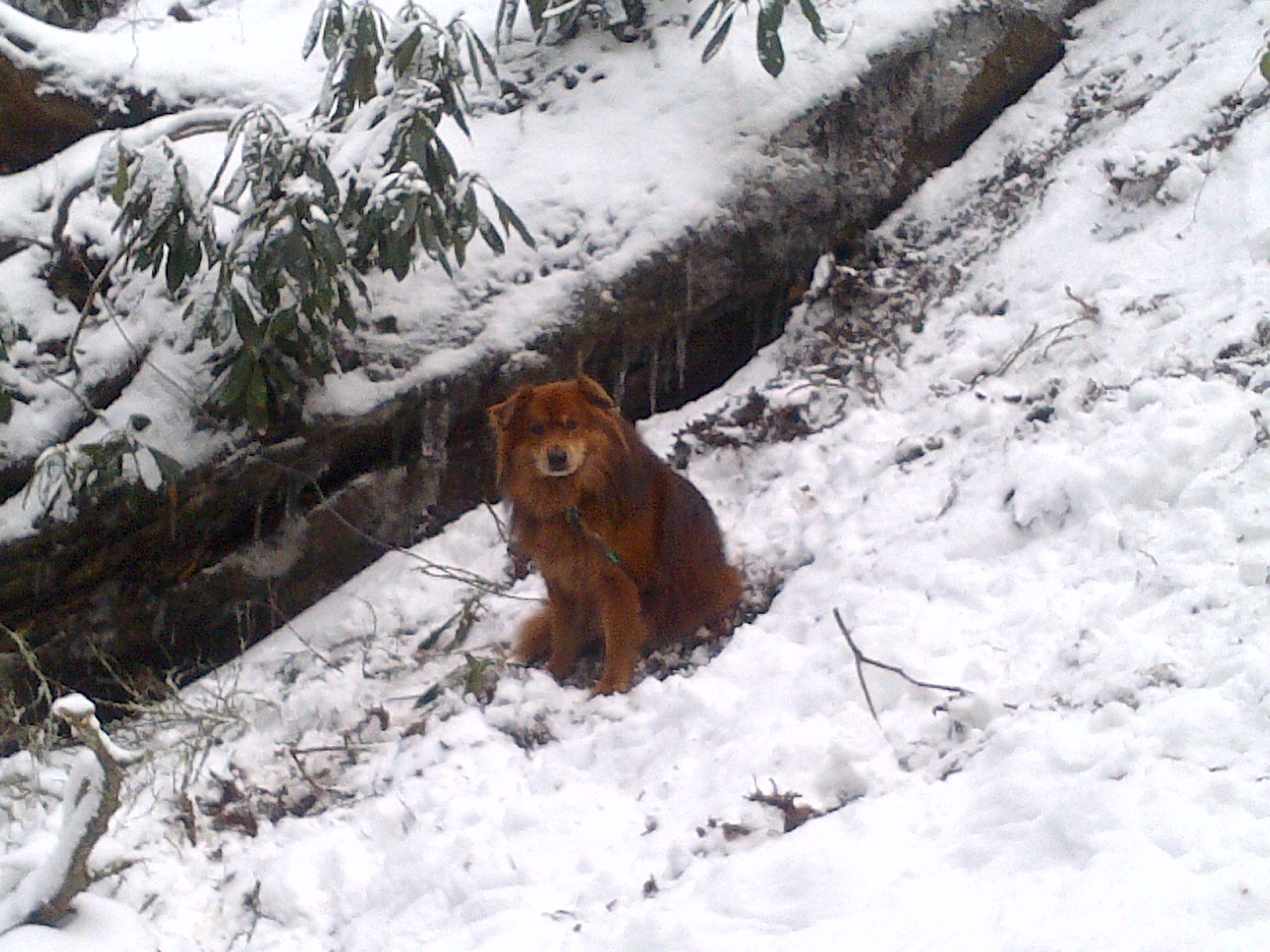
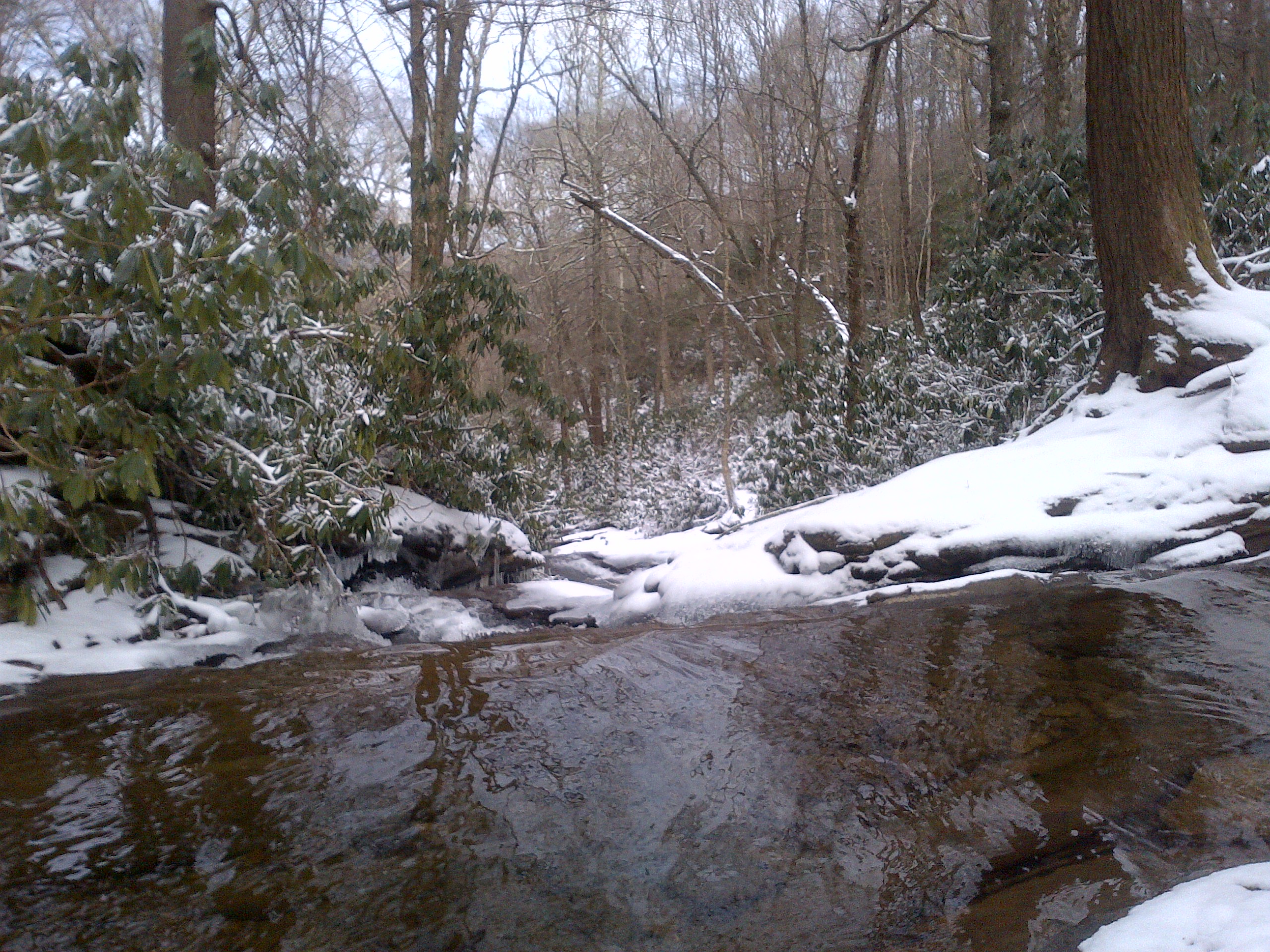
The days surrounding New Years were great fun.  My wife, daughter, dog, and I shared a little cabin in the mountains.  My daughter loved playing in the snow, my dog and I enjoyed fishing, and my wife loved the warmth of the cabin and her family.  Of course, my wife and I jumped into the New Year at midnight and then read Robert Burns’ “Auld Lang Syne.”  Already, it is a fine memory, and many years from now, we will fondly remember this holiday, “a long time ago.”

Sure, for those of us who pay attention to such things, the year turned a few weeks back at the solstice.  Still, I enjoy the January 1st holiday and it serves as a fine reminder that the time we can spend with our loved ones and on the stream are, indeed, getting longer (or at least more sunlit).

IMG-20121231-00691

IMG-20121231-00689

IMG-20130101-00702

IMG-20121231-00697

IMG-20130101-00704

IMG-20121231-00700

And there’s a hand, my trusty fiere,

And gie’s a hand o’ thine,

And we’ll tak a right gude-willie waught

For auld lang syne.

From “Auld Lang Syne” (“A Long Time Ago), a traditional Scots song, put to paper (and, most likely, largely composed) by Robert Burns in 1793.

Required Books for my Fishing Literature Seminar

January 7, 2013

Following are the required texts for my upper-level, undergraduate seminar entitled “Religion, Sport, and Water” Contemplation and Conservation in over 500 years of Fishing Literature.”  These  books will be supplemented by a few more short primary texts, and by some secondary literature as well.  I should have the syllabus completed shortly, and I’ll be sure to share it.  I have some wonderful guest speakers lined up as well — from angling artist Michael Simon to flytier Brad Kern.

Swearer, Donald. Ecology and the Environment: Perspectives from the Humanities (Cambridge: Harvard University Press, 2009).

Herd, Andrew. The Fly (Ellesmere,UK: Medlar Press, 2003).

Browning, Mark, Haunted by Waters: Fly Fishing in North American Literature (Athens: Ohio University Press, 1998).

Walton, Izaak and Charles Cotton, The Compleat Angler, Oxford World’s Classics. (New York: Oxford University Press, USA: World’s Classics, 2009).

Luce, A.A., Fishing and Thinking (Shrewsbury, UK: Swan Hill Press, 2002).

Maclean, Norman, A River Runs Through It and Other Stories, Twenty-fifth Anniversary Edition (Chicago: University of Chicago Press, 2001).

Duncan, David James, The River Why, Twentieth-Anniversary Edition (Sierra Club Books, 2002).

Jumping into the New Year

December 29, 2012

DSC02297

Years ago, during my first visit to my wife’s hometown of Budapest, Hungary, we celebrated New Year’s Eve at the home of a somewhat shady businessman and family friend.  Just before the clock struck 12:00 AM, he had us all stand on the couches and clutch as much money as we could find.  At midnight, we jumped off the couches and into the New Year.  The idea was that the coming months would be filled with wealth.

My wife and I now do this every year, and it has become a tradition in the rest of her family too.  Of course, one can jump into the New Year with things that signify non-monetary wealth too.  As for the shady New Years Party host, who introduced us to this little ritual all those years ago … well, let’s just say that he’d best start jumping into the New Year with a key, since he is usually locked up.

Often times, I have been lucky enough to go fishing on New Years Day (and on the Winter Solstice too, which is a much more proper start date for each new year).  I’ll be doing that again on January 1, next week; I’ll be making yet another visit to my newly discovered, enchanted brookie stream. The tackle is packed, and I’m ready to roll.  Happily, I am heading to the mountains with my wife, daughter, and dog, too.  Therefore, I’ll be jumping into the New Year doing the thing that I love and also enjoying the company of those precious to me.

Photo by Mike Sepelak

Photo of me on the enchanted stream, by Mike Sepelak

My own tradition, by the way, has been to always read Robert Burns’ classic version of “Auld Lang Syne” on New Years Eve.  I have already packed the 1920 copy of Burns Poems and Carlyle Essay, edited by George Marsh, that I have been sure to have in my back pocket every December 31, since 1992.

DSC02317

Brook Trout, Boundaries, and Connections

December 11, 2012

Often, the connection between things is  not obvious to the eye, and even when it is, it can take years, if  not decades, for me to see just what is associated with what.  The events of my life and brook trout often meet at the line of demarcation between the world of the fish and the world of the fisherman, between the seen and the unseen.  This division will be the surface of a stream, which I imagine, from the fish’s point of view, as a silvery horizon, but which I see as a green sheet.  Still, the moment of illumination has often come here, with a trout taking a fly out of the boundary between its world and mine.

Craig Nova, Brook Trout and the Writing Life: The Intermingling of Fishing and Writing in a Novelist’s Life (New York: The Lyons Press, 1999), 3.

IMG-20121207-00602

Like novelist Craig Nova, I am a great fan of brook trout.  I cannot say that they play the significant role in my life that they have for Nova — that place would probably be held by rainbow trout — but I very much appreciate the sense of connection or even transcendence that Nova describes as taking place when one catches a trout on a fly.

Brook trout are stunningly beautiful creatures, and I am almost always happy to catch one, even if I feel a bit disloyal to the cutthroat trout with whom I grew up (yes, I use the word “whom” intentionally).  As is the case with all of the fish in the family Salmonidae, the most special of the brook trout are the ones who are wild and who inhabit the streams to which they are native.  Sadly, there are fewer and fewer of these wild, native “brookies” or “specks.”

Fishing a favorite stream filled with wild brown and rainbow trout a couple of weeks ago, I ran into a fellow fly fisherman, who told me where I could find a nearby stream that not only held wild, native brook trout, but large, wild, native brook trout.  Biologist and popular author Robert J. Behnke notes that brook trout average five to seven inches in small streams and are relatively small even in large rivers and lakes, when compared to other salmonids (Trout and Salmon of North America 2002, 275).  Therefore, hearing this stream side acquaintance describe brookies of several more inches was quite exciting.

IMG-20121207-00607

I visited this stream a few days ago with a good fishing friend, Bill Gregory (above).  We found very quickly that the man who pointed me toward this stream was no liar.  Bill and I caught many brook trout, almost all of which were an impressive size.  While I hesitate  to put words in Bill’s mouth, I daresay it was a pretty great experience and certainly one that we plan to repeat as soon as possible.

IMG-20121207-00597

I felt that sense of connection described by Nova when I caught those brookies.  That sense of connection extended not only to the trout, the water, my friend, and the wildness that encompassed us, but also to the past.  There just aren’t that many places where one can find such special fish these days.  Catching those wild brookies, then, was almost like stepping into a time before nonnative fish were introduced to the Americas and before mining and development ravaged the Appalachian Mountains and their inhabitants.  In this sense, it was like crossing many more boundaries that the one Nova describes.

The Office and Priorities

November 27, 2012

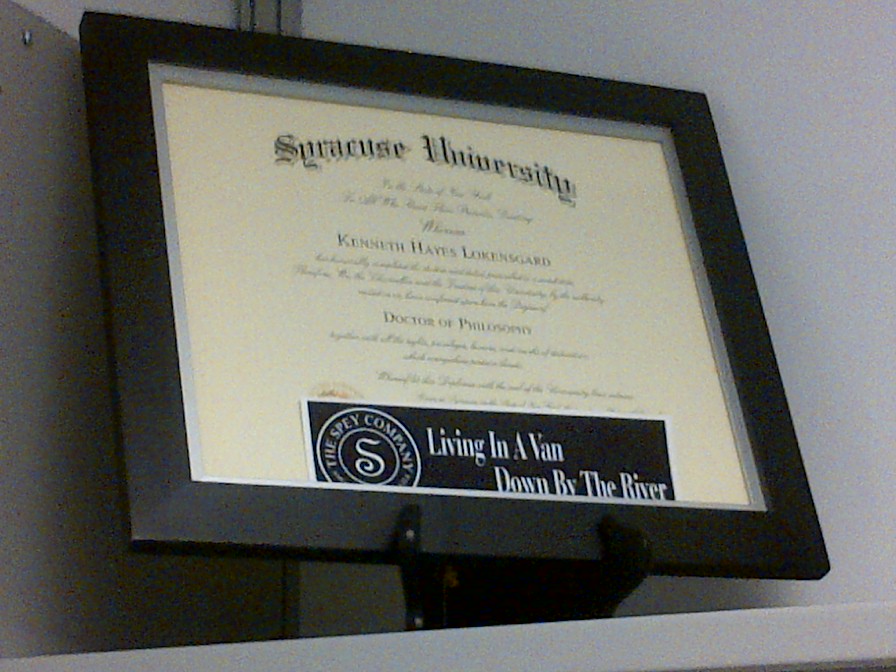
Visit me in my on-campus office, and my interests and priorities will be apparent from the first.  There is no better place for my Spey Company bumper sticker than on my Ph.D. diploma.  SpeyCo’s motto is “Mastering the Art of Living down By the River.”  I can relate to that (trust me).  Fortunately, Tim Pantzlaff of SpeyCo is also mastering the art of reel making.  He clearly understands how passionate some of us are about fishing.  That and his craftsmanship make him a great guy from whom to purchase a reel.  Anyway, it’s a good thing my department chairperson is not likely to stop by.  I’m not sure she’d get the bumper sticker.

Happy Thanksgiving!

November 22, 2012

Sadly, I have no idea who tied this holiday fly.  I picked it up at a friend’s fly shop a few years back.  Regardless, I hope it has been a good day for all.

A Book about Fly-Fishing and Fatherhood

November 17, 2012

After class the other day, a student kindly gave me a book she came across.  The title is Faithful Travelers: A Father.  His Daughter. A Fly-Fishing Journey of the Heart.  The book was written by James Dodson  and published by Bantam in 1998.  As a father of a young daughter, the title has definitely captured my attention.  Also, having glanced through the book, it seems to be well written.  In short, I’m looking forward to reading it.

You can learn more about Dodson, who happens to live down the road from me, at his website.  If I enjoy the book, I’ll certainly look him up (and perhaps invite him to class).  I’ll try not to hold the fact that he normally writes about golf against him.

W.B. Yeats and Love on the Stream

November 9, 2012

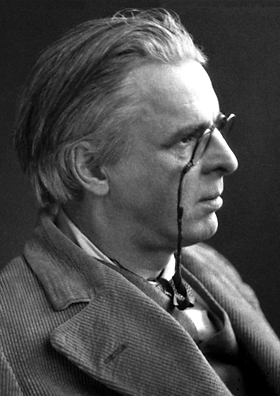
William Butler Yeats (1865-1939) was a renowned Irish poet and nationalist. He won the Nobel Prize in Literature in 1923. He influenced many fellow poets and Irish nationalists. As one interested in spiritualism and mysticism, he also influenced intellectuals as far afield as scholars of religion. W.Y. Evans-Wentz, best known for popularizing the scholarly study of Tibetan Buddhism (and also for romanticizing the religion in an oft-criticized way) cites Yeats as a great influence in his The Fairy-Faith in Celtic Countries (1911).

Following is a wonderful poem by Yeats, referring to both fishing and love. It hints, perhaps, at the transformations described in such ancient Celtic stories as the “Tale of Gwion Bach,” supposedly describing the birth of Welsh bard Taliesin. Yeats’ poem is taken from An Anthology of Modern Verse, published in 1921.

“The Song of Wandering Aengus”

I went out to the hazel wood,
Because a fire was in my head,
And cut and peeled a hazel wand,
And hooked a berry to a thread;

And when white moths were on the wing,
And moth-like stars were flickering out,
I dropped the berry in a stream
And caught a little silver trout.
When I had laid it on the floor
I went to blow the fire a-flame,
But something rustled on the floor,
And some one called me by my name:
It had become a glimmering girl
With apple blossom in her hair
Who called me by my name and ran
And faded through the brightening air.

Though I am old with wandering
Through hollow lands and hilly lands,
I will find out where she has gone,
And kiss her lips and take her hands;
And walk among long dappled grass,
And pluck till time and times are done
The silver apples of the moon,
The golden apples of the sun.